


According to the Companies Act, 2013, a Private Limited Company has a minimum of 2 members and a maximum of 200 members. A One Person Company (OPC) is a private company with only one member. Conversion of an OPC has become a voluntary process, and even NRIs/OCIs can now start an OPC as per the 2021 amendment. For solo founders evaluating the single-member route, OPC registration provides limited liability with simpler compliance. A wrong choice can have a long-term impact on liability, fundraising, and regulatory compliance.
OPC vs Private Limited Company: Key Differences Explained in India
The principal difference is ownership. An OPC consists of 1 shareholder (company promoter) and can operate with just one director. A Pvt Ltd needs 2 to 200 shareholders and should have 2-15 directors. Both forms offer limited liability and possess a separate legal identity.
If you are comparing a One Person Company with a private limited company, the decision usually comes down to whether you want a single-owner structure or a multi-owner structure. A detailed OPC registration process can help you understand the nominee requirement, compliance, and eligibility before you incorporate. A Pvt Ltd company is the standard private company structure for entrepreneurs who want co-owners, investors, and the option to transfer shares. You can also review the step-by-step private limited company registration guide.
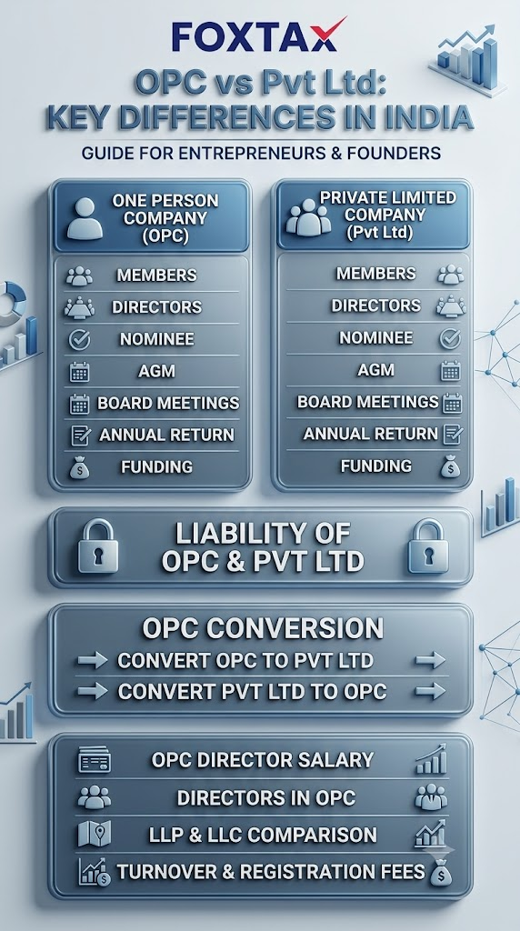
OPC and Pvt Ltd Difference
| Parameter | OPC | Pvt Ltd |
| Members | 1 | 2-200 |
| Directors | 1-15 | 2-15 |
| Nominee | Mandatory | Not required |
| AGM | Exempt | Mandatory |
| Board meetings | 1 per half-year, 90-day gap | 4 per year, 120-day gap |
| Annual return | MGT-7A | MGT-7 |
| Funding | No equity dilution | Can raise VC/angel, ESOP |
An OPC’s annual return filing is generally handled through OPC compliance filing, while a Pvt Ltd must comply with Pvt Ltd annual filing compliance. The broader ROC, GST, and PF compliance requirements also differ in frequency and form.
Liability of OPC
The liability of a One Person Company is limited to its unpaid share capital. The sole shareholder is exposed mainly to their unpaid capital, and their personal property remains unaffected unless fraud or personally signed guarantees are involved.
This is a significant advantage, especially when compared with a sole proprietorship. Such differences in the way the company is set up lead to changes in the risk level for the owner, the scope of work you can do, as well as how fast or even whether the company has the possibility to grow. For a deeper look at why solo founders choose this structure, review the benefits of an OPC.
Can OPC Be Converted to Pvt Ltd?
Yes, it is legal to change the type from an OPC to a Pvt Ltd. As part of the 2021 amendment, voluntary conversion was made possible at any time. It is no longer necessary to change the name of the company or get a new certificate if the company has paid-up capital of ₹50 lakh or turnover of ₹2 crore.
The whole process calls for, in sequence, board approvals, board resolution, MGT-14 form, filing of an application in Form INC-6, approval by the Registrar of Companies, and eventually getting a fresh certificate.
Can We Convert OPC to Private Limited?
Yes. A Pvt Ltd needs at least 2 directors and 2 members for a conversion. It must comply with Pvt Ltd regulations like AGM, four director’s meetings, and MGT-7. If you need help with the transition, professional Pvt Ltd registration and compliance support can keep the filings aligned.
Convert Pvt Ltd to OPC
An OPC is formed through a reduction of shareholders to one and nomination of a nominee for that shareholder, together with filing the required form. This form has to be submitted to the ROC. It is a very rare occurrence since OPCs cannot raise capital from external investors. For many businesses, staying as a Pvt Ltd or choosing an LLP is more practical than converting back to an OPC.
Can OPC Pay Salary to the Director?
The director working full-time may be paid by an OPC. Deductibility of the salary is subject to TDS under Section 192 with Form 16. Also, board approval and a fair degree of salary are required. For ongoing payroll compliance, payroll services and TDS returns filing can help keep salary payments and deductions correctly documented.
Can OPC Have Two Directors?
With an OPC, the maximum number of directors is 15. The minimum requirement is just 1 director. You can add one additional director by providing a DIN to that additional director, getting their consent for appointment under DIR-2, and filing DIR-12 within 30 days of the director’s appointment. This is also a good idea for ensuring succession and banker confidence. If you need to expand the board, add a director in a company with proper ROC filings.
OPC vs Pvt Ltd vs LLP
LLPs are typically used by professionals. OPCs are meant for solo entrepreneurs. Pvt Ltd is most common when there is a desire for an increase in scale. Pvt Ltd is the type of legal company form that investors prefer, which means it is well suited to equity funding and granting of ESOPs. For a side-by-side view, see LLP vs Pvt Ltd.
Which Is Better, LLC or PVT Ltd?
While an LLC is a corporate entity type in the US, it is quite different from a PVT Ltd in India. An LLP is an entity formed in India. The Indian LLC may also refer to an LLP. The type of entity to be chosen depends on the objectives of raising funds in India, issuing ESOPs, or an investor’s exit. If your goal is to raise capital and build a scalable structure, private limited company registration is usually the preferred route.
OPC Pvt Ltd Turnover Limit
Previously, the compulsory conversion limit for a company was set at ₹50 lakh paid-up capital or ₹2 crore average turnover for 3 consecutive years. This limit was removed in 2021. Now an OPC can continue its existence without being forced to convert.
OPC Pvt Ltd Registration Fees
The Registrar of Companies charges as per the prescribed fees on slabs of authorized capital. In addition, fees for DSC, DIN, stamp duties, and professional services have to be paid. Government fees for an OPC and a Pvt Ltd are almost similar, and the difference is usually not too high. However, an OPC will cost less if compliance is limited and it is an annual activity. For a detailed cost breakdown, see the OPC company registration fees guide.
Final Checklist for Choosing OPC vs Pvt Ltd
- If there is only one founder without any outside funding, then choose OPC.
- A couple of co-founders, or some investors, would mean Pvt Ltd is right.
- Protection of liability is an important issue, and that is a common denominator – both are fine.
- If less compliance is preferred, it is OPC.
- If planning to grant ESOP or raise from a venture capital fund, a Pvt Ltd is the way to go.
- An OPC will allow NRI and OCI individuals as shareholders and directors. However, a Pvt Ltd would allow that only in case of foreign equity shares.
Foxtax can support OPC registration, Pvt Ltd incorporation, conversion, and annual compliance. Deciding based only upon the structure to be chosen is not enough. It is very important for startups to pick the right structure that safeguards liability and allows for growth. You can also explore startup India registration and virtual CFO services as you scale.
FAQ
Q1: Is OPC better than Pvt Ltd?
The choice is a personal one, but if the founder is a solo entrepreneur and limited liability is necessary, then OPC is the best bet. Then again, if the founder is planning to raise seed funds from investors and expand the business, then Pvt Ltd would be the preferred structure.
Q2: Can OPC have only one director?
Yes. A single director is sufficient for an OPC.
Q3: Does OPC pay corporate tax?
Without a doubt, OPC bears the burden of corporate tax, just like Pvt Ltd. It does not get proprietorship slab benefits. For filing support, consider income tax return filing.