


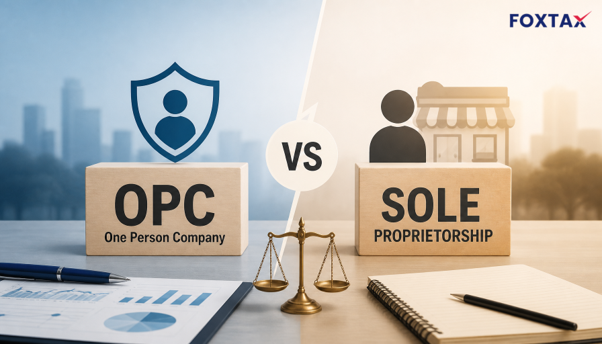
The fastest-growing category of start-ups in India are single-person businesses. The most important question a founder needs to answer very early on is whether to form a One Person Company as per the Companies Act, 2013, or just continue operating as a sole proprietorship concern.
The decision will determine whose assets, if any, will be used if a business-related lawsuit arises, whether it will be profitable under taxation laws, and will also influence whether a financial institution or major corporate client should engage with it. This article presents a straightforward explanation to clarify the choice.
What Are the Differences Between the Sole Proprietorship and the OPC?
Both forms of business are operated and owned by a single individual, so they are often mistaken to be the same thing. The legal fact that separates these two is the very existence of a separate legal person who is the OPC and is recognized by the Ministry of Corporate Affairs, whereas a proprietorship is only an individual carrying on their business under a trade name. The factors like liability, tax, audit, continuity, and transferability will depend upon this legal fact.
Is the One Person Company the same as a Sole Proprietorship – Myth or Fact?
A One Person Company has its own CIN (Company Identification Number), MOA and AOA (Memorandum and Articles of Association), a nominee (by nomination), and a name ending with “(OPC) Private Limited”. On the contrary, none of these documents/requirements apply to a proprietorship.
By law, the proprietor and business are the same, meaning any of the business loans or decrees may encroach on private savings and property. Except for the fact that both forms are controlled by a single person, nothing else is common between them.
Interpreted in another way, this clarification will give you, in detail, what exactly OPC vs sole proprietorship are about, without even touching on tax or cost.
OPC vs Sole Proprietorship: Which One is Better in India?
There is no clear winner, and comparisons of the OPC vs Sole Proprietorship in India that often declare one or the other usually ignore factors like turnover, risk, and client profile.
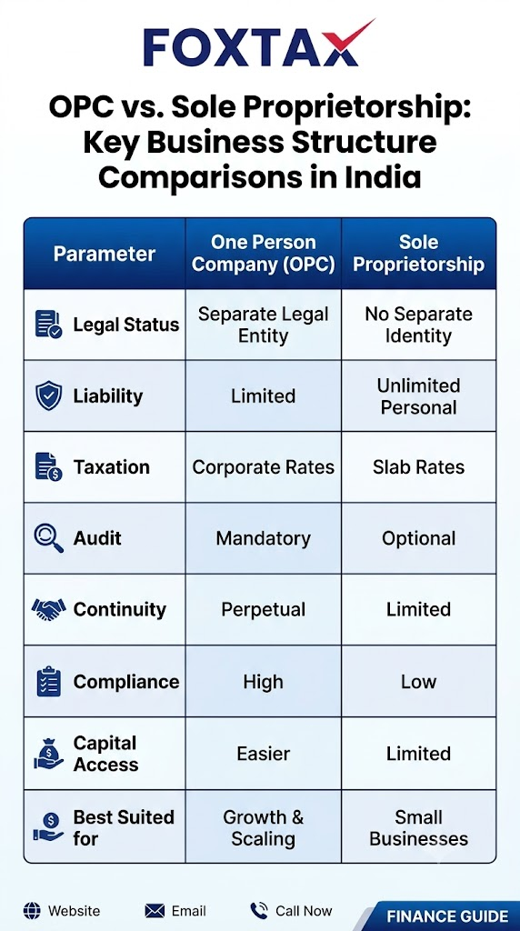
| Parameter | One Person Company | Sole Proprietorship |
| Legal status | Separate entity with CIN | No separate identity |
| Liability | Limited to unpaid share capital | Unlimited; personal assets at risk |
| Taxation | [Corporate rates](https://foxtax.in/blog/income-tax-private-limited-company-rates-slabs-regimes/) on company income | [Slab rates](https://foxtax.in/tools/income-tax-calculator/) up to 30% plus surcharge and cess |
| Audit | [Statutory audit](https://foxtax.in/service/appointment-of-auditors/) mandatory | Tax audit only beyond Section 44AB limits |
| Continuity | Continues through the nominee | Ends with the owner |
| Compliance | [AOC-4, MGT-7A, DIR-3 KYC](https://foxtax.in/service/opc-compliance-filing/) | [ITR](https://foxtax.in/service/income-tax-returns-filing/), [GST](https://foxtax.in/service/gst-returns-filing/), and [TDS returns](https://foxtax.in/service/tds-returns-filing/) |
| Best suited for | Risk-bearing, scaling businesses | [Freelancers](https://foxtax.in/blog/freelancer-tax-guide-india-2025-26/) and small traders |
The brief conclusions – select a proprietorship if you are developing/validating an idea, serving locals, and need to keep setup costs about zero. Select an OPC if you run a business with high potential liability, go for corporate or tender-related work, or intend to convert it into a Private Limited Company later.
OPC vs Sole Proprietorship Tax
This is the point where the nature of these business structures becomes completely different. A sole trader pays tax on business profits at the same rate he is taxed personally, but the slab tax system with different slab widths allows the tax rates to reach as much as 30% plus surcharge and cess, although the compliance is light under Section 44AD if it is the presumptive taxation of profits method. You can compare personal liability under both regimes using the sole proprietorship tax and ITR filing guide.
However, a company has to bear the company tax as a domestic company and it is at the corporate rate regime of its choice, besides – importantly – the director’s salary being considered a deductible expense.
Can OPC Pay Salary to Director?
Yes. Even where the sole member is the only director, director remuneration is permitted provided it is approved by a resolution of the board and the Articles allow it. This salary is deductible from the company’s income and taxed in the director’s hands as salary income, with TDS deducted at source. A proprietor has no comparable lever, as withdrawals are drawings – an apportionment of profit, not an expenditure.
Benefits of One Person Company in India
These advantages are structural and not only a matter of presentation. So, one would find them to be more useful for business growth/development.
Why Is OPC Better Than Sole Proprietorship?
- Limited liability protection. Generally, the personal assets and liabilities from the business would be segregated, except in cases like fraud, personal guarantees, etc. This makes it the best case for a registered company.
- Credibility and credit access. The presence of a CIN, audited financials, and registered office help in the easy opening of a current account, vendor onboarding, tenders, and securing working capital limits.
- Perpetual succession. Upon the death or incapacity of a sole proprietor or an OPC owner, the business is continued by the nominee rather than the business being shut down with the owner’s death or absence.
Yet, it can’t be said that an OPC is the ideal way of business at all times. The reason being that it involves relatively high running expenses and to take in a co-founder, the OPC has to be converted into a Private Limited Company. Learn more about the benefits of an OPC before deciding.
Disadvantages of OPC and Sole Proprietorship
Consider identifying the disadvantages for each to get to a balanced conclusion.
What Are the Disadvantages of OPC?
- A higher setup cost and a bigger annual fee – incorporation, audit, and legal fees are just some of the fixed costs of running a company. Review OPC registration fees in advance.
- The auditor is required to perform a statutory audit of the company irrespective of turnover.
- Continuous MCA filings such as AOC-4, MGT-7A, and DIR-3 KYC with penalties being calculated per day. These are handled through OPC compliance filing.
- Only one member is authorized, which disallows any co-founders, ESOPs and equity investors new until conversion.
What are the 7 disadvantages of Sole Proprietorship?
- Personal liability without limit, so business debts can take away personal assets.
- No separate legal identity is separate or a company registration number (CIN).
- There is not much money, as you can only rely on savings and personal loans.
- The business will not be continuous since it will end with the proprietor.
- Limited ability to handle managerial tasks and expertise.
- Flat income tax with no leverage through salary deduction.
- It lacks strength for big contracts, tenders, and enterprise vendor onboarding.
How to Convert a Sole Proprietorship to OPC
The only way to do it is to create a new company with the registration of an OPC and then move the business – assets, liabilities, licenses, and contracts into it. A capital-gains relief on such a transfer is available only under certain circumstances, so it is better you get the transaction designed by experts before signing anything. You may also need to update trade license registration and related approvals. For transaction-specific advice, consult a tax consultant.
One Person Company Registration
The OPC registration process via SPICe+ starts with getting a DSC and DIN, name reservation in Part A, then submitting Form Part B with MOA, AOA, nominee consent in Form INC-3, and registered-office proof. A certificate of incorporation with PAN and TAN are issued. After that, the OPC will also register for GST and open a current bank account.
One Person Company vs Private Limited
The only reason for a change is that there is a need to have more shareholders. An OPC allows one member, whereas a Private Limited Company allows a maximum of 200. Voluntary change of OPC to another corporate entity is now possible instantly as from the amendment to incorporation rules in 2021. That means, an OPC becomes a company that one would start with and eventually grow into bigger things.
Final Checklist: OPC vs Sole Proprietorship at a Glance
- Go for a proprietorship to quickly try an idea at lower cost and compliance.
- Go for an OPC if liability, credibility, or future funding are issues.
- Keep in mind the GST threshold limits – ₹40 lakh for goods and ₹20 lakh for services. For sales through e-commerce, registration is mandatory, but otherwise you should also register. See the GST registration guide.
- Switch to Private Limited when you decide to add co-founders or investors in the company.
The choice is easy – use a proprietorship while you validate a startup. Once customers, contracts, or debts mean there is a personal risk, move your business into the form of an OPC as a company limited by shares.
Foxtax assists Indian founders in making the transition smoothly – OPC registration, nomination details, audit help, ROC filings, and further conversion – your business structure is your growth partner, not your hindrance.
FAQs
Between OPC and sole proprietorship, which is better for a small business in India?
Small businesses with low turnover and local customers would benefit more from proprietorship since it is cheaper to start and run as an individual. If you have employees, inventory, contracts, or larger customers, an OPC’s limited liability and credibility generally warrant the additional compliance.
Is it possible to convert a sole proprietorship into an OPC?
Strictly speaking, there is no direct conversion option. A person who is the owner of a sole proprietorship and wants to operate in the form of an OPC must incorporate a new OPC. They will then have to transfer the assets of the sole proprietorship, liabilities, and contracts of the proprietorship to the new OPC. They will then have to obtain various licenses and GST registration afresh under the name of the OPC, because there cannot be any direct legal transfer of a proprietorship.
How many directors can an OPC have?
One Person Company (OPC) should have at least one director but not more than fifteen. The sole member can also be a director. It should be mandatory to have only a natural person as a nominee, i.e., no corporate entity or partnership may be a nominee.