



A private limited company (Pvt Ltd) is one of the most popular business structures in India, second only to sole proprietorship or partnership. Thousands of such companies are registered with the Ministry of Corporate Affairs (MCA) through the online portal on an annual basis. The process of online company registration, including the registration of a private limited company, has moved into MCA portal v3. It is faster than the previous methods and completely paperless now.
What Does the Registration of Private Ltd Company Imply?
Through the Companies Act, 2013, registered Private Ltd Companies are legally created by the Ministry of Corporate Affairs. After they are authorized to do business, they are given a Certificate of Incorporation with a unique CIN, PAN, and TAN identification numbers, which also give it a separate legal identity with limited liability. Under this format, shareholders can protect their personal assets while their business can engage in contracts and raise capital independently.
There must be at least one Resident Director (a director physically residing in India for at least 182 days during the current year), two Directors, and a minimum of two shareholders (the owners). Private Ltd is an ideal structure to raise funds equity via Angel Investors and Venture Capital firms, as the company is not in an individual’s name and is legally separate from individual shareholding. The company enjoys limited liability plus the fact of continuity in its existence, even if the existing members discontinue.
Pvt Ltd Company Registration Process: Step-by-Step
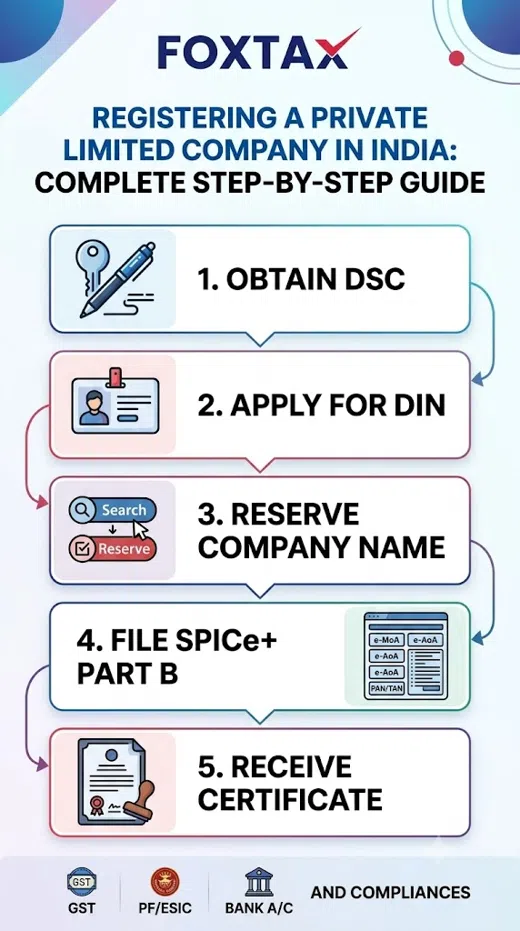
Following the sequence of registration at MCA V3, one step is done after another. If you want to know the process of registering a Pvt Ltd company, then read the following:
1. Obtain Class 3 Digital Signature Certificate (DSC)
Digitally signing a document is legally equivalent to doing pen and paper signatures with DSC. The main use of e-filing documents under the IT Act, 2000 is Class 3 DSC. DSCs normally range from ₹500 – ₹2,000 and vary according to the validity period.
2. Apply for Director Identification Number (DIN)
DIN is a unique eight-digit number allotted by MCA to each director. Directors can apply for DIN at the time of submission of the SPICe+ form, through SPICe+ e-form, or the sole director application form DIR-3. Once a DIN is granted, it remains valid for the lifetime and directors can use it to join several companies.
3. Reserve Your Company Name
After name suggestions are given, the names are sent for final approval via SPICe+ Part A, where you can mention two names as your preference. The cost of reserving a company name with the government is ₹1,000. Once you have reserved a name, you can get it within 20 days. Names that are identical or very similar to a registered company name are refused.
4. File SPICe+ Part B for Incorporation
This is a complete online form that not only registers a company but also records details about its registered office, directors, capital structure, and attachments such as e-MOA (INC-33) and e-AOA. Besides this, the same filing generates an application for your company’s PAN & TAN automatically. The integrated AGILE PRO form includes registrations for GST registration, EPFO, ESIC, and professional tax.
5. Receive Your Certificate of Incorporation
After the Registrar of Companies validates your application, the Certificate of Incorporation together with your CIN, PAN, and TAN is sent to you by mail. For a standard straightforward business setup without any mistakes, registration usually takes 7 to 15 working days to go through. Besides being a document for opening the corporate current account, this certificate has to be shown when you are going to start the operations of your business.
Documents Required for Pvt Ltd Company Registration
Having all required paperwork of private limited company registration ready before submission is one great preventive step against delays or rejections. The MCA lays down specific types of documents for shareholders, directors, and the registered office.
Essential Documents for Directors and the Registered Office
- Proof of Identity and Residence of Directors – Every director has to show their PAN card, a passport-sized photo, and address proof such as Aadhaar, voter ID, etc. Directors from abroad will be asked to notarise their passports and also provide proof of residential address. These documents prove the identity and residential status of all the people present on the board.
- Registered Office Proof – For a company’s registered office address, you must present either an electricity bill of very recent issuance or a property tax receipt. If the company is in rented premises, a rent agreement with NOC from the owner has to be submitted. In case the premises belong to the company itself, an NOC from the owner authorising its use as the office space is acceptable.
- E-KYC Inputs for Directors – Besides a DSC and for verification via SPICe+, an Aadhaar mobile number linked with the director’s phone, a recent photograph, and a specimen signature are required. Usually, the reasons behind delayed submission are incorrect matching of signatures and errors in personal details.
Pvt Ltd Registration Cost: What It Costs in 2026
Private Limited Company Registration fees consist of the Statutory MCA fees, State Specific Stamp Duty, and Professional Consultant Fees.
MCA Government Fee Slabs by Authorised Capital
| Authorised Capital | MCA Government Fee |
| Up to ₹1,00,000 | ₹500 |
| ₹1,00,001 to ₹5,00,000 | ₹2,000 |
| ₹5,00,001 to ₹50,00,000 | ₹12,000 |
| Above ₹50,00,000 | ₹50,000 |
The least amount of capital that you can have when setting up a company in India is ₹1 lakh. Though, rules currently don’t mandate the company to issue any paid-up shares. You will also have to pay a name reservation fee of ₹1,000 and stamp duty varies from one state to another, typically ranging from ₹500 to ₹2,000.
How to Register a Company Name in India
Drafting a company name in India goes under very tight regulations by the Companies (Incorporation) Rules, 2014. If your idea is to come up with a suitable name that matches your company image, you need to be careful—a rejected name can delay your incorporation by a long time.
Company Name Rules and Approval Process
Firstly, check whether a chosen name is already taken or available through online tools on the MCA V3 portal for free.
Secondly, always include the mandatory “Private Limited” at the end of the name. In the online incorporation form, you can mention two company names which you are willing to choose as the first choice and the second choice. Still, you should know that the second name is only a backup in case they reject your first choice or they want you to change the name.
Tips to Avoid Rejection and Get Approval:
- Avoid generic terms as a company name.
- Names that look like statutory bodies shouldn’t be included.
- Try to avoid conflict with a registered trademark.
Is GST Registration Mandatory for PVT Ltd?
The registration of a private Ltd for GST is not mandatory by default after incorporation, but when your company reaches certain sales thresholds, it is legally compulsory to register for GST.
GST Registration Thresholds and AGILE PRO Integration
If your gross sales of products exceed ₹40,00,000 or ₹20,00,000 for goods and services respectively, then GST registration for private limited company becomes unavoidable. Besides this, if you are a seller doing interstate sales, supplying products to clients through e-commerce sites, or have reverse charge liability, then it will be necessary for you to get GST registration.
A large number of startups opt to get their companies registered under the AGILE PRO portal while incorporation to be able to claim input tax credit and avoid filing a separate GST return. So, it should also be included if the business is expected to have interstate supplies, supply through e-commerce platforms, reverse charge liability, or the aggregate turnover is above the limit as specified under the act.
Which Is Better, OPC or PVT Ltd?
When making a decision between choosing an OPC or a Pvt Ltd, you need to consider the nature and structure of your team of founding members, and the nature of your financing strategy.
OPC vs Pvt Ltd: Key Differences
These are factors that are considered key and are compared when choosing between OPC and Pvt Ltd:
- Minimum members: A private limited company is a popular and ideal choice when there are many founders and when it is investor-driven. Then again, an OPC or One Person Company is a one-man show and is the ideal option for sole proprietorship type of business models.
- Funding flexibility: An OPC is not the ideal option if you plan to fund your company in the near or short term. Also, once the authorized capital exceeds ₹50 lakhs or the turnover crosses ₹2 crores, it is mandatory for an OPC to be changed to a different type of company as per the rules.
Can I Register PVT Ltd by Myself?
Yes, registering a Pvt Ltd on your own is possible and legally allowed. Based on MCA guidelines, online tools and services are provided free of cost to entrepreneurs to incorporate their businesses.
DIY Registration of Private Limited Company
The DIY route requires precise DSC bridging, correct PDF attachment formats, and accurate stamp duty computation for your state. A single small error can trigger resubmission and delay your incorporation by several weeks. Experts like Foxtax manage the complete SPICe+ filing, follow-ups with the ROC, and post-incorporation services such as GST and trademark registration for a reasonable fee, which most founders find worthwhile.
Final Checklist for Private Limited Company Registration
Run through this quick checklist before you begin your application:
- Minimum of 2 directors and 2 shareholders that include 1 resident director
- Class 3 DSC and DIN for each proposed director
- Two shortlisted names with the suffix “Private Limited”
- PAN card, photograph, and proof of address for all directors
- Evidence for registered office, rent agreement, or NOC
- Cost estimate for MCA fees, stamp duty, and professional fees budgeted
The process of registering a private limited company in India is now a much simpler online procedure taking approximately two weeks. If you follow the sets of instructions and complete the required paperwork in advance, then you should be able to avoid costly rejection and extra costs along the way.
Foxtax offers comprehensive assistance with private limited company registration from the initial set of DSC and DIN, right through to SPICe+ filing and GST registration, so you can establish your startup with peace of mind. For more insights on related topics, you may also explore our guides on LLP vs Private Limited Company and company registration in Bangalore.
Frequently Asked Questions
Is there a private limited company registration process in India PDF guide available?
There are many PDF downloads currently available from service providers for checklists, yet the process itself is based on information available from the MCA portal. You can download a PDF to keep track of documents and steps, for free from Foxtax with each consultation.
What are the pvt ltd company registration government fees in 2026?
Govt fee is based on authorized capital – ₹500 for up to ₹1,00,000, ₹2,000 (up to ₹5,00,000), ₹12,000 (up to ₹50,00,000), ₹50,000 (more than ₹50,00,000). You also have to pay ₹1,000 for reservation of name and state-wise stamp duty.
What is the official government website for company registration?
The sanctioned platform is the MCA portal www.mca.gov.in, where SPICe+, DIR-3, and AGILE PRO are filed. Other than this, do not visit lookalike third-party websites charging exaggerated prices for the same statutory forms.
Are there free options to register a private limited company in India?
Though statutory government charges and Stamp Duty can never be waived, so in fact no registration is free. Some websites offer free consultation or zero professional fees promotional schemes, but the MCA charges are unaffected.
Where can I get help with the complete pvt ltd company registration process?
Professional services such as Foxtax manage everything, from name approval, to incorporation, GST, and post-registration compliance. It minimizes the chances of rejection and gives back your time to run the business. Most founders prefer setting up through professional services ensuring sooner and error-free incorporation. You can also check our detailed guide on ITR filing for private limited companies for post-incorporation compliance requirements.