

Compliance Services in India: Your Complete Guide to Statutory & Tax Compliance
Managing a business in India entails compliance under various legislations, taxation and statutory standards. Be it monthly GST filing, Quarterly GSTR-3B returns or yearly ROC filing, the liability to comply every time may look endless.
Failure to comply with a certain law results in fines, notices and disqualification of directors. To ensure something like this doesn’t happen, professional compliance services help a business to stay away from these penalties and operate smoothly.
What Are Compliance Services? Understanding Compliance as a Service (CaaS)
Compliance services (commonly known as Compliance as a Service (CaaS)) assist organizations in meeting the regulatory demands of agencies such as the Ministry of Corporate Affairs (MCA), the Income Tax Department, and GST authorities. It enables today’s compliance teams to stay compliant in new ways without the need of constructing large legal departments.
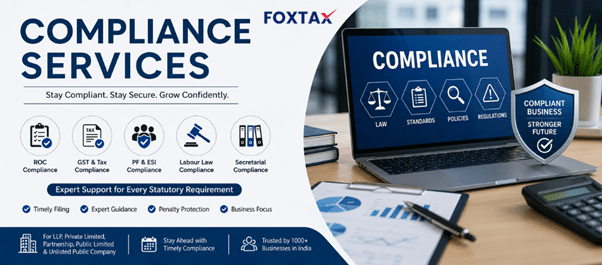
Outsourcing to the specialists increases organizational regulatory compliance, reduces operational costs and risks associated with legal actions against the organization. All the compliance work like registration of business, annual filings, filing of tax returns, compliance to labour laws comes under this. For Indian companies, it also included ROC filings, TDS returns, registrations for ESI and PF, professional tax and secretarial compliance.
The aim is simple, your business should not miss a deadline or get penalized due to an oversight. Hence, ANY business owner interested in protecting their business from law-suits, as well as hefty fines will need to be familiar with the role of compliance services.
What Does a Typical Compliance Service Package Include?
A standard compliance services package for an Indian business usually covers the following:
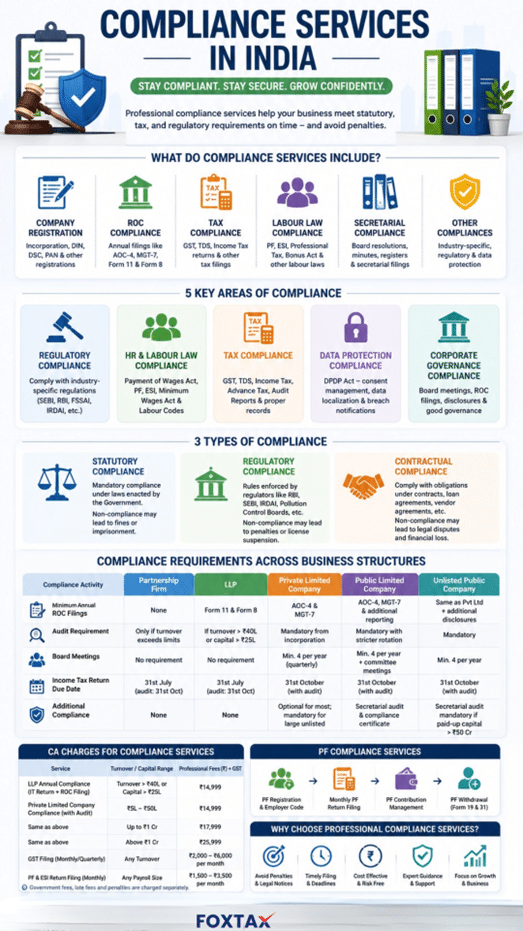
- Company Registration and Incorporation – Help regarding registration as Private Limited Company/LLP/ Partnership Firm /Public Limited Company etc. Help for allotment of DIN/DSC and PAN.
- Annual ROC Filings – The process of filing various forms with the Registrar of Companies, India e.g. AOC-4 (financial statement of the companies) and MGT-7 (annual return) etc. filed by private and public companies.
- Tax Compliance – Registration under GST, filing of returns like GSTR-1, GSTR-3B, GSTR-9, filing of TDS returns like forms 24Q, 26Q and income tax returns for business entities.
- Labour Law Compliance – Registration and submission of monthly returns for Provident Fund (PF), Employee State Insurance (ESI), Professional Tax, and Bonus Act.
- Secretarial Compliance – updating statutory registers, preparing board resolutions and minutes, and lodging forms with the RoC for directors share transfers etc.
What Are the 5 Key Areas of Compliance for Indian Businesses?
According to normal industry standards and Indian regulations, the five areas of compliance that every business needs to comply with are:
- Regulatory Compliance – Complying with industry-specific laws like for food based companies, FSSAI or for insurance, IRDAI or for listed companies, SEBI. Failing to comply with our may result in license cancellation or closure of business.
- HR and Labour Law Compliance – Statutes related to employees including the Payment of Wages Act, the Minimum Wages Act, PF, ESI and the new Labour Codes.
These deal with hiring, working conditions, wages and social security (contributions). - Tax Compliance – Payment of GST, corporate income tax, TDS and advance tax on time. Preparing and filing of various audit reports including 3CA/3CD, transfer pricing documentation, etc. Proper files to be maintained such as invoices, etc.
- Data Protection and Privacy Compliance – With the introduction of the new DPDP, businesses which gather data about its users will be required to have mechanisms in place to obtain consent, localize data and put breach notification systems into place.
- Corporate Governance Compliance – Private or public companies need to hold board meetings and the records of the meetings must be kept. Certain meetings (eg. board meetings) may require the approval of the related party transaction and yearly filing with the RoC.
Bringing it to the big picture – Learn these five areas and you will never have a letter from the authorities, will have the investors lined up and your business flowing without a hitch.
What Are the Three Types of Compliance?
According to industry professionals and the legal frameworks, there are three various types of compliance with their respective rules and punishments if found to have committed it.
- Statutory Compliance – Compulsory respect to statutes legislated. For instance, the Companies Act, 2013 (applicable for company meetings and filings), the Income Tax Act, 1961 (focussing on tax deductions and returns), and state enacted Shops and Establishments Acts.
Offences for contravention include fines, imprisonment, or imprisonment along with a fine. - Regulatory Compliance – Rules enforced by regulators such as the Reserve Bank of India (RBI), Securities and Exchange Board of India (SEBI) or the Pollution Control Boards. As an example, a listed company needs to comply with the SEBI’s listing requirements and an NBFC has to follow the asset classification norms of the RBI.
- Contractual Compliance – Complying with applicable obligations of others (as specified in business contracts, for example vendors, covenants with banks for a loan, franchise agreements etc.). Not necessarily covered by criminal law but can give rise to expensive litigation and undesirable publicity.
Why is it important for your business – Understand that so you can begin to understand the areas involved as it will influence the urgency of the actions required. Statutory and regulatory compliance are a matter of law and can incur government fines. Contractual compliance is about protecting commercial relationships.
Compliance Requirements Across Different Business Structures (LLP, Private Limited, Partnership, Public Limited, Unlisted Public Company)
Different structures in business have different compliance requirements. The following compares the compliance that are required for five typical entities.
| Compliance Activity | Partnership Firm | LLP | Private Limited Company | Public Limited Company | Unlisted Public Company |
| Minimum Annual ROC Filings | None (no ROC filing) | Form 11 (LLP Annual Return) & Form 8 (Statement of Accounts) | AOC-4 (Financials) & MGT-7 (Annual Return) | AOC-4, MGT-7, and additional board reporting | Same as Private Limited plus additional disclosure norms |
| Auditor Appointment | Not mandatory (tax audit only if turnover exceeds limits) | Mandatory if turnover > ₹40L or capital > ₹25L | Mandatory from incorporation | Mandatory with stricter rotation rules | Mandatory |
| Board Meetings | No requirement | No requirement | Minimum 4 per year (once per quarter) | Minimum 4 per year + separate committee meetings | Minimum 4 per year |
| Income Tax Return Due Date | 31st July (audit cases 31st October) | 31st July (audit cases 31st October) | 31st October (with audit) | 31st October (with audit) | 31st October (with audit) |
| Additional Secretarial Compliance | None | None | Optional for most; mandatory for large unlisted | Mandatory secretarial audit and compliance certificate | Secretarial audit mandatory if paid-up capital exceeds ₹50Cr |
Unlisted public companies also have to comply with having AGM within 6 months of year end and form MGT-14 for special resolution. Partnership firms are less compliances but do not provide limited liability, against increasing business they are riskier.
Practical tip: Volume of compliance work to be done increases when moving from partnership to plc ltd to plc company. Get professional help to complete the compliance work on time.
How Much Does a CA Charge for Company Compliance in India?
Company compliance CA fees depend upon the turnover, Capital and type of entity.
| Compliance Service Scope | Turnover / Capital Range | Professional Fees (₹ + GST) |
| LLP annual compliance (IT return + ROC Form 11 & 8) with CA audit | Turnover above ₹40L or capital above ₹25L | ₹14,999 |
| Private Limited Company compliance (IT filing, ROC AOC-4 & MGT-7, CA audit 3CA/3CD) | ₹5L – ₹50L revenue | ₹14,999 |
| Same as above | Up to ₹1Cr revenue | ₹17,999 |
| Same as above | Above ₹1Cr revenue | ₹25,999 |
| Additional services: GST filing (quarterly or monthly) | Any turnover | ₹2,000 – ₹6,000 per month |
| PF & ESI return filing (monthly) | Any payroll size | ₹1,500 – ₹3,500 per month |
Generally, these fees consist of financial statements preparations, tax audit (3CA/3CD if applicable), ROC filing, and income tax return. Fees for government fees (MCA filing fees, GST late fees) and late penalties are charged separately.
Clarify whether these quotations include an unlimited number of consultations or each time whether the fee is charged by each query.
Reason why transparency in pricing is important: Once you see how much it will cost, no surprises when keeping to budget during compliance. This may make all the difference for startups and SME’s, transparent and transparent, providers such as Foxtax provide transparent prices with no hidden costs.
PF Compliance Services: Why Provident Fund Matters for Your Business
E-filing for PF (Provident Fund) is applicable for any business that has 20 or more employees. At an even lesser figure than 20, most companies get themselves registered across the table to ensure better talent acquisition.
PF services constitute a major chunk of total compliance services. It includes registration, monthly return filing and withdrawal.
- PF registration under the PF & MP Act, 1952 along with provision of employer code issued by the Regional PF Commissioner
- Monthly PF return filing (Form 12A, Form 5, Form 10) with correct calculation of contribution ( employer 12% basic wages + employee 12% basic wages)
- PF withdrawal in your locality – Guiding employees in the process of Form 19 (final settlement) and Form 31 (partial withdrawal for Medical/Home loan/ Education purpose) through the UAN portal
The Virtual HR outsource provider will combine non-resident PF compliance with rent out for other services like Payroll, induction and leave administration management for virtual-first businesses.
Non compliance may amount up to 25% of arrear and its interest. So to avoid notices from EPFO it’s better to outsource to a specialized provider.
Why Choose Foxtax for Your Compliance Services Needs
Foxtax is a reliable compliance services associate to Indian companies providing comprehensive statutory, tax and labour law compliances under one platform.
An experienced team of CAs, company secretaries and legal advisors at Foxtax do everything right from a company’s registration to filing annual ROC returns, PF/ ESI returns and GST filings.
What differentiates Foxtax is their tech-enabled service infrastructure platform coupled with custom support.
Every company gets a dedicated compliance calendar, automated alerts regarding due dates and 24*7 access to your filing status through the online client portal.
Whether you are a start-up looking for Pvt Ltd compliance, or an LLP seeking annual filing assistance, or a publicly-listed company requiring secretarial audits, Foxtax designs packages suited to you at competitive prices.
Additionally, having presence across pan-India and providing appointments online, companies from tier-2 and tier-3 cities need not relocate to metros to avail high quality compliance advice!
Quick Checklist: Ensuring Your Business Stays Compliant Year-Round
Use the following list to make sure your business complies with all the necessary requirements for this financial year:
- Your company registration certificate is valid and all director/partner information is updated with the RoC.
- Annual filings with the RoC such as AOC-4, MGT-7 for companies; Form 8 and Form 11 for LLPs should be done before the due date (generally 30th October).
- Business Income Tax Return (ITR) should be submitted by 31st October (if the audit is required) or by 31st July (in case of non-audit).
- GST returns (GSTR-1, GSTR-3B, GSTR-9) are to be filed monthly/quarterly without the accumulation of any late fees.
- TDS returns (forms 24Q, 26Q) are done quarterly and should have the correct challan details.
- PF and ESI returns are processed monthly and contributions should be deposited by the 15th of the next month.
- Minutes of board meetings (in case of companies) should be documented and preserved for a minimum period of 8 years.
- Auditor’s appointment should be finalized within 30 days after incorporation and then yearly.
Conclusion
Compliances for LLP, compliances for a private limited company, compliances for partnership firm, compliances for public limited company or compliances for unlisted public company are a must for your LLP, private limited company, partnership firm, public limited company, or unlisted public company respectively. These are not merely the ways to the legal protection and investor confidence but also the foundation for your business’s growth.
Though rules can be a bit complicated, professional compliance services make the process easy, minimize the risk, and give you the opportunity to concentrate on growing your business.
Working with a knowledgeable company like Foxtax will help you comply with every statutory deadline without any penalties, and be always on hand to provide expert advice when a new regulation is introduced. Be it PF compliance, annual ROC filings, or GST returns, having the perfect compliance partner is worth having.
FAQ – Frequently Asked Questions About Compliance Services
Q1: What is the difference between statutory compliance and regulatory compliance?
Statutory compliance means following the laws which have been officially enacted, i.e. legislations like Companies Act, Income Tax Act, etc.
On the contrary, regulatory compliance entails adhering to the rules formulated by the respective authorities such as SEBI RBI IRDAI, etc.
While both types are compulsory, the violation of statutory compliances generally culminates in the court proceedings whereas the breach of regulatory rules to the cancellation of license or levy of monetary penalty by the regulator.
Q2: Can I handle company compliance myself without hiring a CA or firm?
It is possible to do self-compliance for very small businesses such as proprietorships or partnership firms that are not registered for GST.
However, if your business is a private limited company or LLP or if your business is registered for GST/PF, then due to the complexities and the heavy risk of penalties it is better to take professional help.
Incorrect returns on ROC or tax may result in disqualification of the director or may involve heavy fines.
Q3: What are the penalties for missing ROC annual filing for a private limited company?
A penalty of 100 per day per form (maximum does not exceed 10 times the filing fee for small companies) is levied on delay in filing of AOC-4, MGT-7.
For instance, a delay of 6 months in filing both forms might cost you more than 36,000 plus government fees.
Moreover, if the default continues, directors may be prohibited from submitting documents.
Q4: Are virtual HR services legally recognized for PF and ESI compliance?
Absolutely, virtual HR services are both legal and extensively employed.
The service provider must submit returns with the existing business’s PF and ESI codes, make the contribution payments on time, and keep the digital records.
As long as they fulfill these conditions, they are compliant.
A lot of remote-first companies and startups have virtual HR because it helps them save the cost of physical office overhead.
Q5: How do I find reliable PF consultants near me?
The easiest method is to google “PF Consultants near me” and check the Google reviews, ask other business owners for recommendations, or use Justdial type of platforms which also have the list of top PF consultants by city.
If you are okay with the remote mode then you can also opt for the national level service providers such as Foxtax.