


A proprietor is directly and unconditionally liable on unlimited personal grounds. A case against you may wipe out all personal possessions. With OPC registration, this situation changes. As per Section 2(62) of the Companies Act, 2013, a sole individual may, without a partner, set up a business entity through a private company and be the company director. MCA V3 brings online filing.
The entire process is digital and takes about 7–10 working days. This article is your guide to understand not only what an OPC is, who should be one of its members, and when, but also the full, step-by-step one person company registration process, the required documentation, and related expenses in India.
What is OPC registration and how is it done?
OPC registration is the legal incorporation of the OPC as an independent entity with the characteristic that limited liability is extended to the member. A sole entrepreneur gains a private limited status with the advantages of limited liability and protection without involving a co-founder. The whole procedure is done through the internet, starting from the Digital Signature Certificate until you receive the Certificate of Incorporation from the Ministry of Corporate Affairs.
What is a One Person Company?
The One Person Company is a private limited company with one individual member who can also be the director. As a legal person separate from the owner, the company’s liabilities are not your personal liabilities — unlike proprietorships where owner and business identities are completely merged. Such a type of structure enables the person to get the same benefits and protection that corporate entities do, like limited liability, a separate PAN, and so on. Besides that, it may assist you in securing business banking and credit more easily.
Who can open/register OPC in India?
- Resident Indian citizen: The proposed member should be a natural person who is an Indian citizen residing in India for at least 120 days in the preceding financial year.
- One member company: Only one person can be a member of an OPC, unlike a private limited company that allows up to 200 members.
- Requirement of nomination: The member is bound to nominate, i.e., to pick a person who will be the new director and shareholder upon death or incapacity.
Once the structure of the legal entity is understood, the real work process can begin.
Step-by-Step One Person Company Registration Process
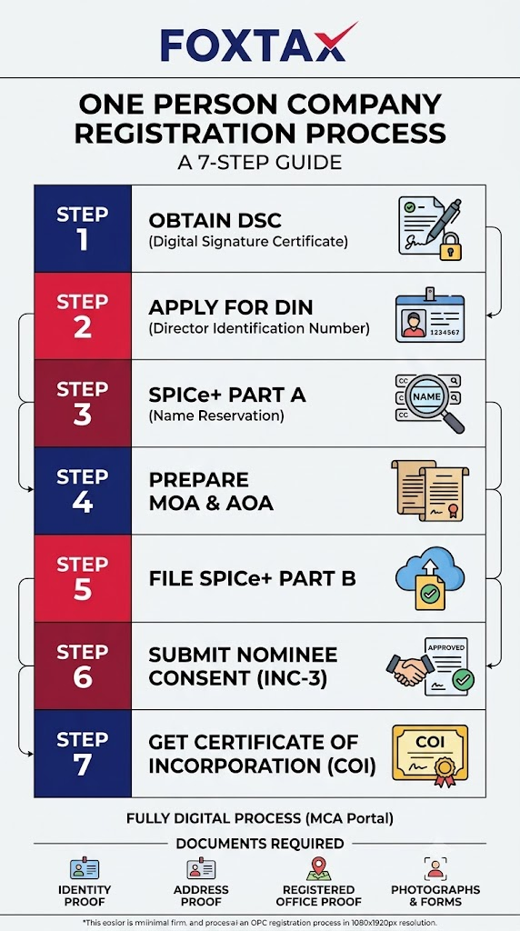
Regardless of the way in which you look up information or who guides you on registering a one-person company, you will end up following the seven-step OPC registration procedure. It is a 100% digital process, which can even be carried out by the founder with or without help from professionals.
Step 1: Obtain a Digital Signature Certificate (DSC)
The Digital Signature Certificate (DSC) is the first and foremost requirement as all MCA filings today take place in digital format. The DSC is issued by certifying authorities licensed by the government, and such DSCs are commonly valid either for one year or two years. To verify your DSC, you will require a PAN, Aadhaar, and a passport-sized photo.
Step 2: Apply for Director Identification Number (DIN)
Each director of a company in India needs a DIN. For people who are resident in India, the DIN is obtained by filing the SPICe+ form, which will also work as identity verification. The applicant furnishes their PAN and identity proof, and it is e-verified.
Step 3: SPICe+ Part A – Choose and Reserve Company Name on MCA portal
SPICe+ Part A is the name reservation form available on the MCA website. Propose one or two names, but make sure that those are not already used by other companies or trademarks. You tend to receive approval within 1 to 2 business days.
Step 4: Prepare the MOA and AOA
The MOA for an OPC company outlines the company activities while the AOA covers company laws. It is essential to get the MOA and AOA documents prepared accurately to specify the business capital clauses, etc., so that they are included as electronically generated eMOA (INC-33) and eAOA (INC-34) in the company registration document.
Step 5: File SPICe+ Part B and Get the Certificate of Incorporation
Certification of incorporation via the online method includes submission of nominee consent (Form INC-3) with SPICe+ Part B. The Ministry of Commerce and Industry, India, after checking, issues the Certificate of Incorporation (COI) with the company’s CIN. This document makes the OPC a legally valid entity. Carrying through with these step-by-step procedures is really important so that objections based on either name or other drafting errors in the MOA do not cause rejection.
Online OPC registration: filing entirely on the MCA portal
Online OPC registration is fully digital — no physical submissions are required at any stage. DSC issuance, DIN application, name reservation, and incorporation all happen on the MCA V3 portal. This has reduced the total timeline to roughly one to two weeks.
Documents required to register an OPC in India
- Identity proof: PAN, Aadhaar, or passport for the director and nominee.
- Address proof: Electricity bill, bank statement, or telephone bill as proof of address.
- Registered office proof: Rental agreement or ownership documents with a No Objection Certificate from the owner.
- Photographs and forms: Passport-size photos, DSC copy, and signed INC-3 nominee consent.
How much does it cost to form an OPC company in India?
- Government fees: MCA filing fees vary with each state’s authorised share capital, which is why the fees vary as well. In some states, one just needs to pay the MCA fees to get incorporated, but in others, you have to also pay for state stamp duty. The stamp duty on MOA and AOA is also a state-specific matter.
- DSC and DIN: The cost of Digital Signature Certificate (DSC) typically ranges from ₹1,000 to ₹2,000. DIN, however, is free to obtain when submitting a return of appointment in the SPICe+ form.
- Professional fees: Professional service charges (like CA/CS) depend on the extent of the job.
OPC Company Registration for an NRI/foreigner
Non-Resident Indians and foreign nationals who wish to incorporate an OPC must have proof that they have lived in India for a minimum of 120 days as an Indian citizen. Signing documents outside India would require notarisation plus an apostille certification if it is a foreign document. This adds an extra few days to the whole duration.
Can I register an OPC myself?
Yes, technically you can file SPICe+ yourself, but the incorporation forms must be certified by a practising CA, CS, or CWA. Most founders still prefer professional help to avoid name rejection, MOA drafting errors, and resubmission delays.
Can an OPC pay a salary to its director?
Salary to the director can be paid by an OPC if there is a formal employment or service agreement. The payment will be subject to Tax Deducted at Source (TDS) under Section 192 of the Income Tax Act even if the company has no profits. It has to be authorized by the board of directors and posted in the books of account.
One Person Company under Companies Act 2013
The OPC structure is defined in Section 2(62) of the Companies Act, 2013 and it enables solo entrepreneurs to enjoy the benefits of a corporate structure without giving up their autonomy. Besides that, the Act also allows for the voluntary conversion of an OPC into a private limited company after two years of incorporation.
Final checklist for OPC registration
- An Indian citizen staying in India is the member, and a nominee has been selected by him.
- Digital Signature Certificate (DSC) obtained, PAN and Aadhaar cards are available.
- A unique name is approved through SPICe+ Part A.
- MOA and AOA drafted and filed.
- SPICe+ Part B, INC-3, and COI received.
Registering an OPC gives solo entrepreneurs the benefit of a corporate structure for credibility and limited liability without the requirement of having a co-founder. With the process now completely online, most of the registrations are completed within 7–10 working days.
Foxtax helps entrepreneurs get their OPCs registered, drafts MOA & AOA, and handles post-incorporation compliance so the founders can concentrate on business operations.
FAQ Section
Q1: How long does OPC registration take?
It takes 7 to 10 business days on an average, assuming that you have submitted all documents properly and that your name reservation is clear.
Q2: Is OPC registration online possible?
The whole process is conducted online through the MCA V3 portal — digital signing of documents (DSC), obtaining the Director Identification Number (DIN), name reservation, and the incorporation of the business itself, as no physical submission is required.
Q3: Can an OPC be converted into a private limited company?
MCA rules state that voluntary OPC to private limited company conversion is possible after two years. The requirement for such a voluntary change must be met by the registered OPC.
Q4: What are some of the top one person company examples in India?
There is no doubt that many consulting, merchandising, and small-scale manufacturing organizations have found an OPC to be a perfect form of company organization for them. The reason is that limited liability protects them while the structure gives the sole shareholder the freedom to make all decisions.
Q5: What is the full form of OPC?
Officially, under company law, OPC is an acronym for One Person Company.