



Running a sole proprietorship keeps things simple on paper, but the tax filing process still confuses many business owners each year. With the Income Tax Department tightening compliance and expanding e-filing requirements, understanding how sole proprietorship tax works is now essential for every proprietor.
This guide breaks down the ITR forms, tax slabs, computation logic, and filing steps you need for a smooth filing journey.
What Is Sole Proprietorship Tax?
Sole proprietorship tax is the income tax levied on profits from the sole proprietorship. According to India’s Income Tax Rules, the proprietorship firm is a single entity which has no separate legal existence. That’s why the complete business-related income is added to the personal income of the owner and taxed per individual slab rates.
So due to the pass-through feature, there isn’t a corporate tax aspect for proprietors. After making an allowance of all possible expenses, your net business income is passed on as part of your personal taxable income for which the liability is calculated accordingly.
Which ITR Form Applies to Your Proprietorship Firm?
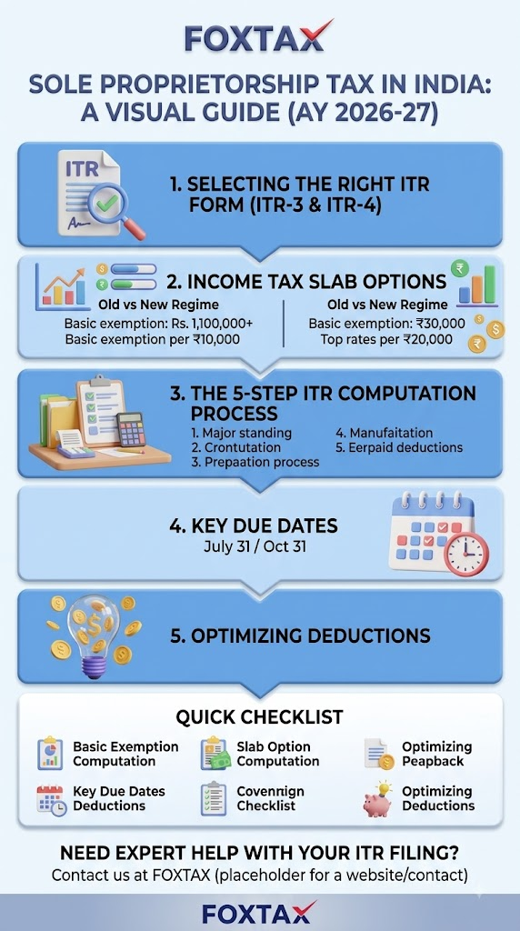
It is necessary to choose the proper form that needs to be filed to do a correct filing. As a proprietary business owner, you normally use either ITR-3 or ITR-4 based on your type of income and whether or not you keep detailed records of your business transactions.
- ITR-3: It is applicable to sole proprietors who have profits or income from profession or business, have kept proper books of account and have not claimed the presumptive taxation option.
- ITR-4: It is for the proprietary business owners who have made a claim for the provision of presumptive taxation under sections 44AD, 44ADA, or 44AE, where the taxable income is based on a fixed percentage of revenue.
For a detailed breakdown of which form suits your situation, explore our comprehensive ITR filing guide for individuals and professionals.
What Is the Sole Proprietorship Income Tax Slab for AY 2026-27?
There is the option for the proprietor to elect either old or new regime in the financial year 2026-27. Under the new regime, slab rates are:
- 0% for income up to Rs 4 lakh
- 5% for income from Rs 4-8 lakh
- 10% for income from Rs 8-12 lakh
- 15% for income from Rs 12-16 lakh
- 20% for income from Rs 16-20 lakh
- 25% for income from Rs 20-24 lakh
- 30% for income above Rs 24 lakh
The older regime allows a basic exemption of Rs 2.5 lakhs and 5% up to Rs 5 lakhs followed by 20% up to Rs 10 lakhs ending with 30% after that. Based on your tax planning and the available exemptions and deductions, you should make the regime choice for the period that will reduce your total liability the most possible. For a deeper comparison, check out our analysis of the old vs new tax regime 2026.
How to Compute ITR for Sole Proprietorship?
Getting your ITR for a proprietorship involves a straightforward logical process starting with your business records and finally reaching your taxable income for reporting.
- Add all the gross revenues: Sum up the income you got from your business throughout the financial year by adding sales, service charges, and other income from the business activities.
- Minus the business expenses: Remove the business costs like the rent, salaries, the raw materials, electricity, marketing costs and depreciation that are directly related to business operations.
- Net profit after business: If the amount that you are left with is a profit and you make it from the business activity, then only this business profit can be taxed as the income tax will flow into your personal return plus the income from other sources.
- Plus income from other sources: If you have any other source like interest, capital gains, or rental income or some other personal earnings of yours besides the business income, add them to the total income.
- Deduction in Chapter VI-A: Claim allowed deductions under section 80C, 80D and 80CCD before you finalize your total taxable income.
How to Calculate Income Tax for a Sole Proprietor?
After your total taxable income is finalized, the main tax calculation consists of applying the applicable rates with necessary adjustments. Apply the slab rate to your income based on your chosen tax regime to get your basic tax amount.
To that add 4%, the health and education cess, and in addition, a surcharge if your income is more than Rs 50 lakh. The advance tax already paid during the year and the amounts which have been deducted at source (TDS) by your clients or banks are to be deducted.
In case you qualify for the rebate threshold, please utilize the Section 87A rebate to reduce your liability to zero through this calculation approach. The same works for proprietors whether they are relying on an online tax slab calculator or performing manual calculation.
How to File ITR for a Sole Proprietor?
After your income tax return has been electronically filled on the e-filing portal of the Income Tax Department, filing your return for a proprietary firm is all done online. Following is the guide step-by-step:
- Access the e-Filing portal: Login at ITR through your PAN and password. The ‘File your Income Tax Return’ button will be displayed for you to select.
- Pick the assessment year and form: Select Assessment Year 2026-27 corresponding to the financial year 2025-26 and then opt for the form – a ITR-3 or an ITR-4 according to your business criteria.
- Crosscheck your tax figures: To be sure the tax has not been deducted at source, pre-validate your bank account and check Form 26AS and AIS after cross-checking that your books of accounts match the details of the deductions.
- Complete the return with income and deductions: Record the details for the business activity, expenses, and the taxes made with the tax deductions and other income, in the relevant section of the tax return.
- File and verify: After filing the return, e-validate it within a period of 30 days using an Aadhaar OTP, EVC or a Digital Signature to finish completing the proceedings.
If you need professional assistance with your income tax return filing, Foxtax’s experts can handle the entire process for you.
How Much Income Is Tax-Free for a Sole Proprietorship Firm?
A sole proprietorship firm has no separate limit of exemption. That means, the personal exemption of basic individuals applies. Per the new regulations, the income of up to Rs 4 lakh has been made tax free. At the same time, the provision for an exemption of Rs 2.5 lakh under the old regime is being retained.
In addition, rebate under Section 87A becomes a major tax saver. Under the new regime, taxpayers with a taxable income up to Rs 12 lakh can get a rebate through Section 87A. That means, such taxpayers will not have to pay any taxes at all.
Turnover Limit for Tax Audit and Key Due Dates
A Section 44AB business audit is needed if your turnover is more than Rs 1 crore or Rs 75 lakh for professionals choosing presumptive taxation under Section 44ADA. The ITR due date is 31 July for proprietorships without an audit requirement, while those requiring an audit get an extended deadline of 31 October.
Delay in filing can incur a fine of up to Rs 5,000 in your tax file via Section 234F and interest on late payments under Section 234A. Consider marking out your deadlines from now so you can avoid penalties. For more on this, read about what happens if you don’t file ITR.
GST and TDS Compliance for Sole Proprietors
Taxation compliance in a sole-proprietorship firm extends from income tax to GST and TDS requirements. Only when your turnover exceeds Rs 40 lakhs (or Rs 20 lakhs for services) in one year are you required to obtain GST registration and deposit GST in monthly or quarterly returns.
Still if you are making certain stipulated payments like rent payments in excess of Rs 50,000 per month, professional fee payments in excess of Rs 30,000 per month, TDS needs to be deducted and paid to the government. Managing these overlapping sets of compliances will ensure you succeed in making your sole-proprietorship business a tax compliant.
Tax Optimisation: Deductions Every Sole Proprietor Should Claim
The taxable owner-operator tends to overpay taxes just by failing to claim allowable business expenses. Some examples of deductible expenses are:
- Office rent
- Staff salaries
- Telephone and internet expenses
- Travel and subsistence costs
- Professional fees
- Insurance
- Depreciation of equipment
The best way to do this is to keep personal and business transactions separate through a dedicated current account. An accounting package may also be used to help keep track of all receipts at the end of the year for filing purposes. Learn more about how accounting and bookkeeping services can simplify this process.
Final Checklist for Sole Proprietorship Tax Filing
Before you file your proprietorship firm ITR, check this quick list of verification:
- Ensure the Business activity and Income on the ITR form you have chosen are as to how your business operates and your financial value.
- As per these details how do you arrive your gross receipts reconciled with the bank statements, Form 26AS etc.
- Claim all valid deductions, with the necessary documentation prepared.
- Confirm if choice on presumptive taxation under Section 44AD makes your filing easy.
- Check whether your turnover is forced to a tax review under Section 44AB.
- Pay advance tax in time as per due dates to prevent interest under Sections 234B and 234C.
Tax filing for sole proprietorships is easy once you master the basics of selecting the right forms, calculating due dates, and understanding the various individual profit calculations involved. Maintain impeccable books of accounts during the year so that a proprietorship firm tax return is always under control and payable at the due date without issues.
If guidance and superb knowledge on the owner’s Indian income tax return filing is what you require, Foxtax has an extremely professional ITR filing package that can make this task a breeze.
Frequently Asked Questions
What is the penalty for filing ITR late for a proprietorship firm?
Further, there is a late fee of Rs 1000/- if your gross total income is less than Rs 5 Lakhs and Rs 5000/- in case it is beyond Rs 5 Lakhs under Section 234F. Further, it is likely that there will be interest under Section 234A on any amount of tax remaining payable.
Is GST registration compulsory for a sole proprietor?
GST registration becomes compulsory when your annual turnover exceeds Rs 40 lakh (Rs 20 lakh for service providers). With turnover below this limit, registration is optional for most proprietors. You can explore our detailed guide on GST registration in India for more clarity.
Can a sole proprietor claim a home office deduction?
Yes, if you use part of your home solely for business, you can offset a percentage of your electricity, rent and internet costs against your business earnings. Save your utility bills and rent receipts.