



Income Tax Return Filing Issues: Top Mistakes and How to Fix Them
Annual filing of Income Tax Return (ITR) is a major responsibility for every working individual in India. Still, it is common to hear about the taxpayers who face issues like delay, no refund, or grab the attention of the Income Tax Department just because of common income tax return filing issues.
From selection of the wrong ITR form to missing the e-verification deadline, these mistakes can make the simple process very stressful. The first step to have an error-free, hassle-free filing is to understand these issues.
What Are the Most Common Income Tax Return Filing Issues in India?
Filing income tax returns can become tedious and troublesome if one is not careful and knowledgeable. A large number of the defective returns are due to mismatched personal details, wrong reporting of income, and not e-verifying, as per the Income Tax Department data. Let’s go over the main problems faced by the taxpayers.
1. Selecting the Wrong ITR Form
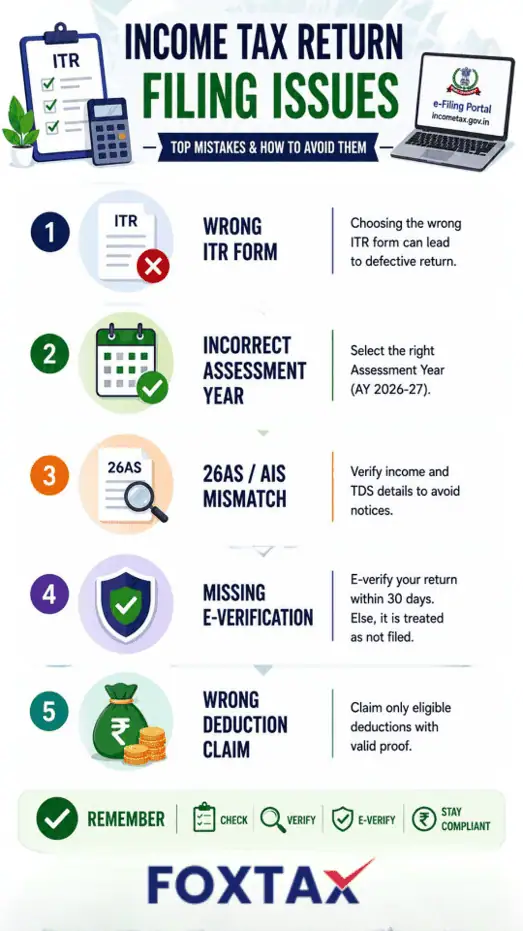
Choosing an incorrect form is one of the biggest ITR problems that people commit. The Income Tax Department offers various ITR forms as income sources like ITR-1 (Sahaj) for individuals earning salaried income, ITR-2 for those with capital gains, ITR-3 for business owners, and ITR-4 (Sugam) for presumptive income. Using the incorrect form will invalidate your return and the department will treat it as a defective return. So, always check your income sources and then choose the relevant form for filing.
2. Quoting an Incorrect Assessment Year (AY)
A very common mistake is that taxpayers confuse Financial Year (FY) and Assessment Year (AY). AY 2026-27 is the correct assessment year for income earned during the period April 1, 2025 to March 31, 2026 (FY 2025-26). In the situation where filing is made under an incorrect AY, it means that the department has no record of your income for that period and it will result in rejection/notice. It is a very simple mistake but it is a very significant one that can cause refund delays by months.
3. Ignoring Form 26AS and AIS Before Filing
Form 26AS (Tax Credit Statement) and Annual Information Statement (AIS) are the official records of all the financial transactions done through your PAN. Failure to cross-check your ITR with these documents is one of the critical income tax return filing issues. When you do not include the income or the TDS from your Form 26AS, the system of the department will automatically detect a mismatch and will lead to a scrutiny notice. Making it a habit of downloading and verifying these documents before filing will save you from the non-matching problems and the notices.
Why Not E-Verifying Your ITR Is a Costly ITR Problem
Submitting your return is only one half of the task. E-verifying your ITR within 30 days of submission is the final, mandatory step. Most of the taxpayers either forget this step or think that it is enough to send a physical ITR-V.
Without e-verification, your return is going to be treated as if it was never filed at all. It results in late filing fees, forfeiture of refunds, and receipt of defective return notices. E-verification can be carried out conveniently using Aadhaar OTP, net banking or digital signature. Not making this deadline is one of the easiest-to-avoid ITR mistakes.
Incorrect Claim of Deductions Under Sections 80C and 80D
Over-claiming Without Proof
Section 80C is the most popular one which allows deduction up to Rs.1.5 lakh. Taxpayers regularly claim deductions for investments such as PPF, ELSS, or LIC premiums etc. without keeping proper documentation like receipts. Section 80D is related to health insurance premium deduction.
Illegally claiming many deductions or not being able to provide proof when the IT department asks for it might cause primary roadblock. Many taxpayers make this error by generalizing that all investments qualify for deductions. It is always better to check eligibility and keep supporting documents ready.
Missing Out on Legitimate Deductions
Besides this, some people are so busy that they omit the deductions rightfully theirs, like interest on an education loan (under Section 80E) or the interest on a savings account (up to Rs.10,000 under Section 80TTA). This leads to paying more tax than one should. So, check out all possible deductions in Chapter VI-A before filing so that money isn’t wasted unnecessarily.
How Foxtax Helps You Avoid Income Tax Return Filing Issues
It may not be so easy to do tax filing yourself, as it calls for a lot of knowledge and effort, which may be quite time-consuming and tedious, mostly after all the changes in the forms and deadlines. Foxtax has expert staff behind the income tax return filing services that help the customers in completely avoiding the common ITR problems that occur.
They make a thorough check of your Form 16, Form 26AS, and AIS to cross-verify every single source of income and deduction. They even help those who have filed a wrong ITR filed in the past or those who want to file a revised return. Their support is from the start to finish right from picking the correct ITR form to e-verification. They are very transparent about their pricing which starts at very reasonable rates and with Foxtax, you can forget about the difficult and stressful process and have a smooth and compliant experience.
Quick Checklist to Avoid ITR Filing Issues
Here is a checklist you should use for last-minute verification before submitting your e-filing portal:
- Check personal details carefully: Your name PAN date of birth and address should match exactly as per the Aadhaar and bank records.
- Cross-check with Form 26AS/AIS: Make sure every income and TDS item in the ITR corresponds to what the government has on record.
- Choose the right ITR form: If you have salary, capital gains business etc. then choose respectively between ITR-1, ITR-2, ITR-3, and ITR-4.
- Remember Assessment Year: AY for FY 2025-26 will be 2026-27. Do not confuse FY and AY.
- Be accurate with claiming deductions: Only make claims for Section 80C, 80D and other deductions if you have valid proof.
- E-verify within 30 days: Do the e-verification like Aadhaar OTP or net banking immediately after filing.
- Do a revised return if necessary: Use Section 139(5) if you find an error in your ITR after submission for making corrections without penalty.
Conclusion
Income tax return filing issues happen often, but can be wholly avoided if given attention to detail and proper guidance. Every misstep, whether selecting the wrong ITR form or forgetting e-verification, can result in refund delay, scrutiny notices or penalties. If you follow the checklist above and stay updated with Form 26AS and AIS reconciliation, then you can have complete confidence in filing.
Whenever you feel that you have made an error or even if you are overwhelmed with the whole process, professional help is just a click away. Foxtax is a specialist for complete error-free ITR filing, revised returns, and personalized tax advice, so you can always be compliant and at the same time maximize your refund. Do not let tiny errors consume your time and money.
Frequently Asked Questions (FAQ)
Q1: What are the most common mistakes to avoid on my tax return?
Some common errors in filing ITR are using the wrong ITR form, quoting an incorrect Assessment Year, not declaring all sources of income (like savings account interest or capital gains), not reconciling Form 26AS/AIS discrepancies, and not filing e-verifying the return on time (within 30 days).
Q2: Can I correct a wrong ITR filed earlier?
Really, the Income Tax Act Section 139(5) allows you to amend the mistakes in your return by filing a revised return. Such a revised return can be submitted up to the end of the relevant AY or the completion of the assessment, whichever occurs first.
Q3: Who is not required to file an income tax return in India?
Those who are below 60 years old and have a total income less than 2.5 lakh (3 lakh for senior citizens, 5 lakh for very senior citizens) will not be required to file. Although, filing even without income may be beneficial to claim refunds or for the loan applications, etc.
Q4: What happens if I miss the ITR filing deadline?
The last date for filing ITR for individuals (not requiring audit) is July 31st and after this you can still file a belated return by December 31st. The downside is that a late filing fee not exceeding Rs.5,000 will be charged and you will lose the option to carry forward certain losses for future years. Besides that, interest under Sections 234A, 234B, and 234C can also be imposed.
Q5: How does the e-filing portal help prevent ITR issues?
Official e-filing portal (incometax.gov.in) auto-fills personal details as well as some income data from Form 26AS. Besides that, it cross-checks the basic information and brings an option of correcting the errors before the final submission.