

Setting the Stage: Why All Eyes Are on the Union Budget 2026
Anticipation is high as the Union Budget 2026-27 approaches. Speculation intensifies around potential income tax changes, particularly for the crucial Middle Class and Salaried Employees. Following its recent electoral success, the Modi Government 3.0 faces significant expectations for economic stability and growth-oriented reforms. A key focus remains on providing tangible relief to taxpayers.
Understanding the Buzz Around Tax Relief for the Middle Class
The electorate widely anticipates tax relief measures aimed squarely at the middle-income group. Salaried Employees, in particular, hope for increased disposable income to combat rising living costs. The government’s fiscal policy in the Union Budget 2026-27 will be crucial in addressing these expectations and potentially recalibrating the tax structure.
Key Economic Factors Driving the Conversation
Several macroeconomic indicators heavily influence the budget deliberations. India continues to demonstrate robust GDP Growth, a positive sign for the economy. However, careful management of Inflation remains paramount to ensure real income growth for citizens. The government’s ongoing commitment to Fiscal Consolidation will balance revenue generation with expenditure control. Crucially, policies that stimulate Domestic Consumption are vital for sustained economic momentum. These factors collectively shape the government’s approach to income tax adjustments.
First, Know Your Current Tax Slabs for FY 2025-26 (AY 2026-27)
Understanding the existing income tax framework is essential before discussing potential changes. Taxpayers currently have two distinct regimes to choose from for filing their Income Tax Return.
The New Tax Regime: Your Default Option Explained
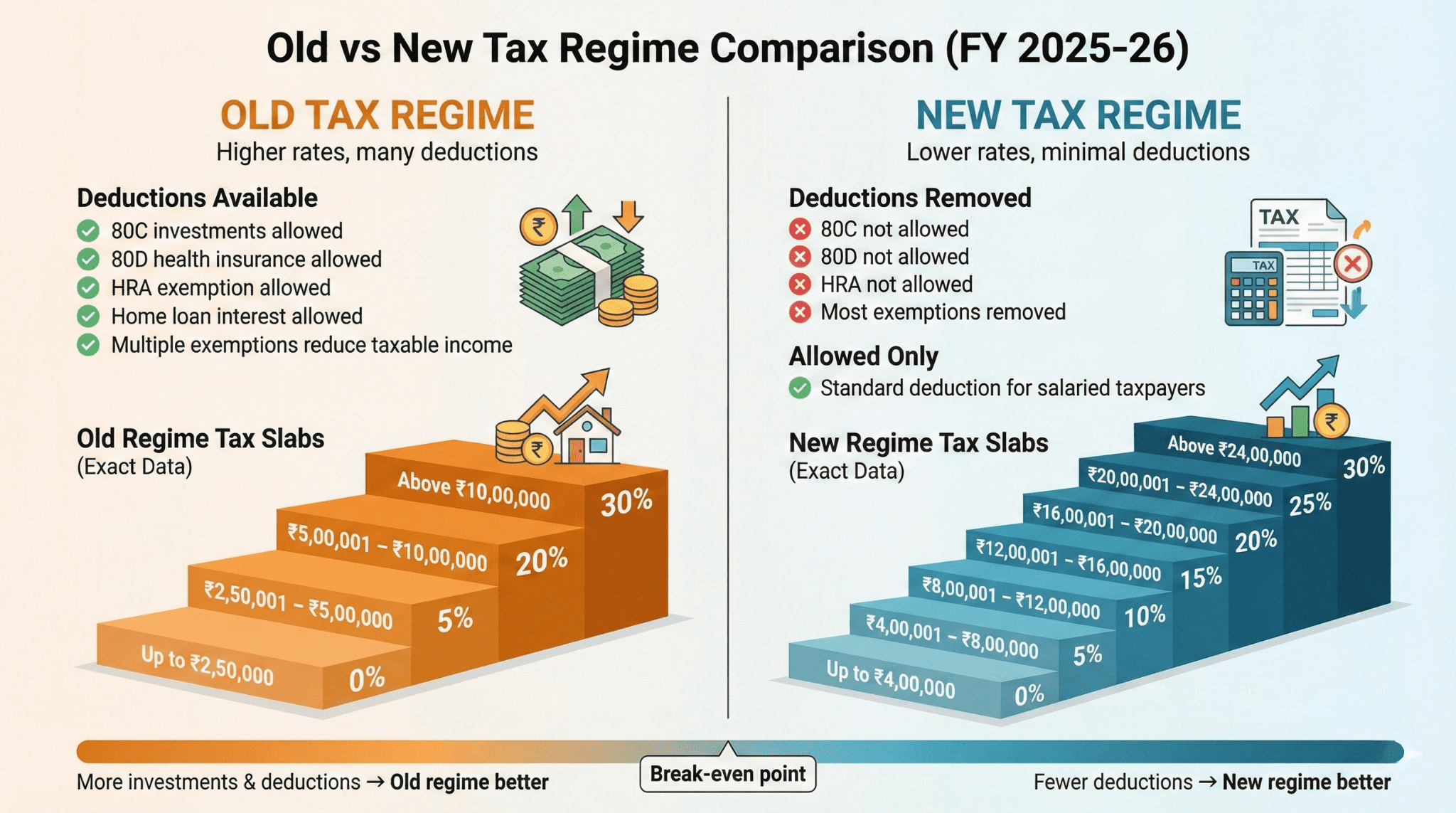
The New Tax Regime is the default option for individual taxpayers unless they explicitly choose the Old Tax Regime. This regime offers lower tax rates but fewer exemptions and deductions. It includes a Standard Deduction of ₹75,000 for salaried individuals and pensioners, and a Section 87A rebate, making taxable incomes up to ₹12 Lakh effectively tax-free. For salaried individuals, the effective tax-free limit is ₹12.75 Lakh.
| Income Slab (New Tax Regime) | Tax Rate |
| Up to ₹4,00,000 | Nil |
| ₹4,00,001 to ₹8,00,000 | 5% |
| ₹8,00,001 to ₹12,00,000 | 10% |
| ₹12,00,001 to ₹16,00,000 | 15% |
| ₹16,00,001 to ₹20,00,000 | 20% |
| ₹20,00,001 to ₹24,00,000 | 25% |
| Above ₹24,00,000 | 30% |
The Old Tax Regime: Still an Option for Savers & Investors
For those who prefer to leverage various tax-saving instruments, the Old Tax Regime remains a viable choice. This regime allows taxpayers to claim significant Exemptions and Deductions, such as Section 80C for investments, Section 80D for health insurance, and HRA for rental payments, among others. While the tax rates are generally higher, the numerous deductions can significantly reduce taxable income for savers and investors.
Top Demands: What the Salaried Class & Industry Expect from Budget 2026
Various stakeholders have voiced their expectations from the upcoming Union Budget 2026-27. These demands largely focus on alleviating the tax burden and promoting savings.
The Biggest Ask: Raising the 30% Tax Bracket Threshold to ₹50 Lakh
One of the most prominent demands from industry bodies like PHDCCI is to significantly raise the threshold for the 30% Tax Slab under the New Tax Regime. Currently, income above ₹15 Lakh falls into this highest bracket. A proposal to increase this to ₹50 Lakh aims to provide substantial relief to high-income Salaried Employees, leaving more disposable income in their hands.
Boosting Savings: Will the Section 80C Limit Finally Increase?
The Section 80C Deduction Limit, currently at ₹1.5 Lakh, has remained unchanged for several years despite rising incomes and inflation. There is a strong push to increase this limit to encourage domestic savings and Investments. This would benefit taxpayers making contributions to PPF, ELSS, and those repaying Home Loan Interest, among other eligible avenues.
More in Your Pocket: The Push to Increase the Standard Deduction
The Standard Deduction currently stands at ₹75,000(Default Tax Regime), offering a flat deduction from the gross salary of the Salaried Class. This benefit is also applicable to most pensioners, as their pension is taxed under the head ‘Salaries.’ Despite this relief, many experts and advocacy groups argue that the limit has not been updated to keep pace with inflation, significantly reducing its real value over time. Increasing this deduction would directly enhance the net disposable income of employees and pensioners, making a strong case for its revision in future budget proposals.
Enhancing Healthcare Security with Higher 80D Limits
With the escalating costs of healthcare, the demand for increasing the limits under Section 80D for Health Insurance premiums and Medical Expenses is growing. Higher deduction limits would incentivize individuals and families to secure better health coverage, thereby enhancing healthcare security across the nation.
A Realistic Outlook: What Changes Are Genuinely on the Table?
While demands are plentiful, the government’s decisions will be guided by fiscal prudence and economic realities.
Prediction 1: Fine-Tuning the New Tax Regime is More Likely Than a Major Overhaul
Significant structural changes to income tax slabs might be unlikely. Instead, the government may focus on fine-tuning the New Tax Regime. This could involve minor adjustments to the basic Exemption Limit or further tweaks to the Tax Rate at lower or middle-income levels. The Section 87A Rebate might also see an upward revision to benefit more taxpayers without drastically altering the overall tax architecture.
Prediction 2: The Old Tax Regime Will Likely Remain Untouched
The Old Tax Regime, with its established framework of Exemptions and Deductions, is likely to remain largely unchanged. The government aims to encourage adherence to tax laws and promote Tax Compliance through a stable policy environment. Maintaining the status quo for the Old Tax Regime would provide predictability for those who plan their Investments around its benefits.
How to Plan Your Taxes Ahead of the Budget Announcement
Prudent Tax Planning is crucial, especially with a budget announcement on the horizon. Don’t wait for the Union Budget 2026-27 to finalize your financial decisions.
Old vs. New Regime: Which One Should You Choose for FY 2025-26?
Taxpayers must carefully assess their financial situation for FY 2025-26. Compare the benefits of the Old Tax Regime, with its various deductions, against the lower tax rates of the New Tax Regime. This assessment is a critical part of Financial Planning and will determine your optimal choice for filing your Income Tax Return. Utilize online calculators and consult with tax professionals to make an informed decision.
Maximizing Your Current Deductions Before It’s Too Late
Even before the budget, maximize your existing tax-saving opportunities. Make timely Investments in various Tax-Saving Schemes, especially those covered under Section 80C, such as PPF, ELSS, and life insurance premiums. Do not delay your tax-saving activities, as some investments require commitments throughout the financial year.
Frequently Asked Questions about Budget 2026 Tax Changes
What is the current highest income tax rate in India?
Answer: The current highest income tax rate in India, including the applicable surcharge, is 39% under the New Tax Regime. Explanation: This rate applies to incomes exceeding ₹5 crore. It comprises a 30% base income tax rate plus a 37% surcharge on the tax payable for that income bracket, further topped with a 4% health and education cess.
When will the Union Budget 2026 be officially presented?
Answer: The Union Budget 2026 is traditionally presented on February 1st each year. Explanation: The Finance Minister presents the annual financial statement and tax proposals to the Parliament during the Budget Session, typically commencing in late January or early February.
Could the government introduce separate tax slabs for senior citizens?
Answer: While possible, introducing entirely separate tax slabs for Senior Citizens is unlikely under the current framework, especially for the New Tax Regime. Explanation: The Old Tax Regime already offers some tax relief to Senior Citizens through higher basic exemption limits. Pension income is taxed based on the applicable slabs, and the New Tax Regime generally has uniform slabs for all individual taxpayers regardless of age. Any relief might come through increased deductions or specific rebates rather than entirely new slab structures.
topic: Budget 2026 Expectations & Tax Slabs Schema: