

ITR Return Filing for Individuals and Professionals: A Complete Guide
ITR return filing follows a common pattern across the whole of India! Millions of taxpayers in India show-up right before the deadline and create mistakes which cost them notices or delay the process to receive legitimate refunds.
Anyone who is a salaried (whether a doctor or entrepreneur or any other profession), should know the compliance information about how to file the Income Tax Return and all the professionals and Individuals Companies or Firms (even a small shop) should know in detail about the ITR filing including the deadline date, the right form, and the solution for ITR filing difficulties.
How to File ITR Return for Individuals and Professionals?
The main task in filing an ITR is to report your gross taxable income (whether it is from salary, business, profession, capital gains, house property or any other source) to the Income Tax Department.
This is done for determining your tax liability and reporting your already paid tax (TDS, advance Tax, etc.).
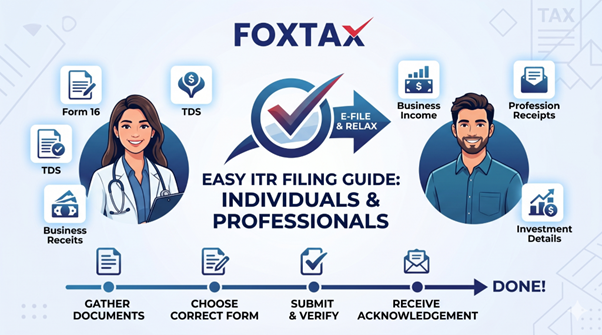
- Gather all your income documents – Form 16 (For salaried employees), bank interest certificates, capital gains statements from your broker, invoices/receipts (if you are a professional or freelancer). Download Form 26AS and Annual Information Statement from efiling portal to cross check TDS credits.
- Select the right ITR form – There are 7 ITR forms by the Income Tax Department, ITR1, ITR2, ITR3, ITR4, ITR5, ITR6 and ITR7.
The default ITR forms for individuals and professionals are ITR1 (Sahaj), ITR2, ITR3 and ITR4 (Sugam). If you select the inappropriate form, then your return will be considered defective as per section 139(9). - Fill the return online or offline – Log on to the mandated income tax e-filing portal (incometax.gov.in). You can fill the form directly online or download an offline utility (Excel or Java) and upload it on the portal. The prefilled ITRs with auto populated data from Form 16, TDS and other facilities have been added to the portal.
- Crosscheck your return before submitting – Revise all entries, i.e. personal details, income heads, deductions (under Section 80C, 80D etc.), tax paid. After submitting, the assessee is required to verify the return within 30 days. The verification can be done online through Aadhaar OTP, net banking or EVC or you can post physically to CPC Bangalore, to be sent with your signature.
- Download acknowledgement – Once verified successfully, download the ITR acknowledgement showing that you have filed. You can check your status on the portal and it should show “processed”.
This is the exact process that will keep you within the Indian tax laws, specifically for a simple income.
But for a professional with complex income (whether capital gains, foreign assets, or receipts from multiple businesses), an expert service like Foxtax can automate much of this workflow and keep you safe from errors.
Which ITR Form Should You File? (For Professionals & Individuals)
Selecting the appropriate form is the most important aspect of ITR filing. Here is a quick summary based on your category of income:
| Income Profile | Correct ITR Form | Key Restriction |
| Salaried individual, income up to ’50 lakhs, one house property, no business/profession income. | ITR-1 | Cannot have income from business/profession or capital gains |
| Salary/pension, own more than one house, capital gains, foreign assets, agricultural income > Rs.₹5,000, no business/profession income | ITR-2 | Not to be used if you receive any form of professional or business income |
| Income profession (doctor, lawyer, teacher, trader, freelancer) or business. | ITR3 | This is applicable If you undertake business, and while you have kept the books of account, you are not subject to presumptive taxation |
| Eligible for presumptive taxation under 44AD, 44ADA, 44AE (e.g. small professionals with gross receipts less than or equal to an amount of Rs. 50 lakh) | ITR4 (Sugam) | Simpler version, you can still choose to file ITR 3 again |
If you are a freelancer or a consultant or a self employed professional (Whether Indian or Foreign professional) and your gross receipts are 50 lakh or less in a financial year, you can claim presumptive taxation under Section 44ADA of the IT Act and can file ITR4.
If your receipts are more than 50 lakh or if you don’t wish to claim presumptive taxation, you have to file ITR3.
An ITR1 or ITR2 filed when you have professional income will not file your return correctly.
How to File ITR for Professionals (Freelancers & Self-Employed)
Professionals have special tax situation. They are not like employees and need to consider business expenses, payment of Advance tax and audit if required.
For Freelancers and Small Professionals (Section 44ADA)
If you are a freelancer, consultant, professional (e.g Interior designer, Lawyer, Architect, Doctor etc.) and your gross receipts are up to Rs 50 lakh in a financial year, then you may be to opted for presumption taxation scheme under section 44ADA, as you only need to show 50% of the gross receipt as your income and rest you are free to show as, no matter what expenses you actually incurred.
There is a huge advantage of this scheme as you are not required to keep any books of accounts and file most easy ITR4 (Sugam). The due date of ITR filing under this scheme remains the same as the normal schedule. (Normally it is 31 July).
For Professionals with Higher Turnover or Complex Income
All other professionals whose gross receipts/turnover are more than 50 lakhs or who have multiple sources of income (salaries, capital gains, Foreign assets) or do not wish to opt for presumptive taxation category should file ITR3.
They need to show books of accounts and provide actual profit/loss of profession while filing the return and file tax audit report under section 44AB.
The ITR3 form involves filling complicated schedules like Schedule BP, which caters to business/profession income/receipts and Schedule CFL, which deals with per opportunity of losses to be carried forward.
With so much to consider, many professionals may look at professional tax firms like Foxtax in automating the schedule and providing Audit consultants to meet the requirements.
E-Filing ITR for Salaried Individuals
As for salaried employees, the process is a little easier. If your overall income from salary, one house property and other sources (interest etc.) is less than or equal to 50 lakh then you have to fill the ITR1 (Sahaj).
You need to do the e-filing ITR for salaried individual like this:
- Log onto the income tax efiling portal (User ID=PAN password captcha).
- Click on ‘e-File’ > ‘Income Tax Return’, select the correct Assessment Year(AY).
- Select ITR1 and select the mode of file (online/offline utility).
- The portal will open up the already filled return with data from Form 16 & TDS.
- Check the entries filled in for you These will include your employer’s TDS, interest on savings accounts and any reliefs claimed.
- Enter any other income (ex. Interests from fixed deposit) or deduction (ex. 80C for ELSS PPF life insurance) which is not ready filled.
- Submit and verify using your own Aadhaar OTP/net banking.
The last date of filing ITR for individual salaried persons is generally 31st July of the assessment year. Late filing beyond this date can invite a late fee of up to Rs.5,000 (Section 234F) and can delay your refund.
Capital Gains ITR Form: Which One to Use?
In case you’ve sold shares/mutual funds/house or any other capital asset(s) during the year, you are required to declare capital gains in your ITR.
According to your other income sources you’ll need to fill in in one of these forms:
- Only capital gains + salary/house property (no business/profession income) – Use ITR2. Fill Schedule CG (Capital Gains), Schedule 112A (longterm equity gains >1 lakh).
- Capital gains + Profession income – For this you need to use ITR3 (or ITR4 if you take presumptive taxation for your profession). ITR3 will have Schedule CG, apart from the various business/profession schedules.
- Capital gains with debt funds, gold or property – These are taxed to a different extent (20% with indexation for long term assets). Please make sure you work out the indexed cost correctly or apply the capital gains account scheme if reinvesting.
Last Date for Filing ITR for Individuals
The due date for filing ITR for most will be 31st July of assessment year.
For professionals requiring audit of accounts (turnover exceeds 1crore in business or 50 lakhs for professionals), the due date is extended to 31st October of assessment year.
Any time after the due date but before 31st December of assessment year, you can file a belated return by paying late fees of 5,000/-(1,000/-, if total income is less than 5 lakh). Beyond 31st December, you still can file a belated return, but with further restrictions (cancelling of certain losses to be carried forward).
Assisted Filing vs. DIY: Which One Is Right for You?
Filed by Yourself or with Assistance: The Best Way to File?
Now the income tax portal offers “Assisted Filing” like a form selection wizard and pre-fills returns, but the DIY (Do-It-Yourself) option is also preferred by many taxpayers. But this solution is suitable for only simple filers, that is a salaried employee with no other sources of income.
For professionals, freelancers or even working people with capital gains, foreign assets or income from business, the scope of errors is large.
Why seek professional help?
- Appropriate form selection and schedule filling The menu contains only names of the forms. Schedule filling is not easy.
- Tax planning to get the maximum benefit (optimum choosing of old versus new regime, availing of all tax deductions)
- Other types of tax audits that focus on avoiding defective return notices and penalties
- Saving time, crucial during peak season to reduce waiting time
That’s where Foxtax steps in, offering an easy to use service that integrates automation, and expert support. Be it a simple ITR4 under presumptive scheme, or a detailed ITR3 with audit schedules, Foxtax guides you step by step, checks for errors and even allows CA supported filing for business professionals.
Quick Checklist for Stress-Free ITR Filing
Before you hit the submit button, run through this quick checklist:
- I have received Form 16, bank interest certificates and capital gains statements.
- I have downloaded Form 26AS and AIS to confirm the credit of TDS.
- I chose the appropriate ITR form (ITR1/2/3/4) which applies to my sources of income.
- I have entered all the deductions under Section 80C 80D etc.
- Any income declared for freelancing or profession (even very modest).
- If tax has been paid in advance (where relevant) and the details of the challan have been entered.
- Return (Aadhaar OTP/EVC) has been verified by me within 30 days from the date of filing.
Conclusion
Doing your ITR return filing does not have to be a horrific experience. If you know which form to use, can prepare your papers beforehand, and make use of the assisted service offered by the efiling portal, you will be able to file correctly before the deadline of 31st July.
If you are a salaried person, your most likely form will be ITR1.
If you are a professional, you will need to file ITR3 or ITR4 according to your turnover or whether you are a presumptive taxpayer.
Whenever you are unsure, Foxtax is available to help you file your return- from choosing the best form, to preparing it, to writing/ archiving the annotations to your accountant to verifying the implementation of the return, Foxtax’s expert services and vast CA network will make sure your return is filed on time and without error.
So file early and relax!
Frequently Asked Questions (FAQ)
Q1: Which ITR should be filed for professional income?
For Professional Income (Doctor, Lawyer, Freelancer and the like) file ITR3 or ITR4.If you gross receipts is not exceeding 50 lakhs and you choose presumptive taxation under Section 44ADA (prescribe 50% of income) go for ITR4(Sugam), otherwise go for ITR3.
Q2: Can we file ITR-2 for professional income?
No, this is for Individuals and HUF only where there is no income from business/profession. If you would have professional income then, ITR 2 cannot be filed. The return would be defective. (Section 139(9)).
Q3: Who will file ITR-1 and ITR-2?
ITR1 is for Resident Individuals having income up to 50 lacs from Salary, One house property & other income sources & no business/profession, No capital gain.
ITR2 is for Individuals/HUF having Capital Gain, multiple house property, foreign asset, agricultural income > Rs.5000 but no business/profession income.
Note: ITR 1 & 2 now cover the same income going up to 50 lacs for comparison.
Q4: How much does a CA charge to file an ITR?
Cost depends on complexity – cheapest salaried ITR1 sent in by CA could be as little as Rs.500-Rs.2,500. But, for professional filing of ITR3 with audits involved, CA cost varies between Rs.2,500 – Rs.15,000 or more.
Some platforms, like Foxtax, provide cheap plans starting at Rs.499 for basic return filing and Rs.1,999 for professional ITR3 filing with CA help.
Q5: Is there a PDF guide for ITR filing for individuals and professionals?
The Income Tax Department supplies official user guides for each ITR form in Adobe PDF format on the efiling portal.
Numerous tax sites (e.g. Foxtax) also supply free user friendly, step-by-step PDF guides complete with screen shots describing the entire e-filing process.
Q6: What is the penalty for late ITR filing?
If you file after 31st July (but before 31st December of the assessment year), then it may be a late fee of Rs.5000/- (if total income is less than 5 lakhs then late fee is Rs.1000/-).
After 31st December, it is permissible but you can not carry forward the loss ( house property loss only).