



GST on E-Commerce Sellers in India: A Complete Guide for Amazon & Flipkart Sellers
Starting your online business on e-commerce sites like Amazon, Flipkart & other such platforms has become a common norm in India. But e-commerce sellers often fall into a trap when it comes to GST compliance.
The GST norms for e-commerce firms are a little bit different and the new business owners or sellers on e-commerce portals find it quite confusing. As per CGST Act, all the suppliers or sellers working on e-commerce sites are obliged to obtain registration regardless of their turn overs.
Here is a guide on GST for E-Commerce Sellers explained in simple language.
Is GST Mandatory for E-Commerce Sellers in India?
Yes, it is a must. As the Section 24 (ix) of the CGST Act 2017, registration of GST is a must for every person who is supplying taxable goods and services in the course or furtherance of business through an electronic commerce operator.
So, if you are selling on Amazon, Flipkart, Meesho or any other similar website then registration is must even if your turnover is below the GST exemption limit of 20 lakhs ( or 10 lakhs in case of special category states ).
While normal businesses could benefit from the threshold exemption, there is no such thing in eCommerce.
You have to register for GST if you sell just 1 product or up to thousands of products. If you do not register yourself and get caught, there is penalty, suspension of seller account, no input tax credit on all your business purchases.
Is GST required to sell on Amazon?
So, to register as a seller on amazon.in, your GSIN is required. Amazon seller registration terms demand this document at the time of registration. It is required even if you want to sell some products on a trial basis. Amazon India seller policy mentions “using a valid GSTIN as a seller on our marketplace is a requirement”.
TCS is deducted at 1% (0.5%CGST + 0.5%SGST) on the net taxable value of supplies made through the Amazon platform. If you are not yet GST registered, Amazon will not pay out your dues and you will be barred from your seller account indefinitely.
Is GST compulsory for Flipkart sellers?
Yes ! Just like Amazon, Flipkart also calls for GST registration for all vendors. The Seller is required to pay TCS@ 1% into the government account and also provide GST return on time and if at any time it is found that the vendor is not following the GST regulation, then their account will be blocked by Flipkart.
Which GST Registration is Required for an Amazon Seller?
E-commerce sellers need to understand the type of GST registration based on their business operations. A single GSTIN may not be sufficient if you sell across multiple states or use fulfillment centers in different locations.
| Selling Scenario | GST Registration Required | Example |
| Selling within the same state (intra-state) | CGST + SGST registration in that state | Seller in Mumbai selling to buyer in Pune |
| Selling to buyers in other states (inter-state) | IGST registration; may need registration in destination state | Seller in Delhi selling to buyer in Bengaluru |
| Using fulfillment centers in multiple states | Separate GST registration in each state where warehouse is located | Amazon FBA seller with centers in Maharashtra, Karnataka, and Tamil Nadu |
| Occasional selling in exhibitions/markets outside home state | Casual Taxable Person registration (temporary) | Seller participating in a trade fair in another state |
You cannot register under the composition scheme as an e-commerce seller. You need to register as a normal tax payer and file monthly returns even if you have no turnover.
Do I need multiple GST registration as Amazon seller?
If you use Amazon FBA and have stocks in warehouses in different states, you should have GST registration in every such state. Remember, the movement of goods to these warehouses attracts GST at state level.
What is the GST Rate for E-Commerce Business?
GST rates to be used depend on the nature of the transaction, since e-commerce sellers have to deal with many GST rates. Proper invoicing and return filing require that the seller be aware of these rates.
The GST rate on your products depends on their HSN classification. Common rates include:
- 5% – Packaged food items, footwear up to ₹1000, certain medicines
- 12% – Apparel below ₹1000, frozen meat, butter, ghee
- 18% – Electronics, smartphones, ACs, refrigerators, branded apparel above ₹1000
- 28% – Luxury goods, automobiles, aerated drinks, high-end motorcycles
GST on Platform Commission
E-commerce companies such as Amazon, Flipkart etc. charge 18% GST on their commission fees. This is a cost borne by the seller but is claimable as input tax credit.
For example if Amazon charges you say Rs.1000 as commission, you pay Rs.180 as GST which can be set-off against GST liability in due course.
Tax Collected at Source (TCS) – 1%
Section 52 of the CGST Act mandates e-commerce operators to charge TCS at 1% (0.5% CGST + 0.5% SGST) on the net value of taxable supply.
The TCS is withheld before the platform remits funds to you. Yet, you can get TCS as credit in GSTR 3B (to be matched with GSTR 2A/2B).
How to Calculate GST on E-Commerce Sellers for Amazon and Flipkart Sellers
There’s Three elements to take into account when calculating your GST liability:
- TCS deducted by platform on your sales,
- GST on your product sales,
- Input tax credit on your business expenses.
Step-by-Step GST Calculation Example
Let’s say you sell a product worth Rs.10,000 on Amazon with an 18% GST rate:
- Product GST – ₹10,000 × 18% = ₹1,800 (₹900 CGST + ₹900 SGST for intra-state sales)
- TCS deducted by Amazon – ₹10,000 × 1% = ₹100 (₹50 CGST + ₹50 SGST)
- Net tax payable by you – ₹1,800 – ₹100 (TCS credit) = ₹1,700
- GST on platform commission – If commission is ₹1,000, you pay ₹180 GST, which you can also claim as ITC
The actual cash outflow will be relative to your input tax credit on the purchases of raw material packaging, logistics etc. Reconciliation of Amazon sales report with GSTR1, GSTR-3B, GSTR-2A is your best bet to avoid mismatches.
How to show sale through Amazon in GSTR-1
The sales through the e-commerce operator will be reported in the following tables of GSTR-1 :
- B2B sales will be reported in Table 4, and
- B2C sales will be reported in Table 7 (inter state sales) or Table 8 (Intra state sales).
- HSN wise summary of outward supplies also needs to be reported. If there is any mismatch between your GSTR-1 and the platform GSTR-8, you may receive notices from the tax department.
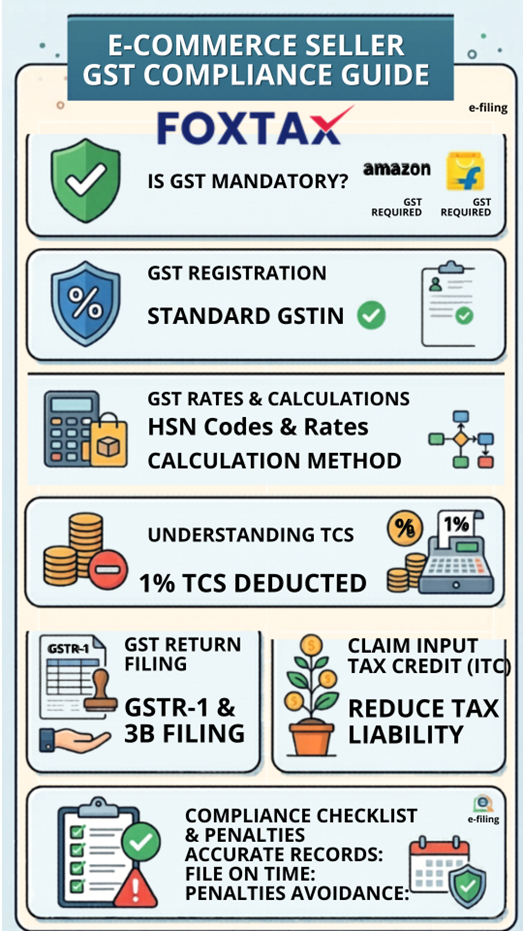
Quick Glance at GST Compliance Checklist for E-Commerce Sellers
Here is a simple checklist to ensure you stay compliant with GST rules as an E-commerce seller:
- Get GST registration Essential regardless of turnover. Register in each state where you have a warehouse.
- File monthly returns: GSTR-1 (by 11th of the next month), and GSTR-3B (by 20th of the next month). Even if there are no sales to report, the customer is required to file a nil return.
- Reconcile TCS credit: Ensure TCS deducted by Amazon/Flipkart in GSTR-2A/2B is matching with your records before claiming credit in GSTR-3B.
- Prepare the correct invoice : even though the selling price is final, all the tax invoices should be issued for every sale and the digital record should be preserved for at least 5 years.
- Pay tax on time: work out the net GST payable after claiming ITC and TCS credit and make payment on or before the due date to avoid the interest @ 18 % p.a.
Conclusion
GST for Ecommerce Sellers in India is compulsory. There are no exemptions or thresholds for GST. You are required to get registered, know the GST rates for each product, maintain the records to claim the TCS deducted by the platform and file returns monthly on time.
Although the rule looks complicated but if followed timely you will be able to recover input tax credits, not attract penalties and be hassle free.
To avoid all this and get going with your online sales you can rely on companies like Foxtax who can take care of all the GST related formalities, while you concentrate on growing. Gst compliance actually sets up a range of added profits and values that every business needs.
FAQ Section
Q1: What happens if I sell on Amazon without GST registration?
You are not able to sell on Amazon without a valid GSTIN as it needs GSTIN for registration. If, for some reason, you get to sell without registration, Amazon will not pay out the payouts, the tax department can levy a fine of Rs.10,000 or 10% of the tax where payable (whichever is greater) and your seller account will be suspended.
Q2: Can I claim TCS credit in the same month?
Yes, TCS by e-commerce portal can be claimed, as reflected in GSTR-2A/2B of you. In GSTR-3B of that month, you can set it off if details are matched. If mismatch, can be claimed in subsequent months after reconciliation.
Q3: What is the penalty for late GST return filing for e-commerce sellers?
Late filing of GSTR-3B is subject to late fee of Rs.50/day (Rs. 25/each CGST and SGST) for NIL GSTR-3B, and Rs. 100/day (Rs. 50/each CGST and SGST) otherwise, and interest on any outstanding amount at 18% p.a.
Q4: Do I need to charge GST on sales to customers in other countries?
Exports are to be supplied at zero GST. GST is not payable on export sales. But, a shipping bill has to be filed and a claim for refund of input tax credit has to be made. Registration for provision of exports is still mandatory.
Q5: How is E-commerce HSN code related to GST rates?
HSN Codes (Harmonized System of Nomenclature) are used to classify products for GST. First 2 digits decide the chapter and full code (4 or 6 digits) decide how the product is classified for specific GST rate. Using wrong HSN code may cause wrong calculation of tax and might cause penalties after audit.