



There are 1.4 crore plus active GST registrations in India, and an increasing proportion of them are pvt ltd companies—the structure many founders choose through private limited company registration when they want limited liability and the ability to obtain funding.
For most pvt ltd companies, GST registration is a pre-requisite, not an afterthought—especially the day they trade across state borders, list on a marketplace, or cross the threshold limit. Doing it right the first time spares you interest, penalties, and painful rework.
What Is GST Registration for a Private Limited Company?
GST registration for a private limited company is the registration of your company as a distinct legal entity on the GST portal and results in a 15-digit GSTIN (Goods and Services Tax Identification Number). With GST registration, a private limited company can charge GST on the sale of goods and services, claim input tax credit on purchases made for business purposes, and file monthly or quarterly GST returns.
GST Registration Requirements Under the CGST Act, 2017
As per the CGST Act, 2017, registration under Section 22 is threshold-based. Compulsory registration is covered under Section 24. A private limited company has to register separately in each state from where it is selling.
When Is GST Registration Mandatory for a Pvt Ltd Company?
Threshold-based registration is relevant only for suppliers operating exclusively within a single state. The aggregate turnover thresholds are:
| Type of supply | Threshold limit |
| Goods (most states) | Rs 40 lakh |
| Services (most states) | Rs 20 lakh |
| Goods (special category states) | Rs 20 lakh |
| Services (special category states) | Rs 10 lakh |
Irrespective of turnover, company GST registration becomes compulsory in these situations:
- Inter-state supply. If goods or services are supplied to a buyer in a different state, registration is compulsory from the first invoice under Section 24. There is no threshold exemption in this case.
- Selling via an e-commerce operator. There are limited exemptions for intra-state supply of goods by vendors within their threshold and for service providers below Rs 20 lakh as per Notification 65/2017. For most sellers, GST on e-commerce sellers applies from day one.
- Reverse charge liability. Any business required to pay GST under reverse charge—for example, legal services, transport, or import of services—must be registered.
- Casual and non-resident taxable persons. If your company has no physical office in India but conducts business from a temporary stall or exhibition, registration is mandatory.
How Long Do I Have to Register?
Your registration must be done within 30 days from the date the liability was accepted—for example, the date of incorporation for a new company or the date when turnover crossed the limit. This is what makes GST registration the first mandatory compliance step for any pvt ltd company.
Documents Required for GST Registration of Private Limited Company
The paperwork is the part most founders overlook, but the list is routine and mostly digital. Documents do not have to be turned in on paper—you simply upload PDFs and JPEGs to the GST portal. Maintain similar file sizes, and do not change the names when renaming files, as mislabeling is a common reason for a clarification notice. For a master list, see this GST registration documents checklist.
Company and Director KYC Documents
- Certificate of Incorporation. It is the company’s unique ID and is issued by the MCA. This certificate contains the CIN, which is used as a prefilled value in many fields. You can also review the documents required for private limited company registration.
- Company PAN and PAN of each director/promoter. PAN of the company is compulsory, as are the PAN and Aadhaar of every individual identified as a promoter or authorised signatory.
- MOA and AOA. They define the company’s objects and affirm that the proposed business activity is within the company’s objects. Learn more about MOA and AOA.
- Board resolution and authorization letter. The board must authorise the signatory who will file the application and use the company’s digital signature certificate or electronic verification code.
Registered Office and Bank Account Proofs
- Proof of address of principal place of business: electricity bill, municipal khata copy, property tax receipt, or valid rent/lease agreement. If the premises are owned by someone else, include a no objection certificate from the owner.
- Bank account evidence. Cancelled cheque or the first page of a bank passbook or bank statement showing the company name, bank account number, and IFSC.
- Photographs and digital signatures. Promoters’ passport-size photographs with the digital signature certificate or electronic verification code of the signer for application signing.
These pvt ltd company GST registration documents do not vary much whether it is a newly incorporated pvt ltd company or one that has already begun business.
Company GST Registration Process: Step-by-Step
- Part A: Form GST REG-01. Enter Company PAN, legal name, and state. After OTP authentication of email and mobile, the portal may generate a Temporary Reference Number. The full GST registration process guide explains this in detail.
- Part B. Complete the TRN login, principal and additional place of business, business activity, authorised signatory, and bank details.
- Upload and check. Upload scanned proofs, sign with DSC or EVC, and submit. An Application Reference Number will be issued.
- Aadhaar authentication. When submitted, this typically calls for 7 working days for officer approval. Without Aadhaar authentication, it can require 30 days and physical verification.
- Get GSTIN and Form GST REG-06. After successful registration, the registration certificate can be downloaded from the portal, and the company can raise tax invoices. If you prefer expert handling, use GST registration services.
Voluntary Registration and Composition Scheme for a Pvt Ltd Company
Voluntary GST registration is possible even for a company below the threshold, and quite a few companies register to avail input tax credit, participate in tenders, or cater to corporate clients who only source from registered vendors. The composition scheme is available only in limited cases and prevents e-commerce operators, inter-state supplies, and turnover above Rs 1.5 crore for goods. Voluntary registration can be revoked only after all returns are filed.
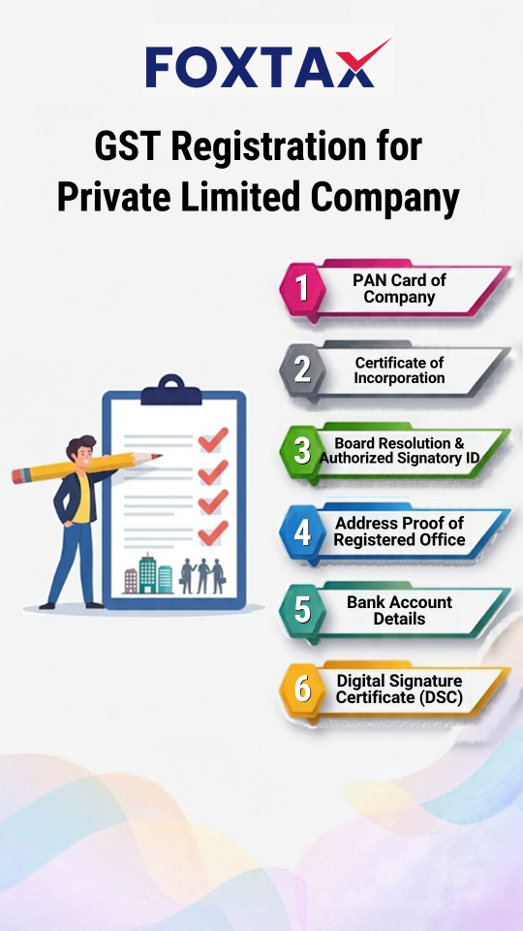
Quick Checklist for GST Registration of a Private Limited Company
- Certificate of Incorporation, MOA, and AOA prepared.
- Company PAN, PAN, and Aadhaar of each director.
- Board resolution naming the authorised signatory.
- Proof of registered office with rent agreement and NOC, if needed.
- Company’s bank statement or cancelled cheque.
- DSC or EVC to sign the application.
- Aadhaar authentication completed for faster approval.
Getting your private limited company registered for GST is all a question of documentation and timeline. If your company deals in inter-state supplies or sales online, it is a day-one compliance item rather than something to achieve in the future. Foxtax takes care of it for you so you can concentrate on the business.
FAQs
1. Is GST registration mandatory for a private limited company with zero turnover?
Not necessarily. An entity with no inter-state supply or e-commerce sales and turnover less than Rs 20 lakh or Rs 40 lakh is not liable for registration. Registration is required as soon as any Section 24 trigger is met—whether inter-state supply or sales through an e-commerce operator—irrespective of turnover.
2. What is the penalty for not registering a private limited company under GST?
Under Section 122(1) of the CGST Act, the penalty may be up to 100% of the tax evaded. Interest is charged at 18% per annum under Section 50. The company also forfeits the right to claim input tax credit on purchases made during the period it was not registered.
3. How long does GST registration take for a private limited company?
Once Aadhaar authentication is done, approval is generally granted within 7 working days. If approval is not obtained, the officer may take up to 30 days and can also ask for physical verification of the place of business.