



Tax on Selling Property in India: A Complete Guide for Homeowners & Investors
In India, money from selling property is a tax haven for the government, let alone the fact you are likely selling your primary asset for the first time. Capital Gains Tax is the main tax on property sales in India. Changing your understanding of this tax can save you a great deal of money. With property sales in India setting new records in 2026, it is even more important to understand tax issues.
What Are the Tax Implications of Selling Property in India?
The gains made by selling (sale price minus purchase cost) is not considered your regular income. It is treated separately as Capital Gains on property sale. The property owner’s length of ownership before sale decides taxation.
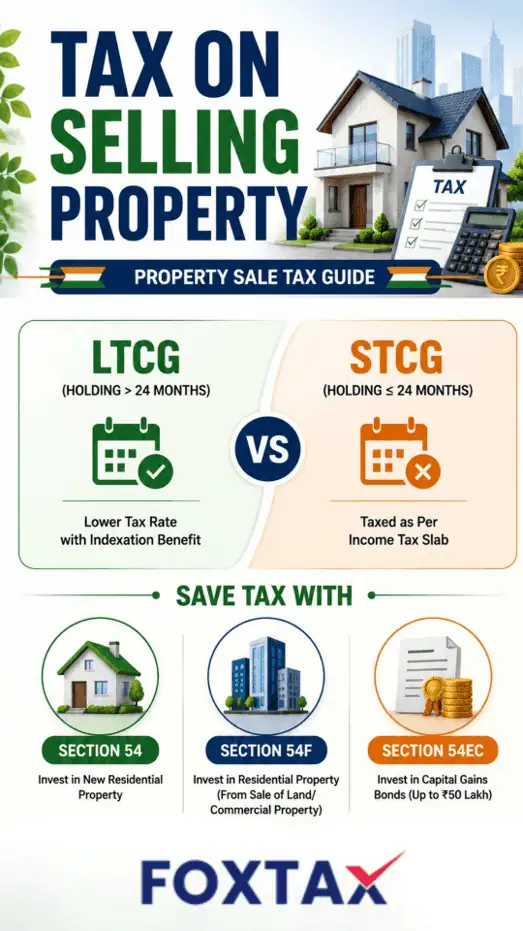
The Income Tax Department of India decides sale of asset type by ownership period. In real estate, holding time for 24 months (2 years) is the border line. When the property is sold within 24 months from buying, it is considered as Short-Term Capital Gain (STCG).
If the property is held for more than 24 months, the sale will be considered Long-Term Capital Gain (LTCG). Different expenses, including taxes and tax-free concessions, have a big impact on the returns from the sale. This is why you should note the separations well.
Taxation on Property Sale: LTCG vs. STCG
You have to figure out which of the two types your transaction is in. The taxes for sale of property depend largely on this categorization.
Long Term Capital Gain on Sale of Property (Holding > 24 months)
Tax wise things get a little liberal when it comes to property held for more than two years. At present, sellers of residential property in India have two ways to pay tax on LTCG:
- 12.5% without Indexation : You are simply taxed at flat 12.5% on the actual gain. But it can mean a tax hike in case of an old property.
- 20% with Indexation: Only the “indexed” capital gain is taxed. Indexation is accounting for inflation by multiplying the purchase price by the relief factor (CII) for that year ( Sale year CII / Purchase Year CII). The inflation adjustment is made through the use of the Cost Inflation Index (CII) that is published by the department of Income Tax. It reduces your “paper profit” quite a bit and because of this your tax liability also gets reduced.
Normally, the second one is advantageous for a longer period (like 5-10 years) holder.
Short Term Capital Gains Tax (Holding 24 months)
In case you decide to sell the property within two years, your profit is a short-term capital gain (STCG). There are no indexation benefits or special rates in this case. Simply, the profit will be included in your overall income for the year and taxed at the regular income level. Infect, for those in the highest tax bracket, that means 30% tax plus cess on the profit.
How to Calculate Tax on Property Selling in India?
It is not as difficult as you might think if you keep a record of your property at cost price, its sale price, and any renovation or major tonal such expenses.
To calculate your Capital Gains, use this basic formula:
Sale Price of Property – Cost of Transfer (Indexed) – Cost of Acquisition (Indexed) – Cost of Improvement = Capital Gain
- Sale Price: The last price that you sold the property for.
- Cost of Transfer: It is the money you spent on selling the property, e.g. broker’s commission, lawyer’s fee, house ads etc.
- Indexed Cost of Acquisition: The Cost price is first multiplied by the ratio CII(sale year)/CII(purchase year).
- Indexed Cost of Improvement: Expenses on major repairs multiplied by the same CII ratio.
Capital gain is the net amount. You will then use that amount to calculate the tax liability at either the long-term or short-term capital gains tax rates.
How to Save Tax and Avoid Capital Gains on Property Sale Legally
You may be worried about when and where to pay the tax on your capital gains, but in fact there are exemptions available in the law for smart use of one’s capital gains.
Exemption under Section 54 (Residential Property)
Exemption is available under Section 54 against the capital gain if you invest your sale proceeds into a new residential house. Only one residential house in India can be acquired under this exemption. Buying the new house before the sale of the old one is allowed one year before, or two years after the sale of the old house. In case the new house is under construction, you have three years to complete the same.
Exemption under Section 54F (Selling Land or Commercial Property)
This is the right approach if you want to move into a residential home after the sale of non-residential assets like lands, commercial establishments, etc. Section 54F needs reinvestment of the entire sale consideration amount to secure exemption. Partial reinvestment results in proportional exemption only.
Saving Tax via Section 54EC (Capital Gains Bonds)
Capital gain bonds are your choice, if you have no plans to purchase another house immediately. Among a few investment options, bonds issued by NHAI or REC offer great safety with fixed interest rate and maximum exemption amount is 50 lakhs bonds. The bonds have a 5 year lock-in period.
Special Considerations: NRIs, Senior Citizens, and Agricultural Land
The tax laws also vary based on certain special scenarios.
Tax on Agricultural Land Sale
Agricultural land in an urban area or within 2 kms from a municipality is considered a capital asset, hence inviting capital gains tax on its sale. However, rural agricultural land sale does not attract capital gains tax. Thus, tax on agricultural land sale is not there.
Capital Gains for Senior Citizens
There is no separate tax rate for capital gains for senior citizens (60 years & above). But they have higher basic exemption limits. Since STCG forms part of income, an old age person not having any other income would be liable to pay zero tax upto Rs. 3 lakhs on STCG. Exemptions under Sections 54 and 54EC are similar. Besides that, they may also invest in tax-saving fixed deposits under Section 54EC.
TDS Rules for NRIs
Property buyers paying NRIs must deduct Tax at Source (TDS) at 20%, plus applicable surcharge and cess for Long Term Capital Gain (LTCG), without considering the actual tax liability of the NRI. To get back the excess amount deducted, they must file a return of income in India.
Quick Glance: Checklist Before Selling Your Property
Using this checklist before signing the sale deed will ensure you are tax efficient:
- Check the Calendar: Has it been over 24 months since you acquired the property? If not, a short delay of a few weeks might help you save 10-20% in taxes by changing STCG to LTCG.
- Gather Old Documents: Besides the purchase agreement, documents of renovations should also be collected (electrical plumbing flooring) to increase the “Cost of Improvement” and reduce your gain.
- Plan the Reinvestment: Ready the funds if you wish to buy a house. You must invest capital gains before filing ITR to get the exemption.
- Consider 54EC Bonds: Not interested in a new house? Then, either open a Demat account or even visit a bank and invest through bonds issued by NHAI/REC up to a maximum of 50 lakhs within the 6 months.
- Consult a Tax Expert like Foxtax: Try to calculate your tax either at 12.5% or 20% with indexation; see which works better for your situation.
Conclusion
Paying attention to tax on selling property should be considered a means of wealth preservation besides a mere compliance activity. Short and Long Term Gain separation combined with indexation usage and sections 54, 54F, and 54EC utilization can see you save a healthy chunk of your profits legally. But, you are required to be well-thought on the planning as strict timelines exist (e.g. 6-month for bonds, 2-year for house buying).
Foxtax has the right expertise to handle these complex calculations, file accurately, and not stress the legal language – saving you lakhs of money. So keep in mind, preparation leads to profits in a property sale.
Frequently Asked Questions (FAQ)
Q1: Do I have to pay tax if I sell a property at a loss?
Tax on Capital Gains in India is levied only on gains. If however you choose to sell a property for lesser value than its purchase price (and improvement costs), then it will be a “Capital Loss.” No taxes are payable Yet you can carry forward this loss for up to 8 years and set off against future capital gains.
Q2: How to avoid capital gains tax on sale of commercial property in India?
By no means can you use Section 54 (which is for only residential houses) for commercial property. Even so, there are other ways like Section 54F that come into effect when you sell a commercial property, use the proceeds to buy a residential house, and invest the whole amount into it. Another option is the 54EC bonds that can be used to invest the profits.
Q3: Is there a tax on selling inherited property?
Actually, no taxes are payable at the point of inheritance. The sale of inherited property is where you become liable for Capital Gains Tax payment. In particular, to obtain the tax base, the price paid by the ancestor (original owner) is used as the cost of acquisition, and the holding period includes the time the property was held by the ancestor.
Q4: Can I claim exemption under both Section 54 and Section 54EC?
Really, you may do so. You can spend the capital gains on a new house (Section 54) and also allot any remaining profits (up to 50 lakhs) in 54EC bonds. Essentially, it is a method used by many who have capital gains of over 50 lakhs.