



What Happens If You Don’t File ITR? 5 Serious Consequences Every Indian Taxpayer Should Know
Everyone living in India earning a salary has to file an Income Tax Return (ITR) in the hope of getting a refund or paying less tax. But, people tend to forget the last date and file the return late. As per figures filed by the Income Tax Department, late returns filed by taxpayers result in a lot of running around to the department and penalty payments which could have been easily avoided. So, if you are asking yourself, “What Happens If You Don’t File ITR?“
It ranges from a fine that you pay to being theoretically brought to court. Late or not filing essentially affects one’s life and routine, say getting that home loan or on a final note, getting that visa. Below we shall enumerate each point in detail.
What Exactly Happens When You Don’t File Your ITR?
When you do not submit your Income Tax Return by the due date (in case of non-audited assessments it is 31st July of the assessment year), the Income Tax Department does not leave you far.
The first thing is that you have to face a broad spectrum of financial penalties and interest. For instance, if you have TDS deducted and aren’t filing ITR, the government won’t refund you the excess tax automatically. It will stay with the department until you file ITR and the penalty for late filing of ITR under Sec 234F starts effect immediately after the deadline date. The main point In short is, not filing is never a neutral thing. It always costs you even if you aren’t liable for taxes.
Does the Income Tax Department Send a Notice for Non-Filing?
Yes, you can count on it. When you fail to file your ITR, the department picks up your trail by way of its non-filer monitoring system having a record of all non-filers with taxable income who file their return after the due date.
You will probably get a notice under section 142(1) of the Income Tax Act which is a notice to you to file the return within a specified period in response to which later on you may get a best judgment assessment. It is a notice from the tax officer of the estimated income and tax based on which he would calculate your demand, which is always more significant than what you would have actually paid if you were to file your return regularly.
Penalty for Late Filing of ITR Under Section 234F
The most straightforward penalty you are going to be hit with is the late filing penalty. This is not a tax, it is a weird extra charge for failure to file on time. This varies given how many months late you are and how much you earn. This is not tax on what you should owe the tax man.
So even if you have nothing to pay the tax man, this can still apply if you earn more than the basic exemption level.
What is the Late Filing Fee Structure for Different Incomes?
The penalty for late filing of ITR is clearly defined under Section 234F:
- If you file after the due date but before December 31st of the assessment year: A late fee of ₹5,000 is levied.
- If you file after December 31st: The penalty increases to ₹10,000.
- Special provision for small taxpayers: If your total income is less than ₹5 lakh, the maximum late filing penalty is capped at ₹1,000. This provides some relief to lower-income groups but does not eliminate the penalty entirely.
- No penalty for nil returns (in some cases): If your income is below the basic exemption limit (e.g., ₹2.5 lakh under old regime) and you have no tax liability, you may not have to pay a penalty, but filing a nil return is still recommended for a clean financial record. The penalty for late filing of ITR is automatic and must be paid before you can successfully submit your belated return.
Interest on Unpaid Taxes Under Section 234A
Besides the fixed penalty, you are also required to pay the interest on unpaid taxes, i.e. amount of tax not yet paid. For most people the interest can actually be the biggest piece of the bill, as it is charged each month from the original due date until the date you file the return.
How is the 1% Monthly Interest Calculated?
Based on Section 234A, simple interest (i.e. not compoundable) an interest of 1% per month or part of a month is levied on the amount of unpaid tax. For example, if you had a liability of Rs.50000 to be paid to the Income tax, and you file your return after three months, the interest would be 1% for each of those three months i.e. Rs.1500 (3% on Rs.50000).
The interest is payable even in case of the belated return. It is not a charge payable only once, but keeps on getting added every month till you file your return, Because of this sometimes the interest paid is higher than the actual penalty itself. (i.e. for 10 months the charge will be 10%).
This is one of the most underappreciated yet most expensive ways to trap investors and business leaders.
You Lose the Ability to Carry Forward Losses
Late submission of your ITR is the only condition to carry forward some of the losses to subsequent years for cross deduction with future income. Miss it and you lose the benefit.
Which Losses Cannot Be Carried Forward?
If you do not file your ITR by the due date, you cannot carry forward the following types of losses:
- Capital Losses (like stocks, mutual funds, or property): Say you lost 1 lakh in the stock market during the year. Because of the late filing you have locked this capital loss in and can’t carry it forward for set-off on future capital gains, thus paying more tax in profit making years.
- Business and Profession Losses: Any loss from business or profession (excluding depreciation) cannot be carried forward.
- House Property Loss: This house property loss can be offset with other income in the same year but the unabsorbed portion cannot be brought forward.
Only house property loss on owning a self-occupied property that is up to Rs. 2 Lacs can be brought forward but only if return for that year is filed before the ITR filing date.
Can You Be Jailed for Not Filing ITR? Understanding Prosecution Risk
People also ask if not filing ITR is a crime and the answer is complicated. Civil default by delay/late filing of ITR invites levy of penalty and interest. Willful and deliberate non-filing with intent to evade tax makes up a criminal offense.
When Does Late Filing Lead to Imprisonment?
How bad is a late filing?
Tax evasion is only reached in serious cases. Under the provisions of Section 276CC of the Income Tax Act, whoever willfully does not file a return, and if the tax evaded exceeds Rs. 25,000, then he shall be punishable with rigorous imprisonment for a term (if the amount is below 1 lakh then for a term of not less than 3 months or excess of 7 years) and with a fine.
Now, when you are a habitual defaulter, having not filing for several years consecutively, then the probability of prosecution increases massively. The department sees it as an evasion pattern. So, you won’t go to jail for missing one date by just a few days, but your continued absence to file ITR (where the outgo is massive) can land you in jail.
How Not Filing ITR Affects Your Loans, Visa, and Refunds
Failing to file ITR has repercussions far beyond the Income Tax Department. Your ITR is an important financial document that banks, embassies and other organizations refer to, to determine your regular income flow. Any break in your ITR filing record sets off alarms.
What Practical Hurdles Will You Face?
- Loan and credit card rejections: Banks like SBI, HDFC, ICICI, etc will ask for ITR receipts of last 2-3 years as an income proof, before granting home loans, car loans or business loans. If one year is missing then it can cause outright rejection or lower loan amount.
- Visa Application Refusal: Many countries like USA Canada UK, Schengen countries demand ITR copies to establish the applicant’s financial solvency. Not filing ITR for a year can be perceived as a lack of financial austerity and result in visa refusals.
- Delayed/Forfeited refund of Income Tax: Where the TDS has been deducted from your salary/income by way of interest, your ITR has to be filed before you get your refund. The more delayed the filing, the more money is being held by the government and refund may even be forfeited if return is filed after a prescribed time limit.
Quick Glance at the Consequences of Not Filing ITR
Finally, here is a final checklist covering the answers to “What Happens If You Don’t File ITR?“
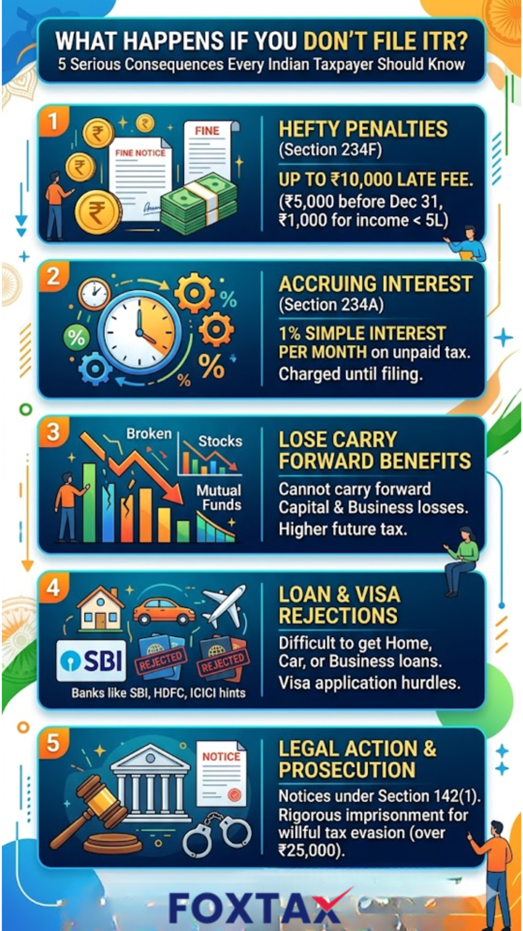
- Monetary Penalty: Rs. 5,000-Rs.10,000 as late fee under Section 234F or Rs.1,000 in case of income below Rs. 5 lakh.
- Monthly Interest: You shall pay a monthly interest of 1% on any unpaid tax as stipulated under Section 234A up to the Date of Filing.
- Loss of Benefits: Capital losses or business losses cannot be carried forward to reduce your future tax burdens.
- Legal Notices & Risk: Under Section 142(1), you might be sent a notice and suppression of income of over 25,000 can cause rigorous imprisonment.
- Financial & Travel Hurdles: Your home loan, car loan and visa applications might not be approved and your genuine tax refund will get lost in transit.
Conclusion
Filing your Income Tax Return is not a mere administrative formality, it’s an integral financial practice that safeguards your future earnings, investments, and credit profile.
The repercussions of neglecting it can be harsh (penalty interest on unpaid taxes, tax probing, abatement of ongoing cross-border projects, scrapping of timing-delayed and phase-delayed projects, forfeiting the right to carry forward your losses to set off against current gains, etc).
While one missed deadline may not put you in jail, it will strain your wallet and make life difficult for your tax authorities. Even so, if you are already behind the curve you need not fret!
You still have the option of filing a belated or revised ITR, but It’s best to meet your filing deadlines by consulting an efficient service (like Foxtax) that makes the process easy, simple, and error-free. Don’t leave out filing your ITR!
Frequently Asked Questions (FAQ)
Q1: Can we skip ITR for a year if our income is below 5 lakhs?
In theory, if your income is below the basic exemption (which ranges between 2.50 to 3 Lakhs given the regime you belong to) then you needn’t file.
That being said, it is best to file a “nil return” because overlooking it results in a gap in your records which will be a pain if you apply for a loan or a visa. It also means that you will have no TDS refunds if your employer had deducted TDS from your salary.
So you may, but shouldn’t.
Q2: What happens if I don’t file ITR for 2 or 3 years?
The total amount of penalty and interest charges will be extremely high. For the last 2 years, you can make use of the belated return process by making an additional tax payment of 25% to 50% of the total tax for the year.
For years before 3 years ago, you normally will not be able to file a return. The department can always send you notice under Section 148 for reassessment. There will be the penalty and even the prosecution for those years.
It’s always more sensible to make a belated return for the last few years.
Q3: Is it mandatory to file an income tax return below 2.5 lakhs?
No, not if your income is below 2.5Lakh (3 Lakh under the new tax regime) and if you have income from salaries/interests.
But to be on safer side you should file if you have – deposited more than 1 crore in a bank account, spent more than 2 lakhs on foreign travel, contributed more than 1 lakh on electricity bill or held assets in an account located outside India.