



Every GST-registered business in India runs on a compliance calendar for GST return filing, and the moment a date on it slips, the system starts charging you automatically. The late fee under GST is ₹50 per day for returns with tax liability, split as ₹25 CGST plus ₹25 SGST, while a nil return attracts ₹20 per day.
On top of that sits interest on unpaid tax and, if you keep ignoring it, much heavier consequences. This guide walks through the GST return filing due date for every return type, what a missed deadline actually costs, and how to recover.
What Is the GST Return Filing Due Date and How Does It Work?
The GST return filing due date is the last day on which a registered taxpayer must submit a return for a particular tax period. Each return carries its own date, and that date depends on the return type, whether you file monthly or under the Quarterly Return Monthly Payment (QRMP) scheme, and for quarterly GSTR-3B filers, the state category.
Once the date passes, the return becomes a belated return and the GST portal begins computing late fees from the very next day – there is no grace period built into the law. Your GST returns and due date obligations therefore need to be tracked as a calendar, not as a year-end activity.
| Return | Frequency | Due date |
| GSTR-1 | Monthly | 11th of the following month |
| GSTR-3B | Monthly | 20th of the following month |
| IFF (months 1 and 2 of quarter) | QRMP | 13th of the following month |
| GSTR-1 (QRMP) | Quarterly | 13th of the month after the quarter |
| GSTR-3B (QRMP) | Quarterly | 22nd or 24th of the month after the quarter |
| CMP-08 | Quarterly (composition) | 18th of the month after the quarter |
| GSTR-4 | Annual (composition) | 30 June following the financial year |
| GSTR-9 and GSTR-9C | Annual | 31 December following the financial year |
| GSTR-10 | Final return | Within 3 months of cancellation |
GSTR-1 Due Date
For monthly filers, the GSTR-1 due date is the 11th of the following month, and it must be filed even if there were zero outward supplies. Under QRMP, invoices for the first two months can be uploaded through the Invoice Furnishing Facility by the 13th, so your buyers keep seeing your invoices in their GSTR-2B while your quarterly return is still pending.
GSTR-3B Due Date for Monthly Return
The GST monthly return last date for GSTR-3B is the 20th of the following month. This is the return where you declare your tax liability, claim input tax credit, and discharge the net amount in cash, so a delay here is what most often triggers both late fees and interest together.
GSTR-3B Due Date for Quarterly Return
The GST quarterly return due date for QRMP filers is the 22nd or 24th of the month after the quarter, depending on whether the state falls in Group A or Group B. Tax for the first two months of the quarter has to be paid through FORM GST PMT-06 by the 25th of each such month, so quarterly filing does not mean quarterly payment.
GST Composition Annual Return Due Date
The GST composition annual return due date is 30th June following the end of the financial year, when a composition dealer files GSTR-4 for the full year. Quarterly tax installments, however, are paid through CMP-08 by the 18th of the month after each quarter.
Missing any of these dates converts a routine filing into a chargeable default, which is exactly what the next section deals with.
What Happens If I File My GST Return Late?
Late filing triggers three things at once: a per-day late fee, interest on unpaid tax, and restrictions on your subsequent filings. It helps to separate them clearly, because they arise from different provisions. Interest under Section 50(1) of the CGST Act runs at 18% per annum on the net cash tax liability that remains unpaid, while Section 50(3) prescribes 24% per annum where input tax credit has been wrongly availed and utilized.
Is There a Penalty for Filing GST Late?
In the strict legal sense, a mere delay in filing attracts a late fee under Section 47, not a penalty. Penalties live elsewhere – Section 122 lists offences such as issuing an invoice without an actual supply, where the penalty can be 100% of the tax involved, and general contraventions where it can extend to ₹10,000 or the tax involved, whichever is higher.
So if you have only filed late, you are dealing with a fee and interest, not a penalty.
Late Fee for GSTR-3B Per Day and the Maximum Penalty for Non-Filing of GST Returns
Because the late fee accrues daily, the number that ultimately matters is the ceiling. The Central Board of Indirect Taxes and Customs has notified turnover-linked caps for GSTR-3B, which is why the late fee for GSTR-3B per day starts at ₹50 but stops growing once the maximum is reached.
| Aggregate turnover (previous year) | Maximum late fee (with tax liability) | Maximum late fee (nil return) |
| Up to ₹1.5 crore | ₹2,000 | ₹500 |
| ₹1.5 crore to ₹5 crore | ₹5,000 | ₹1,000 |
| Above ₹5 crore | ₹10,000 | ₹5,000 |
For non-filing, the charge is only the beginning. Late fees keep accruing to their cap, FORM GSTR-3A is issued, and if you still don’t respond, the officer completes a best judgment assessment under Section 62, estimating your liability.
In serious cases of evasion, penalties under Section 122 and prosecution exposure follow. The annual return behaves differently – GSTR-9 carries ₹200 per day, capped at 0.5% of aggregate turnover, and GSTR-10 is capped at ₹5,000.
Can I File a GST Return After the Due Date?
Yes, and you should. A belated return can be filed at any time before the statutory cut-off for that financial year, which is generally 30th November of the following year for GSTR-1 and GSTR-3B, or the date of filing the annual return, whichever is earlier. There is no penalty-free window after the due date – every additional day adds to the fee – but filing late is far better than not filing, because unfiled returns block future filings and invite notices.
What Happens If I Don’t File My GST Return for 6 Months?
Continuous default for six months makes your registration liable for cancellation under Section 29(2)(c) read with Rule 21, and suspension under Rule 21A can be triggered even earlier by the system. The escalation usually follows this order:
- GSTR-3A notice – The department officially notifies you of the default and gives you 15 days to file the pending returns before proceeding further.
- Best judgment assessment – If the notice is ignored, the officer assesses your tax liability under Section 62 based on available records.
- E-way bill blocking – Generation of e-way bills is blocked for taxpayers who have not filed returns for two consecutive tax periods under Rule 138E.
- Input tax credit loss for buyers – Your unpaid invoices never reach your buyers’ GSTR-2B, so their credit is denied and they must reverse it with interest. This damages commercial relationships faster than any notice does.
- Cancellation of registration – Once cancelled, you cannot issue valid tax invoices, and you must apply for revocation within the notified window. This is precisely where professional help such as Foxtax‘s GST filing and notice-management support keeps a defaulter from losing the registration permanently.
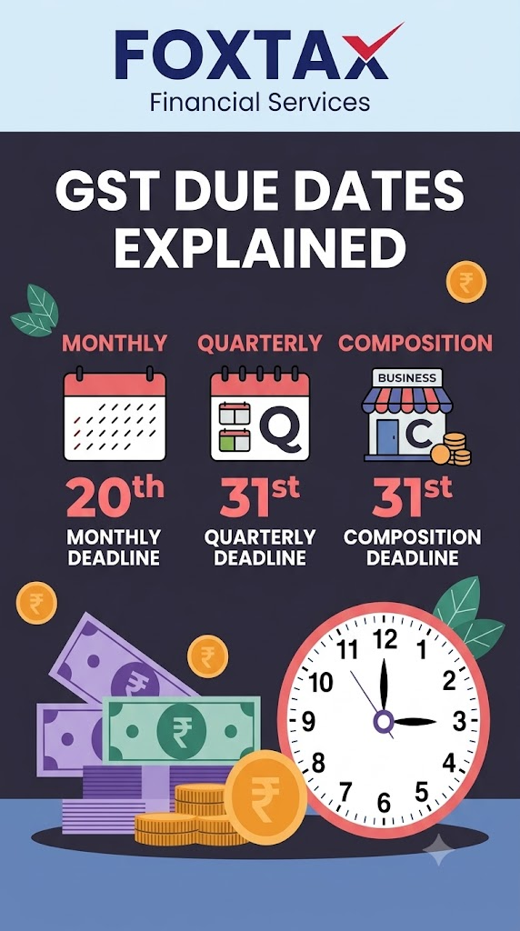
Quick Glance: GST Return Filing Due Dates and What to Do If You Miss Them
- File GSTR-1 by the 11th and GSTR-3B by the 20th if you file monthly.
- QRMP filers: IFF by the 13th, GSTR-3B by the 22nd or 24th after the quarter.
- Composition dealers: CMP-08 quarterly by the 18th and GSTR-4 by 30 June.
- Missed a deadline? File the belated return, pay tax plus interest and the auto-computed late fee before the cut-off.
- Track the turnover-linked caps, reconcile GSTR-2B monthly and keep portal contact details updated.
Conclusion
The GST return filing due date is not a formality – it is the trigger that decides whether a month costs you nothing or costs you money, blocked filings and eventually your registration. Build a compliance calendar, file nil returns without fail, and clear pending returns before the cut-off so the caps and the notices never come into play.
If managing this internally is becoming difficult, Foxtax helps businesses file returns on time, respond to notices and keep their GSTIN healthy. A few minutes of discipline each month is far cheaper than a year of cleanup.
FAQ
Is late fee applicable if I file a nil return?
Yes. A nil return also carries a reduced late fee of ₹20 per day (₹10 CGST plus ₹10 SGST), subject to the lower turnover-linked caps of ₹500, ₹1,000 or ₹5,000.
How do I pay the late fee and interest?
Both are auto-populated in the return you file and are paid from the electronic cash ledger along with the tax, split automatically between CGST and SGST.
Can a cancelled GST registration be restored?
Yes, through a revocation application within the prescribed window, but only after all pending returns are filed and the tax, interest and late fee are paid, or the department may reject it. See our guide to GST cancellation for the process.
Do I need to file GST returns if my business had no transactions?
Yes. Every registered taxpayer has to file returns even if there were no transactions during the period and failure to file nil return is also considered as a default for the purpose of blocking and cancellation.