


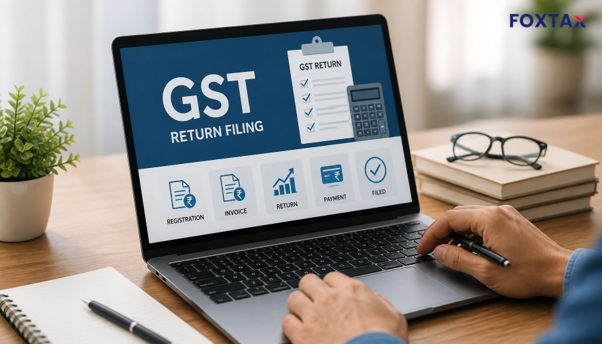
GST Return Filing is a routine filing cycle for every registered business in India. Reporting of a GST payer’s business transactions (sale, purchase, and tax payable) for all goods and services purchased and sold must be filed with the government.
Every individual who has an active GST registration account is required to file GST returns online. Amid 1.4+ crore GST registration accounts in India, if you make a mistake in a single return or miss your deadline, penalties, interest, and notices from the tax department are sure to follow. Here is a step-by-step GST return filing guide for every user.
What is GST Return Filing and Who Needs to File?
Filing a return simply means submission of the company’s income and expenses to the authorities. So, it is also known as a periodic statement of income and expenditure of the company. Yet when a company files the return, the tax department disposes of the income to tax the exact amount the company has to pay as taxes, considering the business existence.
GST return filing is similar to a periodic report card for business income, and the filing of returns could be quite frequent depending upon the volume of turnover, nature of business, and type of business also (regular or composition scheme). Even if a company does not have any sale or purchase transactions for the period, a ‘Nil Return‘ has to be filed by paying a sum of minimal tax.
Which GST Returns Apply to Your Business?
The initial requirement is to know the GST returns relevant to your business. Different types of forms are prescribed by CBIC (Central Board of Indirect Taxes and Customs) for different types of taxpayers.
If a wrong form is filed or missed, it could result in non-compliance issues. Identification of the relevant return is based on business type (e.g. regular taxpayer, composition dealer, e-commerce operator, etc.), annual turnover, registration as ISD or Tax Deductor, etc.
GSTR 1, 2B, and 3B: Understanding the Core Forms
There are 3 important forms for most regular taxpayers as they form part of the monthly/quarterly filing cycle. Here is a step-by-step guide to understanding their significance in the GST filing process step by step.
- GSTR-1 (Outward supplies): This is the main return for each sales transaction you have done during the prescribed period. For B2B sales, you will have to specify invoice-level details, and for B2C sales, you’ll have to specify a consolidated amount. This return contains the information from which your buyers will claim Input Tax Credit.
- GSTR-3B (Summary Return & Tax Payment): This is a summary return where you report your aggregate outward supplies, available ITC, and establish your net tax payable. This is the return on which you pay the tax to the government. The values as per GSTR-1 and GSTR-2B (auto-drafted ITC statement) are auto-populated in GSTR-3B.
- GSTR-2B (Auto Drafted ITC Statement): The GSTR-2B is a static statement specific to the month for you to view the eligible ITC based on the GSTR-1 filed by your suppliers. GSTR-2B is the ultimate document that offers an accurate summary of your purchase records and helps precise ITC claims. The complete transaction chain GSTR-1 → GSTR-2B → GSTR-3B maintains data accuracy in the system.
Documents Required for GST Return Filing
Before logging into the GST portal, make a collection of the required documents. It brings you all important information which is required to complete your online GST return without any disruptions. The quality of your filed return completely relies on the data you put in. If you are having a large number of transactions, then you may use accounting software or bookkeeping services or a professional in this practice such as Foxtax.
The primary documents you will need include:
- Sales Register: A complete listing of all invoices issued for B2B and B2C sales made within the return period.
- Purchase Register: A list of each of your inward supplies’ tax invoices. This also includes expenses.
- Credit and Debit Notes: Documentation of any sales returns, discounts allowed after sale (credit notes), or chargeable amounts (debit notes).
- GSTIN and login details: Your 15 digit GSTIN and login details for the GST portal.
- HSN/SAC Summary: Outward supplies summary by (SAC) Services Accounting Code and the same for goods by (HSN) Harmonized System of Nomenclature.
GST Return Filing Process: Step-by-Step Guide
Whether you file online or through third-party software, the GST return filing process is generally performed on the GST official portal, and so, needs to be signed off on or filed within the due date.
Adhering to an effective process allows you to effectively manage last-minute errors and portal issues, and generally consists of a three-step process involving preparation, reconciliation, and filing on the official portal.
How to File GST Return Step by Step Online?
Here is a simplified GST filing process step by step for a typical monthly filer:
- Log in and Choose Return Period: Sign into the GST portal through your login credentials. Go to the ‘Returns Dashboard’. Select the appropriate Financial Year and period (month/quarter) for return filing from the dropdown.
- Prepare and File GSTR-1: Opt to prepare your return online or prepare by uploading a JSON file created using Returns Offline Tool. Once you have provided all the details of the invoices, verify, submit, and file your return with your Digital Signature Certificate (DSC) or Electronic Verification Code (EVC).
- Reconciliation with ITC GSTR 2B: Get the GSTR 2B statement from the portal and match it to your purchase register. Focus on identifying discrepancies such as invoices that are not available or mistaken details. You might have to contact your vendors for rectification of their GSTR 1.
- Create and Submit GSTR-3B: Access your GSTR-3B, where the summary data from GSTR-1 and GSTR-2B will be pre-filled. Verify the details, fill in any eligible ITC not pre-filled, and confirm the amount of tax payable.
- Offset Liability and Submit: Use the available ITC balance in the electronic credit ledger to offset your output tax liability, while the remaining liability can be paid in cash through the electronic cash ledger via a challan. Now you can submit your return.
- Final Filing: After the return is submitted, the final step is to file the return with DSC/EVC. If the filing is successful, you will receive an ARN for your reference.
Due Dates and Frequency: Monthly vs. Quarterly Filing
You need to file all your GST returns by the due date, else it attracts a late filing penalty. Your filing will be quarterly for a taxpayer with an annual turnover of Rs. 5 crore or less under the QRMP scheme. Under that scheme, you need to file GSTR-1 and 3B every quarter and GST PMT–06 form to pay taxes on time each month.
Otherwise, the period will be monthly for those above that turnover threshold. A late-paid GST return is liable to penalty and an 18% interest rate per annum on the amount payable. Ensure you keep track of the compliance calendar properly to guide you.
Can You File a GST Return Without a CA?
Yes, it is free of cost for any registered taxpayer to do GST return filing on the GST portal. You can do self-filing of GST return on the GST portal as it is very user-friendly. Whether you avail the services of a CA to file GST return depends on the nature of your business. You can do GST filing without a CA, but there is a higher risk of mistakes in calculating ITC and filing returns, which can cause notices and additional financial penalties.
In the event that you run a more complicated inventory, have multiple branches, or have a large B2B business, specialist knowledge can be extremely useful. Professional services like Foxtax will file your GST return on your behalf, claiming your ITC and lodging the return on time to keep you compliant.
Late Filing: Penalties, Interest, and Consequences
You will have to pay a fine if you do not file your GST return on time. The late fee for delayed GST returns is Rs. 50 per day (Rs. 20 for Nil returns) for each return.
In addition, interest at 18% per annum is also charged on your net tax liability if paid after the due date. Apart from the monetary penalties, continued late submission or non-filing will lead to suspension of your GSTIN and blockage of e-way bill generation and assessment proceeding initiation by the tax department. You can read more about GST cancellation and suspension.

Quick Glance: GST Return Filing Checklist
- Know which of your returns apply to your type of business.
- Settle your sales and purchase tally in the file before you file in.
- Cross-check your ITC claim through GSTR-2B.
- File GSTR-1 to report all outward supplies for the period.
- Cross-verify the auto-filled data in GSTR-3B.
- Use cash and ITC to offset tax.
- Submit the returns electronically (DSC or EVC) before the specified due date.
- Maintain the ARN of each return filed.
- Download the official GST return filing complete guide for businesses in India PDF available from the portal.
Dealing with the complexities of GST return filing is paramount for all businesses to stay in the good books of the tax department. It helps in providing a steady flow of input tax credit and in avoiding any dues to the tax department.
To make the process as simple as possible for you, experts like Foxtax can take charge of your entire filing regime, giving you time to expand your business with less stress of being compliant.
Frequently Asked Questions (FAQs)
Q1: What happens if I miss a GST return filing due date?
A: A late fee is payable for each day or part of a day that a due date is missed, for payment of tax. Also, if a tax liability is paid late, 18% p.a. interest will be charged. Persistent non-filing can result in your GST registration being suspended.
Q2: Can I revise a GST return once it has been filed?
A: No, the GST return cannot be revised. Yet, a mistake or a missed detail in the return can be rectified in the return of the next tax period. For instance, if an invoice has been overlooked in the GSTR-1 of January, it may be added to the GSTR-1 of February.
Q3: Do I need to file a GST return if my business had no sales or purchases?
A: Yes, you have to do a Nil return if there has been no business during the period. Submission of Nil return is a legal requirement for all registered taxpayers, and it’s crucial for remaining compliant.