



Tax Deduction at Source (TDS): A Complete Guide for Indian Taxpayers
For most Indians, the very mention of “Tax Deduction at Source” or TDS sounds like a daunting financial menace. But, it is one of the most potent and handy tax collection instruments rolled out by the Government of India. You might be a salaried staff, a freelancer, or an entrepreneur, and still TDS affects pretty much all your major money dealings.
Getting a hold of the main features of this system will enable you to steer clear of last-minute tax surprises, stay up to the mark, and maybe even lower your outlay with planning. Here is this handbook wherein we will dissect TDS, its operation on your salary, rental and fixed deposit provisions, and many more, all made easy for the Indian taxpayer.
What is Tax Deduction at Source (TDS) and How Does It Work?
The Tax Deduction at Source (TDS) is basically a system where the payer (deductor) deducts a certain percentage of tax from the payment they are making to the payee (recipient). The deducted sum is then paid to the Income Tax Department by the payer on the payee’s behalf.
It is, in essence, a method of collecting tax in advance that also ensures that the government receives its share of the revenue directly at the source of the income thereby limiting opportunities for tax evasion.
A newbie will find the method quite straightforward. When you get paid for your work via salary, rent, or interest, the payment giver rarely hands you the full amount. They work out an approximate tax amount using the rates fixed in the rules, withhold this amount from you, and give you the rest. Take your professional fee as an example.
If the amount is Rs.50,000 and the applicable TDS rate is 10%. The person paying you will then give you only Rs.45,000 and pay Rs.5,000 to the government. This system tightly links the deductor, the deductee, and the tax department in a clean and clear chain.
Key Income Sources Subject to TDS and Applicable Rules
The scope of TDS is much wider than that of monthly salary. Per the Income Tax Act, a tax deducting scheme has been developed to include almost all income sources to maintain a regular revenue stream.
Mentioned below are some common instances where an Indian taxpayer generally encounters TDS in his/her daily life.
1. Deduction of Tax at Source from Salary
This is the channel through which most people will encounter TDS for the first time. Under section 192, TDS is deducted by your employer based on your total estimations of income for the financial year. The withholding amount aligns with the income tax slab rates that are effective in the concerned year.
The employer will adjust the taxable income and correspondingly the TDS deducted from your monthly salary will go down if you provide investment proofs for deductions under section 80C (like PPF investments, ELSS etc.) or 80D (health insurance). Your employer will give you Form 16 after the end of the year. This paper is very useful when you prepare your Income Tax Return (ITR).
2. TDS for Rental Income
When the total annual rent received is above Rs.2,40,000 for the use of plant, machinery, or equipment or if the monthly rent of residential property is more thanRs.50,000, in either case TDS will be deducted. In case of residential or commercial property rent, the tenant has to deduct TDS at the rate of 2% (for individuals/HUF not liable to audit: as per the new rates under section 194-IB) or 10% (under section 194-I for others).
This method encourages reporting of rental income. If you get high rentals as a landlord, you must get your tenant’s TDS certificate.
3. TDS Deduction on Fixed Deposit
Banks and post offices deduct TDS on the interest earned from Fixed Deposits (FDs). If the total interest from all your FDs in a bank branch exceeds Rs.40,000 in a financial year (Rs.50,000 for senior citizens), the bank will deduct TDS at 10%.
If you have not provided your PAN to the bank, the deduction rate jumps to 20%. To avoid this, you can submit Form 15G (or Form 15H for senior citizens) if your total income is below the taxable limit, requesting the bank not to deduct TDS.
4. TDS on Contractor Payments (Section 194C)
Under Section 194C, TDS is applicable on payments made to contractors or sub-contractors for carrying out any work (including advertising). For an individual or HUF, the TDS rate is 1%, while for others (like companies), it is 2%.
This is common in the construction, event management, and transportation industries, ensuring that tax is captured at the very beginning of the business supply chain.
Comparison: Key TDS Rates for Different Payments (FY 2024-25)
First of all, here is a clear picture of the most common TDS sections and their TDS rates for paying Indian residents.
Keep in mind that the existing rates are for those payee taxpayers who have submitted the PAN, those who haven’t are charged at the 20% highest rate (usually).
| Nature of Payment | Applicable Section | TDS Rate (Resident) | Threshold Limit (Annual) |
| Salary | 192 | Slab Rates | Basic Exemption Limit |
| Rent (Plant/Machinery/Property) | 194-I | 2% (Property)/10% (Plant) | 2,40,000 (commercial Rent)/ 50,000 (Monthly Rent) |
| Interest on Securities / FD | 194A | 10% | 40,000 (50,000 for Senior Citizens) |
| Professional / Technical Fees | 194J | 10% | 30,000 |
| Payment to Contractor (Individual/HUF) | 194C | 1% | 30,000 (Single)/1 00 000 (Aggregate) |
| Commission / Brokerage | 194H | 5% | 15,000 |
Critical Rules for TDS Deduction and Compliance Deadlines
Knowing when to deduct TDS properly is almost as important as knowing how to do it right. Besides, the government has prescribed certain timelines within which TDS deposit should be made. The tax deducted in one month has to be deposited by the 7th of the next month. For the month of March, the payment has to be made by 30th April. You might get caught up in interest at 1.5% per month (compounded monthly) on the amount of TDS that has not been deducted or deposited if you do not pay your TDS on time.
Besides that, the deductor needs to make TDS certificates. For non-salary payments, the TDS returns are filed with TDS certificates being the official evidence of payment of tax. For this, the deductor is given fifteen days after the return due date to provide these certificates.
Form 16 (for salary deductions) must be provided by June15 of the year following the end of the financial year. Form 16A for non-salary payments must be issued within 15 days from the due date of TDS return filing. Such negligence can even lead to non-recognition of the expenses during company audits, so it is quite crucial that you remain well-organized.
Final Checklist: TDS Compliance for the Common Taxpayer
Before you finish reading, here is a quick glance at the essential steps any Indian taxpayer needs to master TDS:
- Provide Your PAN: Always link your PAN with your bank accounts and inform your deductor (employer, tenant, bank) to avoid getting a higher 20% TDS deduction.
- Check Form 26AS: Check your Form 26AS regularly on the Income Tax e-filing portal to confirm that all TDS deducted by others is credited to your account.
- File Nil Returns if Needed: Even if no TDS has been deducted in a quarter, businesses having a TAN may be required to file a “Nil” TDS return not to receive any notice.
- Submit Form 15G/15H: If your income doesn’t reach the taxable limit, submit these forms to your bank or other deductors to stop the Tax Deduction at Source on interest.
- Claim TDS Credit: When filing your ITR, you can claim credit for all TDS credited to your account as per your Form 26AS and if you have paid excess tax, you will get a refund.
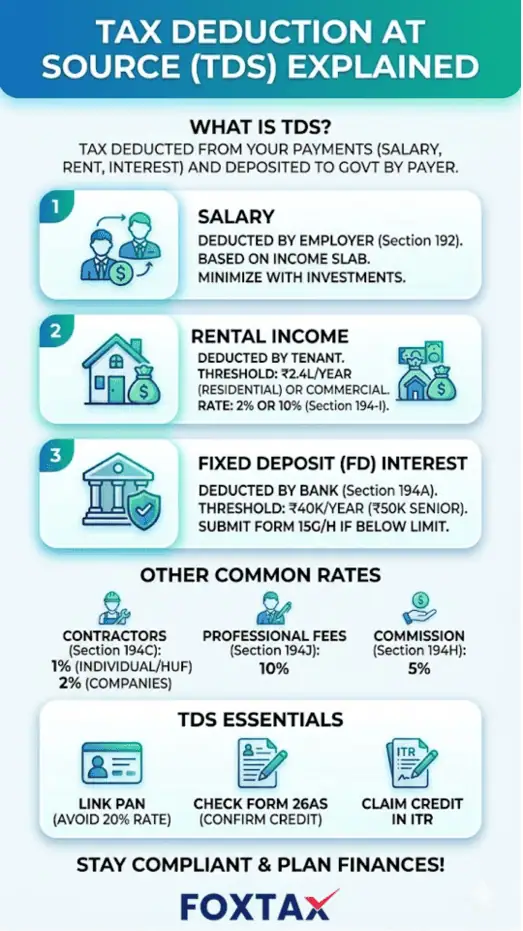
Infographic explaining tax deduction at source
Conclusion
Comprehending Tax Deduction at Source is a requirement of law, and understanding it as a financial strategy is a matter of intelligence. TDS makes your tax saving plan strict and also safeguards you against the scenario of heavy tax payment for the whole year by a single tax payment. Your tax deduction gets done almost everywhere, be it the salary credited to you or the rent paid by you or the interest credited to you on fixed deposit.
Managing these deductions manually can be very tiresome, but having a trusted partner like Foxtax to automate your compliance, help you evade penalties, and align your finances with the government is a perfect solution. No matter if you are a salaried individual or a businessman, getting hold of your TDS is the right way of achieving complete financial transparency.
Frequently Asked Questions (FAQ)
What is the difference between TDS and TCS?
The main point of difference is the time of collection. TDS (Tax Deducted at Source) is deducted from the payment made to a person (e.g. salary paid to an employee). TCS (Tax Collected at Source) is raised by the seller from the buyer when the sale of specific goods takes place (e.g. selling scrap, timber, or cars above 10 lakh). So, while TDS is a deduction, TCS is a collection on sale of goods.
What is Section 194C 1% and 2% TDS?
Section 194C relates to providing the contractor’s services. The TDS is deducted 1% if the contractor (payee) is an individual or a Hindu Undivided Family (HUF). The rate is 2% if the payee is any other entity like a private limited company or partnership firm. This applies to works contracts where labour is supplied also.
What if the deductor fails to deposit my TDS to the government?
If the deductor has filed their TDS return showing the deduction, then you, the payee, will still get TDS credit in your Form 26AS. But, if the deductor has deducted tax from your payment and not deposited it with the government, you cannot get TDS credit. In this case, the deductor may face heavy penalties (interest) and even prosecution besides other functionalities, but you may need to follow up with them or the department to claim your rightful credit.
Can a person with no taxable income avoid TDS deduction?
Yes. You can avoid TDS if your total income for the financial year is below the basic exemption limit (presently 2.5 lakh for individuals below the age of 60 years). If the interest earned is from the bank, you are required to give Form 15G (or Form 15H for senior citizens) to the bank right at the start of the year. To not have TDS on rent or other payments, you need to file Form 13 with the Income Tax Officer to get a certificate for NIL or lower TDS deduction.