



The Limited Liability Partnership (LLP) has become one of the most popular business forms in India after the enactment of the LLP Act, 2008. It is the perfect combination of a traditional partnership and the limited liability protection of a company, but the secret that helps an LLP function smoothly is an LLP agreement—a document that guides and sets out rules on how the partnership will be conducted and what each partner can expect.
What Is an LLP Agreement?
An LLP agreement (also known as an LLP contract or limited liability partnership contract) is a written document that contains agreements among partners in a Limited Liability Partnership and sets out the rights, duties, and responsibilities of partners.
Subject to the LLP Act of 2008, this contractual agreement serves as the partnership’s internal regulation. It covers everything from profit-sharing and capital contribution to admission, withdrawal, and expulsion of partners, as well as dispute resolution. Therefore, it should be one of the most important documents for an LLP.
What Is the Purpose of an LLP Agreement?
The main purpose of the LLP agreement is to set out the operating procedures of the LLP and protect the partners’ rights and interests. It clarifies who should be responsible for what, how decisions can be made, how profits should be shared, and what will happen if a partner leaves. The LLP Act doesn’t cover everything; because of this, the agreement is used to cover the unaddressed aspects and is considered first when solving disagreements.
Which One Is Better, PVT Ltd or LLP?
| Aspect | LLP | Private Limited Company |
| Liability | Partners have limited liability | Shareholders have limited liability |
| Compliance requirements | Relatively easier with quarterly filings | Compliance is more stringent requiring board meetings, audits, annual filings |
| Taxation | No dividend distribution tax | Dividend distribution tax applies (depends on the regime in place) |
| Fundraising | Equity can only be issued to existing partners who can raise their capital | A company has the facility of raising funds by issuing shares to outsiders. It can also get investment by venture capital |
| Management | Open environment where partners themselves carry out the day-to-day activities | Closed environment where the board of directors governs the business. Directors make the main decisions and execute them |
A small or medium-sized firm of professionals and start-ups whose business does not depend on outside funding will benefit from going through the LLP route, as the LLP registration and maintaining its status is easier and less onerous. In addition, there is a much lower compliance burden for LLPs.
On the other hand, a Private Limited Company is much better when it comes to raising external equity. If a startup has a dream of getting angel or venture funding, a Pvt Ltd would be the preferred form as it permits equity dilution. For a detailed comparison, you can review our guide on LLP vs Private Limited Company.
What Is the Disadvantage of LLP?
No business structure is flawless, and LLPs also come with some drawbacks. Here are the principal disadvantages for you to consider before taking the LLP route:
- Restricted funding avenues – It is impossible for an LLP to offer equity shares or convertible instruments to external investors. This seriously curtails its ability to attract investment capital from a wide variety of sources such as angel investors, venture capitalists, or private equity firms.
- Increased burden of compliance compared to a regular partnership – Although lighter than a company, an LLP still needs to file statements of accounts and solvency every year, undergo mandatory audits given turnover thresholds, and conform with the LLP Act, 2008. Our compliance services can help manage these obligations.
- Restricted scope of tax optimization – LLPs are not allowed by the Act to use several exemptions that would otherwise be enjoyed by a company, and partner remuneration is under deduction limits, thereby lowering overall tax flexibility.
Can LLP Pay Salary to Partners?
Yes, an LLP can give salary or remuneration to partners, provided that it is clearly specified in the LLP agreement. Any salary paid to partners must strictly follow the terms and profit-distribution rules as explained in the agreement. As per income tax law, the allowance to a partner is limited to deduction and it doesn’t constitute a “salary.” Instead, a partner’s allowance is treated and taxed as the partner’s business income itself.
Is LLP Agreement and Partnership Deed Same?
This is probably the topmost issue that entrepreneurs get confused with. Although LLP agreements and partnership deeds seem alike, they are different from one another as per law. Partnership deeds, executed under the Indian Partnership Act, 1932, do not protect partners legally from unlimited liability.
Then again, LLP deeds governed under the LLP Act, 2008, give a legal right of limited liability to partners. In a nutshell, a partnership firm is governed under a partnership deed, whereas it is the LLP agreement for an LLP. If you are considering a traditional partnership, you may want to review the partnership firm registration guide to understand the differences better.
LLP Agreement Format: PDF, Word and Sample Templates
A standard LLP agreement usually contains information about your company, partners and their names and addresses, capital contributions, share of profits, role of management, name and details of designated partners, method and schedule of meetings, and the process of dispute resolution among the partners.
You can get a sample or a PDF of an LLP agreement format online. It is always good to refer to a few examples when you prepare the LLP agreement. Still, it would also be prudent to remember that the agreement is a very legal and specific matter for the business, and it has to be customized keeping in mind the unique characteristics of the business and the expectations of different partner members.
How to Amend an LLP Agreement: Supplementary Deed and Form 3
All sorts of changes in an LLP agreement—be it changing profit-sharing ratios, admitting or retiring partners, relocating the principal place of business, or amending the capital structure—are considered amendments. Such amendments are to be documented by filing LLP Form 3 with the Registrar of Companies. After that, partners make a supplementary LLP agreement as evidence of that amendment.
It is also advised not to delay submitting the document after making changes, since a late submission could expose the business to penalties and compliance difficulties. At Foxtax, our expert team will help clients with drafting, legal review, and filing these amendments accurately so that they remain fully compliant at all times.
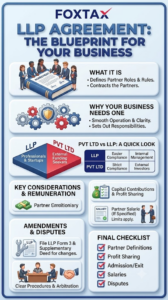
Final Checklist for Your LLP Agreement
- Clear definitions of partners, designated partners, and business scope
- Profit-sharing ratio and capital contribution terms
- Provisions for admission and exit of partners
- Remuneration and salary clauses for partners
- Dispute resolution mechanism, including arbitration
- Compliance procedures and LLP Form 3 filing timelines for amendments
Conclusion
To wrap up, an LLP agreement is a fundamental document through which the partnership’s internal governance is carried out, and doing things correctly here can save you from expensive litigation and regulatory actions by the government. Whether it is about starting a new LLP or making changes to an existing partnership agreement, hiring a professional could make a significant difference compared to doing it by yourself.
Foxtax offers assistance from start to end in drafting, amending, and compliant filing of an LLP agreement, so you can devote your attention to growing your business without any worries.
FAQ
Where can I download an LLP agreement PDF?
LLP agreement templates in PDF or Word are available for download from legal service portals or Chartered Accountant websites. Even so, templates do not suit all cases, and it is always wise to get your business-specific agreement customized and have a professional review before signing.
Is it mandatory to register an LLP agreement in India?
In India, an LLP agreement is to be filed with the Registrar of Companies within 30 days of incorporation. LLP Form 3 is to be submitted online along with the agreement through the MCA portal.
Can an LLP agreement be verbal?
Although an LLP agreement can be verbal or written, a written agreement is highly recommended. In written form, the document offers more legal protection, helps in conflict resolution, and it is a necessity to file it with the Registrar of Companies.