



Any business in India that deals in export should know and understand GST for export. Although the Goods and Services Tax in India considers an export as being a supply without any GST, that is, the product or service going out to other countries from India doesn’t bear any GST, but the part of export compliance is done through proper documentation and refund claims at the right time, and also by choosing between the two main export options: paying IGST and getting refunds or under a Letter of Undertaking (LUT), exporting without paying IGST.
If you get things mixed up, the consequences include loss of cash flow for working capital block, delay in refunds and the penalty part too. In this article, we will walk you through all the essential rules, steps & tips to maintain your export business fully within the scope of GST law while cash flow is optimised.
What Is GST for Export and How Does It Work?
GST Act offers zero rate for export goods/services to the extent to which the supplier has to pay nil tax. Export of the goods is allowed to be free from the tax, and the exporter is eligible to claim a refund of the taxes paid during the production, that is, the taxes paid on procurement of the raw materials and services that the exporter has used to make the goods or provide services.
Exporting with the payment of IGST on a bond or through a Letter of Undertaking (LUT), or exporting with no payment of IGST under a LUT are the two ways that you can do the export and get it zero-rated. In either case, the exporter will recover or reimburse them for the taxes incorporated in the exports, this way keeping Indian exports competitive with no extra burden of cascading taxes.
Why Is GST Registration Mandatory for Export Businesses?
One of the myths that small-scale or new exporters might believe is that they are not required to register if their turnover is less than or equal to the threshold. But, no matter the total turnover with such businesses engaged in importing or exporting, GST registration is a legal formal requirement that cannot be waived. Lacking such registration you would not be capable of legal export invoicing, claiming zero-rating of supplies or filing for return of Input Tax Credits.
Running without registration is quite risky for a business. Besides, not getting your Input Tax Credit, you have to risk paying a penalty, facing legal action as well as other negative effects. GST compliance is also legally fundamental for a few other export processes, like preparing the export invoice, shipping bill, bill of lading, and realization certificate of a bank, to name a few of them. Because of this, registration under the GST is the first prerequisite or condition that cannot be avoided by any export business.
Export of Services Under GST: Key Rules and Compliance
The rules for export of services under GST is based on Section 2(6) of the IGST Act. A service rendered by an Indian supplier to a foreign recipient, for payment to be received in foreign currency, and the place of supply is outside India is an export of services by an Indian service provider.
The place of supply as per section 5 and 10 of the GST Act will form the location where the supply took place, and if it is abroad, the supply qualifies for export and the exporter can claim refunds of the Input Tax Credit.
A common mistake among service providers is that any service provided to a foreign client is considered an export by the Indian service provider, but this is not always true. In fact, if the supply location is regarded as being in India, a foreign architect who designs a building in India would not be considered as exporting that service. Because of this, a local GST would apply. So, make sure to have the correct determination of the place of supply per the IGST rules to prevent an error in taxation that might cause audits.
Conditions to Qualify as Export of Services
The four principal conditions required by tax provisions for a service to be an export are simple but all four have to be fulfilled at the same time.
- The supplier has to be Indian
- The recipient has to be outside India
- The supply should happen in the country specified by the place of supply rules
- Only if the payments of services exported in foreign currency are made and realized within FEMA norms as prescribed by the government at the time of export, and so on
Filing a Letter of Undertaking for Service Exports
Those service exporters who go for the LUT option have to file a Letter of Undertaking on the GST portal before they make an export. A letter of undertaking is valid for a year so you have to renew it every year. It’s easy as the process is online. Once the LUT is accepted, the exporter issues invoices without charging IGST and there is no need to pay GST to the government.
This method suits exporters who want to avoid blocking working capital by depositing IGST payments while waiting for the refund of their input tax credit which they collected over time, i.e. going through the other route. For detailed guidance on this process, check out our guide on GST LUT Letter of Undertaking filing.
Understanding Deemed Export and Its GST Implications
Based on the Indian tax laws, there is a concept of deemed export under GST which means the actual export didn’t take place but still, they get the advantage of export. Some examples of such deemed export cases are – supply to an SEZ, supply against EPCG license as well as supply to projects backed up by specific international bodies.
If your supplier is dealing with deemed exports, they can claim not only the Input Tax Credit Refund but also the person receiving the goods has the option of the ITC. Though, the paperworks would be unlike the physical exports and certain forms would be required to be submitted with the refund application.
That’s why, recognizing the circumstances when a transaction is a deemed export can greatly increase the benefits available under tax without the need of exporting and importing.
GST on Export of Goods: Procedures and Documentation
There are several procedural steps when it comes to a taxpayer exporting goods subject to GST on export of goods, one of them being correct classification via use of HSN codes and generation and the linkage of the export invoice with the shipping bill on the ICEGATE portal.
The exporter needs to firstly, pay the IGST for exports made in such a way that they are paid by either cash, or using the Accumulated Input Tax Credit, and then they file the refund about that through Form RFD-01.
When it comes to an exporter who does exports under the LUT, there is no payment of IGST, the person can though claim a refund of the unutilised ITC. It would be good if the exporter also puts on the invoice that a supply is being made for an export and the name of the country of destination and when it comes to an LUT, put the LUT number. Getting the reconciliation right between GSTR-1 data and ICEGATE shipping bill data is key if you don’t want your refunds to be delayed or your application to be rejected. Learn more about proper GST filing and compliance to avoid common pitfalls.
How to Choose Between LUT and Paying IGST for Exports
To make a smart decision for you, let us understand what the factors are.
In fact, your company’s Input Tax Credit availability and the amount of capital the company calls for operations will be the biggest factors to consider. Exporting in the manner where an exporter is not liable to deposit IGST in the export transaction is the general choice because this way of doing things is less likely to result in a part of the company’s finances getting trapped from payment of IGST. On the contrary, it also means that you have the possibility of getting a refund on the ITC you could not use. So a company with a lot of ITC such as those manufacturers that bring in their raw materials are a good match for this kind of exporting.
In some cases exporters who have a shortage of ITC will choose to export under bond/LUT+_payment because they wish to recover their IGST payment quickly and this process is sometimes faster than their ITC refund.
| Point | Export Without Depositing IGST | Export with IGST Payment |
| Payment | No IGST paid at the time of exporting | Yes, IGST paid by using ITC or cash if any |
| Type of Refund | Refund of unutilised Input Tax Credit | Refund of the amount you paid as IGST |
| Working Capital Impact | The business owner gets to retain the cash as he/she can get ITC refund due to zero-rated exports. | It could result in a block of a business owner’s cash as the refund may take some time. |
| Suitable | It suits the companies having high Input Tax Credit (ITC). | Those with low ITC would find it best to proceed this way. |
| Filing requirement | A valid LUT shall be filed by a registered person under section 164 of the CEA, with the proper officials of the Government. | A Bond or LUT with Payment is filed. |
| Refund Timeline | It may take a while, as the case involves a refund of unutilised ITC that is not used. | Often very fast. |
Understanding the Export GST Rate for Goods and Services
The export GST rate for your export is zero, since export is a ‘zero rating supply’. But the rate based upon which IGST can be deducted if goods/services were sold domestically decides the refund amount that you will get back.
With goods, the applicable IGST rate is dependent on the HSN code of the goods. Meanwhile, in the services, the rate is determined by the SAC code. When exporting via the LUT route, you do not pay any GST and the refund of the ITC (unutilised) is based on the formula prescribed in the GST rules which takes into account the amount of the zero-rated supply and your total turnover.
Getting clarity of the fundamentals of such rate structures helps one not only to accurately calculate refund eligibility but also prevents refund applications from being made with errors.
GST Refund Process for Exporters: Step-by-Step Guide
Exporters’ GST refund is one of the areas in which compliance is of vital importance as any mistake made at this point often means rejection of a valid claim or delay in its release.
In RFD-01 form, you have to upload the required documents of a refund claim and file it online at the GST portal. Also, make sure to remember that you should file it within 24 months of the date (e.g.). Generally, such a date is at the end of the financial year in which the exported goods or services were the focus.
The necessary papers to include will be your export invoice, LUT document, shipping bill (if the product exported is goods). The documents also contain bank realization statements or inward outward remittance statements and proof of receipt of the foreign currency.
The main elements to avoid a smooth refund experience would be accurate keeping of records, submission of the forms in time and verification of GSTR-1 data with that of ICEGATE to ensure there are no data mismatch issues. For professional assistance with your refund claims, explore our GST returns filing services.
Final Checklist for GST Compliance for Export Businesses
When you close your books for the financial month/year, before that make sure you have done the following important steps for smooth GST compliance:
- Check your GST registration and see if it is active and valid for export activity
- Before the commencement of each financial year, file your Letter of Undertaking (LUT) if you decide to go for LUT
- Correctly classify all goods and services by their HSN or SAC codes
- Prepare export invoices, which should clearly specify the nature of the supply as zero-rated one and carry the number of LUT
- Export supplies shall be separately reported in Table 6A of GSTR-1 unlike domestic supply cases
- Carry out matching of the GSTR-1 data with shipping bill data from ICEGATE every month
- In Form RFD-01, submit refund application(s) within the stipulated time, i.e. two years
- Keep all export-related documents including export invoices, copies of LUT, shipping bills, and bank realization certificates safely
Diligently completing these items will secure your export business against compliance issues and help you to get the Input Tax Credit you deserve.
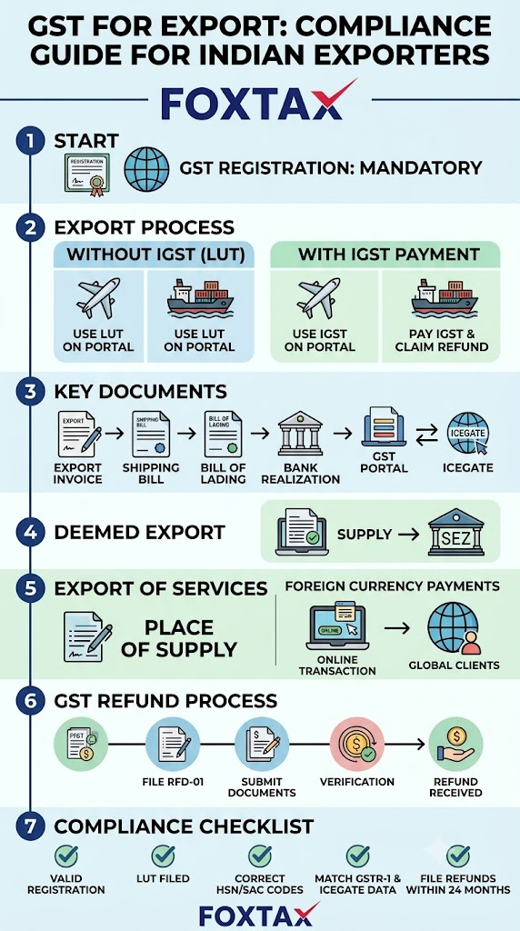
Conclusion
It is a big challenge to comply with GST when you are an exporter. The rules about goods supplies that are zero-rated, the selection of either payment of IGST or a LUT and the detailed paper documentation and proof in connection with claims for refund can be really tough areas in particular for inexperienced exporters who have to go through the learning curve.
Though, with the aid of this article, export houses of India should be able to not just follow the compliance requirements but also be in a better position on working capital and tax recovery if the article is used correctly.
Looking for a partner who can help automate your compliances and refund process? Foxtax is the only GST compliance system that is more exactly intended for export-oriented businesses. In such a case, the use of Foxtax will relieve one of worries over the daily compliance matters and allow one to concentrate exclusively on running the export business and international trading.
Frequently Asked Questions
Is GST registration mandatory for all export businesses in India?
Yes, GST registration is mandatory for any business engaged in export of goods or services, regardless of turnover. Without registration, you cannot claim zero-rated supply benefits or file for refunds.
What is the difference between LUT and bonds for export under GST?
A Letter of Undertaking (LUT) is a simple online declaration that does not require any security deposit. A bond, on the other hand, requires a bank guarantee or surety. Most exporters prefer LUT for its simplicity and zero cost. You can file your GST LUT Letter of Undertaking online through our platform.
Can I claim a refund of IGST if I export under LUT?
No, when you export under LUT, you do not pay any IGST. Instead, you claim a refund of the unutilised Input Tax Credit (ITC) accumulated on your inputs and input services.
What is the time limit to file a GST refund claim for exports?
The refund claim must be filed within two years from the relevant date, which is generally the end of the financial year in which the goods or services were exported.
Are services provided to foreign clients automatically considered exports under GST?
No, not all cross-border services qualify as exports. The place of supply must be outside India as per IGST rules. For example, services related to immovable property located in India are not exports even if the recipient is abroad.