



Knowing about NRI taxation is a must for any NRI earning money through any means in India. With the end of financial year 2025-26 and assessment year 2026-27 upon us, the aspects around tax for NRI individuals have been revamped quite a bit, mainly after the 2026-27 Union Budget.
Regardless of whether you have rental income, capital gains, or interest from Indian securities, awareness about tax handling can ensure your tax compliance and even help you save money. Here, we explain the aspects from how to figure out your residential status to the latest TDS methods on property sales.
What is NRI Taxation and How is it Determined?
NRI Taxation basically means income tax rules that are applicable to Non Resident Indians who earn money in India. One major concept is that NRIs will only be taxed on the incomes that they have earned or have been received in India. This is called the source rule of taxation. You do not have to pay Indian taxes on your worldwide income like your foreign salary or the returns of your foreign investments.
Knowing your non resident indian income tax begins with figuring out your residential status as per Section 6 of the Income Tax Act, 1961 which is the main criterion. You are a Non-Resident if in that particular financial year, you are in India for less than 182 days. Still, if you stay in India for 60 days or more in that year and during the last 4 years you cumulated to 365 or less, then you qualify as an NRI as well. Your residential status controls what kind of income will be taxable.
Income Tax Slabs for NRIs for FY 2025-26 (AY 2026-27)
When it comes to income tax for NRI individuals, one of the frequently asked questions is about the tax slab applicable to them. In fact, the income tax slab rates for NRIs are the same as those of resident individuals under the respective tax regime. For the financial year 2025-26, you have the choice between the Old Tax Regime and New Tax Regime.
If you choose the New Tax Regime (which is the default option), then these tax slabs are applicable for NRIs:
| Income Range | Tax Rate |
| Up to ₹4L | Nil |
| ₹4L–₹8L | 5% |
| ₹8L–₹12L | 10% |
| ₹12L–₹16L | 15% |
| ₹16L–₹20L | 20% |
| ₹20L–₹24L | 25% |
| Above ₹24L | 30% |
Do not forget that a 4% Health and Education Cess is also added to the tax computed and a surcharge may be levied if your total income is more than ₹50 lakh.
What is the Tax Slab for NRI in India for AY 2026-27?
The tax slab for an NRI in India in AY 2026-27 will be the same as for a resident Indian. So, you will have the option to take two routes: Old Regime (with deductions like 80C) and New Regime (with lower rates but fewer deductions). In reality, the New Tax Regime is simpler and more profitable for the majority of NRIs as these individuals usually do not have any significant Indian deductions.
TDS on NRI Income: Rental Income and Property Sales
Tax Deducted at Source (TDS) is one of the most important aspects of tax for NRI compliance. The person paying you (e.g., a tenant or a property buyer) is obliged to deduct TDS before remitting the amount to you.
TDS on Rental Income for NRIs
Should you be an NRI landlord deriving rent from the property situated in India, your tenant will have to deduct TDS at the rate of 30% (immediately adding 4% cess, total becomes 31.2%) for making the payment of rent to you. This is one of the highest TDS rates applicable in India right now. But, if your overall tax liability is less than the standard rate, you may apply for a lower TDS certificate as per Section 197 of the Income Tax Act.
New Rules for NRI Property Sellers (Union Budget 2026-27)
One of the major notifications in the Union Budget 2026-27 is making capital gain tax for NRI easier for property sellers. From 1 October 2026 onwards, the purchasers of the property from NRIs can source TDS by using only the seller’s PAN (Permanent Account Number). Before this, they’d need the TAN (Tax Deduction and Collection Account Number) of the buyer, which was causing a considerable compliance burden. This modification of course eases the property selling process for both parties. For a detailed breakdown, refer to our complete guide on TDS for NRI property sale.
How to Calculate 182 Days for NRI Status
One of the frequently asked questions is how to calculate 182 days for NRI status. This depends on the number of days you were physically present in India during the financial year (April 1 to March 31). A physical count of the days spent in India is the way to proceed.
If the count is less than 182 days, you can be considered as Non-Resident for that year. It is advisable to maintain your travel log or use your passport stamps for the accurate day count. Though, once you reach the mark of 182 days or more, you can be considered as a Resident (ROR or RNOR) and, because of this, your global income becomes taxable in India.
ITR Form for NRI with Only Interest Income
If you only derive interest from savings accounts or fixed deposits as your source of Indian income, then it’s obligatory to submit an ITR form for NRI with only interest income. Most of the time, ITR-1 (Sahaj) is the right choice provided your total income is less than ₹50 lakh and there’s no inclusion of capital gains or business income.
If you have other types of income like rental income or capital gains, you will have to go for ITR-2. You can find more details in our comprehensive ITR filing guide for 2026.
Quick Glance at NRI Taxation in India (FY 2025-26)
Use this quick checklist to manage your taxation as an NRI:
- Establish Residential Status: Check your days of stay in India (less than 182 days) to confirm NRI status.
- Determine Taxable Income: Only the income which is earned or received in India is taxable; foreign income is exempt.
- Pick a Tax Regime: Mindfully select the Old or New Tax Regime considering your deductions and income sources.
- Get Acquainted with TDS Rules: Be informed about the standard TDS rates (e.g., 31.2% on rent); and also know how to apply for a certificate of lower tax deduction if necessary.
- Use the Correct ITR Form: Choose ITR-1 for filing returns only on interest income or ITR-2 if you have capital gains and rental income.
- Keep Yourself Informed About New Rules: Utilize the new simplified TDS compliance on property sales by using PAN starting from October 2026.
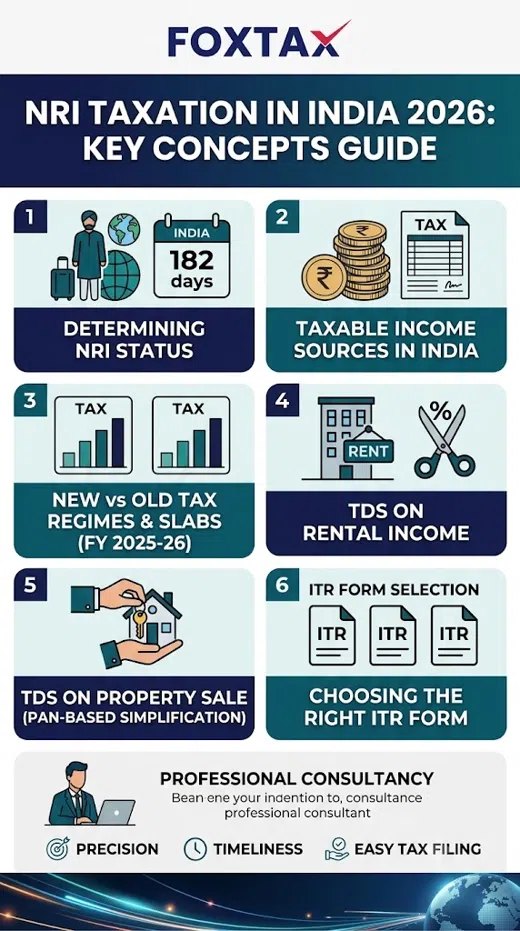
Conclusion
Knowing about NRI taxation will not only help you in dealing with your finances but also in complying with Indian laws. From the basic source rule up to the latest Union Budget 2026-27 related amendments for property sellers, keeping yourself informed is the best way to stay disciplined in tax payment and optimize your tax burden.
First of all, understanding your residential status should be your main focus. Further, apply the tax slab and TDS rules accordingly. For custom help and professional consulting in your income tax for NRI requirements, you can always rely on Foxtax. Our efficient team is committed to precision, timeliness, and making your tax filing a breeze so that you can comfortably settle overseas. Explore our specialized online tax consultant services for NRIs for more tailored assistance.
Frequently Asked Questions (FAQ)
What is the income tax slab for NRI AY 2026-27?
About the income tax slab for NRI AY 2026-27, it is actually the same as for resident Indians. The basic exemption limit under the New Tax Regime is ₹3 lakh, and tax rates go up to 30% for higher income brackets. Also, a 4% cess and surcharge apply as per the norm.
Is foreign income taxable for a Resident Indian?
Yes – a Resident Indian is taxed on their global income including foreign salary, overseas returns on investments, and rental income from foreign properties, unlike an NRI. For more details, read our guide on foreign income reporting for Indian residents.
What are the new rules for NRI in India?
The new Union Budget 2026-27 has brought up a major change in the NRI rules in India. They have made the procedure of filing TDS for sale of properties more easy. Starting from 1st October 2026, it will be sufficient if buyers deduct TDS using the PAN of the NRI seller and no longer the TAN will be required.
What is the NRI income tax exemption limit?
The NRI income tax exemption limit is ₹3 lakh if you are under the New Tax Regime and ₹2.5 lakh if you are an Old Tax Regime taxpayer. As long as your total taxable income within the country does not exceed these limits, you are not required to pay any taxes.