


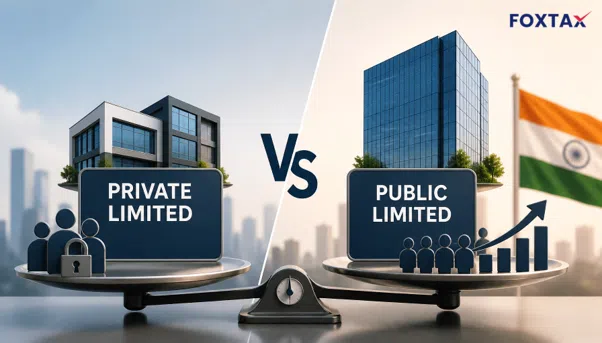
India is home to over 1.5 million licensed private limited companies whereas due to the tougher legal provisions, public limited companies are a much smaller group. The fundamental distinction between setting up a private or public limited company lies under the Companies Act, 2013.
This will influence your ways of raising capital, the amount of shareholders you can have, and degree of regulation you will have to comply with. This blog outlines the main differences between these two models.
What is the main difference between a private and a public limited company?
The single most significant difference is the freedom that a public limited company has of issuing and advertising shares to the public. A private limited company is not an open entity, meaning its securities and stock cannot be sold to the wider public. Their equity shares are mainly owned by a small group of investors, including the founders, their families and close friends.
In contrast, a public company can issue a prospectus for the public investment and because of this it is called a public company, not a privately owned company. So, only public limited companies can be publicly listed on stock exchanges like BSE and NSE while private companies are not included in the lists.
What does public invitation and share subscription mean?
Private limited companies are limited to issuing shares privately, that is they cannot invite the public to invest in their company (through a prospectus) or list their shares to the public by conducting an Initial Public Offering (IPO). Public companies are allowed to both, and this allows the shares to be freely traded when listed.
This makes it possible for a publicly listed company to mobilize a lot more capital through retail as well as institutional investors – investors of such type would never be able to invest in private limited companies due to restricted availability.
What are the key differences between a private company and a public company?
The differences between a private and a public company can be drawn with membership, share transfer, listing of the stocks, conducting of meetings and compliance. The table below outlines the comparison between both the structures, which includes 5-10 differences which most readers are looking for.
| Basis | Private Limited Company | Public Limited Company |
| Minimum members | 2 | 7 |
| Maximum members | 200 | No limit |
| Minimum directors | 2 | 3 |
| Share transfer | Restricted | Freely transferable |
| Public invitation | Not allowed | Allowed via prospectus |
| Stock exchange listing | Not permitted | Required if listed |
| AGM requirement | Not compulsory annually | Mandatory annually |
| Commencement of business | Can start immediately | Needs certificate of commencement |
| Compliance burden | Lighter | Heavy, including SEBI norms |
| Name suffix | Pvt Ltd | Ltd |
What are the membership and share transfer rules?
The membership of a private company is limited only to 200 people, while employees and ex-employees are exempted. While a public limited company requires a minimum of 7 shareholders and has no upper limit.
In a private company, transfer of shares is only allowed among close shareholders to maintain the secrecy of ownership. Though, in a public company, shares can be readily transferred through stock markets, which is one of the most effective ways for investors to get in and out.
What are the compliance and regulatory requirements?
Public limited companies are subject to more severe compliance requirements since they have to organize Annual General Meetings, disclose their financial reports, and also be under SEBI rules if they have listed themselves.
On the contrary, private companies do not face such requirements and because of this, they have a lighter regulatory load, which makes them more convenient for owners and decisions can be made with greater speed. That is why small and mid-sized businesses often go for this type of company. If you are considering this route, you can explore the benefits of pvt ltd company in India to understand why this structure suits growing businesses.
Public limited company vs private limited company examples
Public limited companies are like the Reliance Industries Ltd, Tata Consultancy Services Ltd, Infosys Ltd, HDFC Bank Ltd, the shares of which are trading openly in Indian exchanges. However, most startups and family businesses operate as private limited companies, even Swiggy and Ola Electric had been such entities before going public with their Initial Public Offering (IPO).
To the question “which is bigger, Pvt Ltd or Ltd”, typically it’s public companies that are bigger with shareholder count, paid-up capital, and scale. Although one mustn’t underestimate a private company that has large revenues. For a deeper comparison between structures, you can also review our analysis on LLP vs private limited company to see how other business forms stack up.
Benefits of a public limited company
Even with higher compliance, the reasons for going public limited company explain why many growing businesses choose to make the transition.
What are the four main advantages of going public?
- Raise large capital: A public limited company will get access to both retail and institutional investors after an IPO. The capital raising ability through such public offerings far exceeds the raising capacity by private fundraising efforts.
- Enhanced market credibility: Getting your company listed in a well-known equity market indicates a sign of transparency and this kind of transparency in business attracts the customers, partners, and the lenders too.
- Liquidity for investors: Through exchange, investors can sell their shares quite easily which allows for an easier sell for the investors and that is why more investors come forward.
- Easier institutional funding: It is easier for banks to know the actual position of a company and decide whether to give a loan or not. A public company does audits on a stricter basis than private companies, makes all necessary disclosures and follows proper governance policies. This is why banks prefer lending to public companies.
Which is better for job – Public Ltd or Pvt Ltd
If you look at it from the lens of jobs, there are certain advantages that public limited companies can offer to the employees that private ones can’t. Public Ltd companies give a better level of security in jobs, bigger brand names, and more professional HR policies, with perks such as stock options and plans for retirement.
However, private limited companies, mostly in their early stages, tend to offer faster opportunities for promotions, roles with more freedom, and diverse areas of responsibility. In case you are looking for a secure job and long-lasting employee benefits, Public Ltd companies might be a good choice. On the contrary, if you are aiming for quick learning and high-paced development, Pvt Ltd companies could also be very attractive for you.
How a private limited company can become a public limited company
Changes in conversion need a special resolution by the shareholders, updating the Articles of Association, compliance with the company’s minimum membership and director requirements, and filing the required documents with the Registrar of Companies.
The converted entity may then go public through the issue of shares after which IPO would follow and its stocks could be enlisted publicly. As the process involves complexity of the filing and compliance with SEBI, getting professional help from firms such as Foxtax would be a wise thing to do. You can also refer to our detailed guide on converting your private limited company into a public limited company for step-by-step assistance.
Final checklist: Choosing between Pvt Ltd and Public Ltd
- Go public if you want to raise capital from the public through an IPO.
- Stay private if you want ownership control within a small group.
- Choose public only if you can handle heavy compliance and mandatory AGMs.
- Prefer private if you value quick decisions, flexibility and lower regulatory pressure.

Conclusion
The choice between pvt ltd vs public ltd shapes the future of your business. A private limited company offers control, confidentiality and operational freedom, while a public limited company provides capital-raising power and public trust.
If you need help with company registration, ROC filings or annual compliance, Foxtax can handle the entire journey from incorporation to compliance.
Frequently Asked Questions
Which is bigger, PVT Ltd or Ltd?
Public limited companies generally have more shareholders and a higher capital. But, private limited companies can be quite large for revenue and number of employees. The answer ultimately depends on the aspect you are measuring.
What are the three differences between public and private?
One difference is the maximum number of members – a private limited company is only allowed to have 200 members at maximum whereas a public limited company can carry any number of shareholders.
Share transferability is another – shares of private listed companies are usually not freely convertible, while shares of publicly listed companies can be purchased and sold on the stock exchange very easily and without any restrictions.
The third difference is – private companies cannot accept capital from the public, while public companies do this all the time through the issue of prospectuses and other related documents.
What is the minimum paid-up capital for a public limited company in India?
Based on The Companies Act of 2013, there is no compulsory minimum paid-up capital in case of a public limited company. Yet, the listing requirements of SEBI and stock exchanges set certain limits.