



Reporting the foreign income of Indian residents is no doubt a complicated task. Still, earning global income is a common thing nowadays due to the globalization of work and investments. Also, remote working, foreign stock dividends, and rental properties overseas are a few examples of ways in which you may get foreign income.
The main rule simply states that the worldwide income of a person who is a Resident and Ordinarily Resident (ROR) of India will be taxed here. This article helps you to understand the foreign income reporting, learn the tips on how to deal with it, etc. so this subject is made easy.
What Does Foreign Income Reporting Involve for Indian Residents?
When you are considered an Indian resident for tax purposes, foreign income reporting refers to the compulsory act of telling the Income Tax Department about all your earnings or properties that are situated outside India. That is not only the money which you bring inside India but also includes the income earned from foreign sources like a salary paid by a foreign company, interest on the foreign bank account, dividends from the stocks of the foreign company, or rent of the house/floor/flat located abroad.
The main schedules which you need to understand and focus on are Schedule FSI (Foreign Source Income) – the schedule for the income part and Schedule FA (Foreign Assets) – the schedule with the list of all the assets which are giving you foreign source income. Getting the first idea of this difference is very important and useful.
Key Schedules for Reporting Foreign Income and Assets
The main work of foreign income reporting is done through the correct filling of the particular schedules of your ITR. These schedules help you to lay out your complete global financial footprint.
What is Schedule FSI and What Do I Report in It?
Schedule FSI is the continuation of “Foreign Source Income.” In this schedule, you disclose a detail of all foreign income gained outside India. This covers various income types such as dividends from overseas companies, interest on foreign bank accounts, capital gains from the sale of foreign property or shares, and even the salary earned by working outside India.
You have to give a country-wise detail of this income, its nature (for example salary interest, dividend), the gross amount in Indian Rupees, and any tax paid by you in that foreign country. This data is indispensable for availing relief from double taxation.
What is Schedule FA and What Assets Must I Disclose?
Schedule FA (“Foreign Assets”) mainly requires you to report the assets responsible for the income shown in Schedule FSI and also any foreign assets you possess, whether or not they have earned any income.
The list of assets that must be reported is quite comprehensive and includes:
- Foreign Bank Accounts: All types of accounts like savings, current and fixed deposits.
- Foreign Custodial Accounts: Accounts where financial assets like stocks and bonds are held, e.g. brokerage accounts.
- Foreign Equity and Debt Interest: Shares bonds mutual funds, and other securities.
- Foreign Immovable Property: Any piece of real estate you own. You must also provide details like the address and the cost of acquisition.
- Foreign Trusts: Your interest in a foreign trust.
- Cash Value Insurance or Annuity Contracts: Insurance policies or annuities with foreign companies.
Note, you are also obliged to report these assets even if they did not generate any income in the year. For example, a forgotten foreign bank account with a zero balance must be disclosed.
How to Report Foreign Self-Employment Income
If you are a freelancer, consultant, or run a business from India but earn income from clients abroad, you have a specific reporting path. This is a common scenario, and the process is straightforward when broken down.
Choosing the Correct ITR Form
The first major decision is selecting the right ITR form. Simple forms like ITR-1 (Sahaj) or ITR-4 (Sugam) cannot be used since these do not have Schedule FA. If you have foreign income or assets, you have to file either ITR-2 or ITR-3. Self-employed persons should use ITR-3 since it has a schedule for business and professional income. For professional assistance, you can explore our income tax return filing services.
Step-by-Step Process for Filing
- Report the Income: You will declare your gross receipts from foreign clients in ITR-3 under the “Profits and Gains from Business or Profession” head. After that, you can deduct the eligible business expenses to determine your net taxable income.
- Fill Schedule FSI: Then, you have to carry the information for this foreign self-employment income to Schedule FSI. You are required to mention the country of source (e.g. USA, UK, Australia) and the amount of tax, if any, that was withheld by the foreign client.
- Fill Schedule FA: Last, you need to identify the asset through which you earned this income. Normally, this would be the foreign bank account where you receive the payment. But, if you have a separate business account abroad, that also needs to be reported. This detailed report allows you to stay fully compliant with the income tax department.
Common Mistakes to Avoid in Foreign Income Reporting
At times, taxpayers inadvertently commit filing errors even with the best of intentions. By knowing these errors, you will be able to bear notice or no penalty.
- Wrong ITR Form Usage: A frequent mistake is filing ITR-1 or ITR-4 even when you have foreign assets. Such a limitation will directly lead to violation and may result in a notice.
- Wrong Currency Conversion: The entire value in ITR should be given in Indian Rupees (INR). This is a common mistake where the wrong exchange rate is used (for example, the rate on the day of transaction versus the RBI reference rate on the last day of the financial year). You should use the telegraphic transfer buying rate (TTBR) as on the last day of the relevant month or the rate prescribed by RBI.
- Not Reporting Accounts with Low or Zero Balances: Many think a foreign bank account with small or nil balance does not require reporting. This is wrong. Every foreign financial account, no matter what the balance is, should be disclosed in Schedule FA.
- Overlooking the Deadline: For most individuals, the last date to file ITR is 31st July. For those who are required to get their accounts audited, it is 31st October. Non-compliance with this date may result in imposition of late fee under Section 234F. To understand the risks better, read our guide on what happens if you don’t file ITR.
How to Avoid Double Taxation on Your Foreign Income
The thought of being taxed twice—once abroad where the income is earned and again in India—is what worries most. Luckily, Indian tax laws have some strong provisions in place to counter such a situation.
Claiming the Foreign Tax Credit (FTC)
A common method to get rid of double taxation is by getting a Foreign Tax Credit (FTC). Firstly, you declare your foreign income in Schedule FSI and the tax paid on such income in the foreign jurisdiction. Then, you prepare Schedule TR to claim offset of the foreign tax against your Indian tax liability. For instance, if you incurred $500 as tax on interest income in the US, you could claim that amount as a credit against your tax payable in India so that no double taxation of income occurs.
Understanding Double Taxation Avoidance Agreements (DTAAs)
India has signed Double Taxation Avoidance Agreements (DTAAs) with about 85 countries. Such treaties outline which country should have the primary right to tax each form of income. For certain kinds of incomes, viz. interest or royalties, the DTAA may cap the rate of tax that the source country can deduct.
Knowledge of the exact phrases of a DTAA between India and the source country of one’s income is indispensable for efficient tax planning. Most of the time, one can pick to get taxed under the DTAA or under the Income-tax Act, whichever happens to be more beneficial. For comprehensive support, consider consulting a tax consultant.
Quick Checklist for Filing Foreign Income
A quick cross-check with this checklist before hitting submit can be a smart move.
- Confirm your residential status: Are you a Resident and Ordinarily Resident (ROR)?
- Select the correct ITR form: Use ITR-2 or ITR-3, not ITR-1 or ITR-4.
- Gather all documents: Bank statements, dividend certificates, sale deeds, and proof of foreign tax paid.
- Fill Schedule FSI: Report all foreign income with a country-wise breakup.
- Fill Schedule FA: List every foreign asset, including dormant accounts and non-income generating property.
- Claim relief: Fill Schedule TR to claim the Foreign Tax Credit.
- Convert currency correctly: Use the prescribed RBI exchange rate.
- Verify and file: Double-check all entries before filing and submit before the deadline.
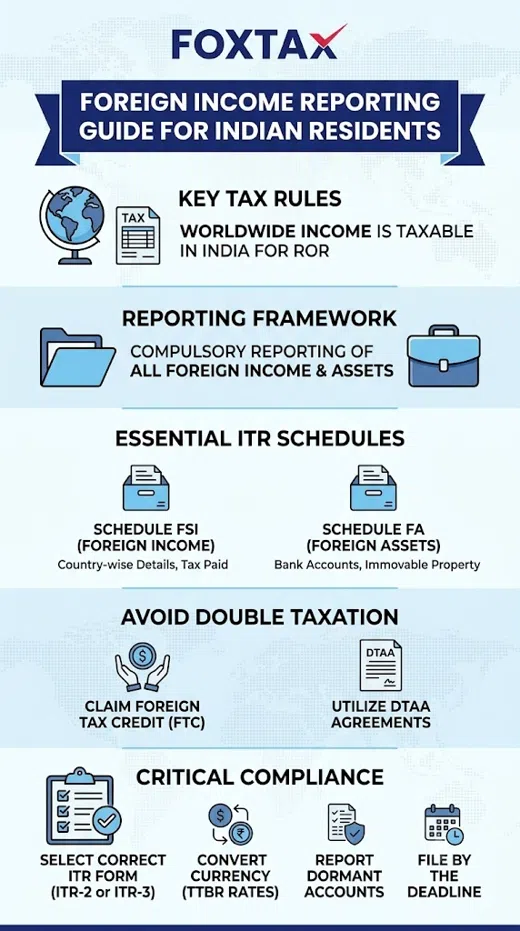
Filing taxes in India as a Resident and Ordinarily Resident (ROR) means your worldwide income is subject to tax. If you have offshore bank accounts, foreign stocks, or overseas property, keeping up with compliance is critical to avoiding heavy penalties.
Here is a quick breakdown of what you need to know for your next ITR filing, as detailed in image_f7e566.jpg:
📋 Compulsory Reporting: You must declare all foreign income and assets—no exceptions.
🗂️ Essential Schedules: Use Schedule FSI for country-wise income details and taxes paid, and Schedule FA for foreign bank accounts or immovable property.
🛡️ Avoid Double Taxation: Don’t pay twice! Maximize your tax savings by claiming the Foreign Tax Credit (FTC) and utilizing DTAA agreements.
⚙️ Critical Compliance: Ensure you choose the correct form (ITR-2 or ITR-3), convert foreign currency using official TTBR rates, report dormant accounts, and file well before the deadline.
#TaxIndia #ForeignIncome #ITR2 #ITR3 #DTAA #IncomeTaxIndia #FinancialLiteracy #Foxtax
Conclusion
For Indian residents who have international financial linkages, foreign income reporting becomes an indispensable task. It may look complicated at first, but if you realize the main points – like the concept of global taxation, the necessity of Schedules FSI and FA, and how to avoid double taxation – you will find it more than manageable.
You can tackle your tax filing confidently if you follow the guidelines laid out in this article and steer clear of mistakes. Also, Foxtax offers expert advice and assistance to make your journey towards international tax compliance easy and smooth.
FAQ Section
Do I have to report foreign income on my taxes?
Absolutely, if you hold the status of a Resident and Ordinarily Resident (ROR) of India, then you must declare all your worldwide income in your Indian tax return. This will cover all types of income like salary, interest, dividends, rental income, and capital gains from foreign sources.
How much foreign income is tax free in India?
In India, foreign income cannot generally be considered as “tax-free”. It becomes part of your global income and is taxed as per the applicable slab rates. What you can do, however, is lower your tax burden by claiming one of the reliefs available through the Double Taxation Avoidance Agreement (DTAA) or by taking a Foreign Tax Credit (FTC) for taxes that you have already paid abroad.
Where to show foreign income in ITR 2?
Reporting of foreign income in ITR-2 happens in Schedule FSI (Foreign Source Income). Details like the country-wise breakup of income, its nature, gross amount, and tax paid in the foreign country have to be filled in.
What is the limit for foreign assets disclosure in ITR?
There is no minimum limit for disclosure of foreign assets in Schedule FA. For foreign asset reporting purposes, you must include all types of assets such as bank accounts, properties, and financial investments irrespective of their worth or income.
What happens if I don’t report foreign income?
Failure to disclose foreign income and assets might not only attract a heavy fine, but you also may end up being prosecuted. The law that governs the matter is the Black Money (Undisclosed Foreign Income and Assets) and Imposition of Tax Act, 2015, which provides for a fine of up to Rs. 10,00,000. You can learn more about handling such issues in our guide on income tax return filing issues.
How do I report foreign income from a previous year?
You can file a Revised Return if you haven’t yet filed the tax return for the year after you earned the foreign income and that year is still open for amendments by you. Otherwise, you can file an Updated Return under Section 139(8A) for the year you want to disclose. You will be required to pay outstanding taxes together with interest on them.