



Every year during tax season, the biggest question every Indian taxpayer faces before submitting their income tax return is: which ITR form should I file? With so many options like ITR-1, ITR-2, ITR-3, and ITR-4, the waters can be quite muddled with confusion.
As per the instructions of the Income Tax Department, for Assessment Year 2026-27, ITR-3 is for individuals and HUFs (Hindu Undivided Families) who are earning income from a business or profession. But the matter can be confusing when you have multiple sources of income like salary, freelance work, capital gains, and business income. In this detailed article, we’ll help you precisely ascertain if you need to file ITR-3 for your income tax return filing.
What is ITR-3 and Who Needs to File It?
ITR-3 is the income tax return form specified by the Income Tax Department of India for individuals and HUFs that are required to report profits and gains from business or profession. ITR-3 is more complicated compared to ITR-1 (Sahaj) or ITR-2, as you need to declare detailed information about your business income, expenditures, assets, and liabilities.
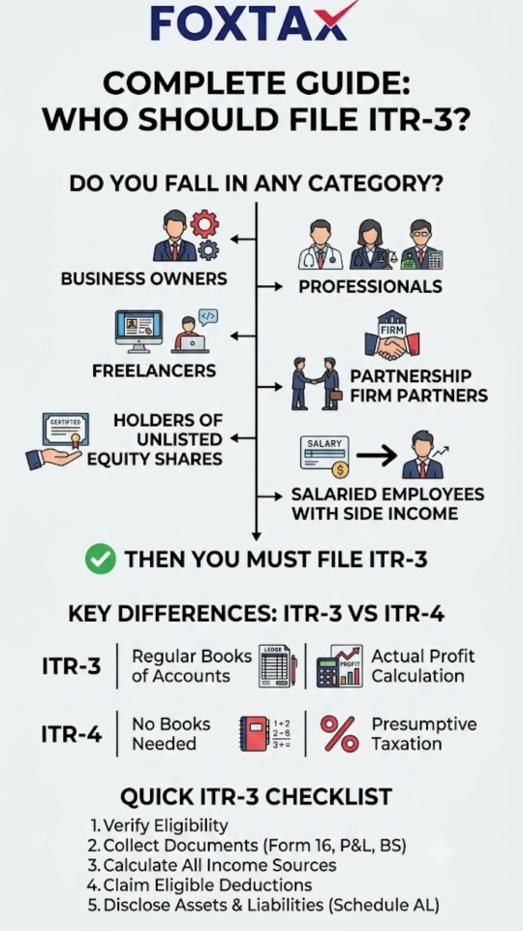
The core eligibility criteria for ITR-3 includes:
- Individuals and HUFs deriving income from a business or profession, either through a proprietorship or through freelancing, consultancy, or any other profession
- Partners in a partnership firm receiving remuneration or interest out of the profits of the firm
- Directors of a company receiving salary as a director
- Holders of unlisted equity shares
If you belong to any of these categories, ITR-3 may be your correct form. The key differentiator between ITR-3 and ITR-1/ITR-2 is the presence of business or professional income.
Can a Salaried Person File ITR-3?
This is the most common question about ITR-3, and the answer depends entirely on your situation. If you are a salaried individual with only salary income and interest from savings accounts, you need to file ITR-1 (Sahaj) or ITR-2. However, there are situations where a salaried individual must file ITR-3.
When a Salaried Employee Must File ITR-3
Here are the conditions under which you are required to file ITR-3 even as a salaried employee:
- You earn business or professional income beyond your salary: It’s common for salaried professionals to have side businesses or freelance work. If you have business or professional income on top of your salary, filing ITR-3 is compulsory. For example, a marketing manager who also runs a freelance graphic design business must file ITR-3.
- You are a director in a company: If your income is solely from director’s remuneration or salary, you cannot file ITR-1 or ITR-2. The Income Tax Department requires all directors of a company to file ITR-3.
- You have unlisted equity shares: If you hold investments in shares of a company not listed on any recognized stock exchange, you need to file ITR-3. This applies even if your only income source is salary with no business income.
- You received capital gains income along with business income: If you have capital gains from selling assets like property or shares and also have income from business or profession, use form ITR-3. This often applies to real estate investors who also own a business.
Who is Eligible to File ITR-3? (Complete Eligibility Criteria)
Once the ITR-3 eligibility criteria are clear, it becomes easier to determine whether you should file this form. If in doubt, run through the complete eligibility criteria.
Eligible Taxpayers for ITR-3
The following categories of taxpayers must file ITR-3:
- Those doing business or practicing a profession: Sole traders, sole proprietors, freelance workers, consultants, doctors, lawyers, architects, chartered accountants, and anyone else earning income through their own practice or business.
- Partner of a partnership firm: If you are a partner in a partnership firm and receive salary, commission, bonus, or interest from the firm, file ITR-3. This applies even if your only income source is from the partnership business.
- HUFs with business income: HUFs earning income from profession or business need to file ITR-3. An HUF can have income from family business operations or investments in business ventures.
- People with income from salary, house property, capital gains, and other sources (without business/professional income): In this case, you file ITR-2. But if you have business or professional income in addition to the above, ITR-3 is mandatory. Business or professional income is the qualifying criterion.
- Resident taxpayer with foreign assets: If you own foreign assets or have signing authority on foreign accounts, you may need to file ITR-3 if you also have business income. Without business income, file ITR-2.
Who is NOT Eligible to File ITR-3?
Knowing who should not file ITR-3 is equally important. Using the wrong form can cause processing delays, refund holds, and unwanted attention from the tax department.
Taxpayers who should NOT file ITR-3:
- Salaried individuals with only salary and interest income: If you have only salary income (from a single employer), interest income on savings bank accounts, and rent from a single house property, file ITR-1 (Sahaj).
- Salaried individuals with capital gains or multiple properties: If you have salary income and capital gains from selling investments or rental income from multiple properties, submit ITR-2. This form accommodates more complex income sources without business/professional income.
- Taxpayers covered under presumptive taxation (Section 44AD, 44ADA, or 44AE): If your business turnover is less than ₹2 crore, or you are a specified professional with receipts under ₹50 lakh, you can opt for presumptive taxation and file ITR-4 (Sugam).
- Companies and LLPs: ITR-3 is only for individuals and Hindu Undivided Families. Companies must file ITR-6, and LLPs must file ITR-5. If you run a business through a company or LLP, you cannot use ITR-3.
- Taxpayers earning only capital gains without business income: If you have only capital gains from selling stocks, mutual funds, or property but no business or professional income, file ITR-2 instead of ITR-3.
ITR-3 vs ITR-4: Understanding the Key Differences
Taxpayers frequently get confused between ITR-3 and ITR-4, as both apply to individuals with business or professional income. However, the distinction is clear once understood.
| Aspect | ITR-3 | ITR-4 (Sugam) |
| Income Description | Business or profession income with regular books of accounts | Business or profession income under presumptive taxation scheme |
| Eligibility | Any person with income from business/profession, company director, partner | Taxpayers who elect presumptive income under Sections 44AD, 44ADA, 44AE |
| Turnover Limit | No limit on turnover | Turnover up to ₹2 crore for business (Section 44AD); Receipts up to ₹50 lakh for professionals (Section 44ADA) |
| Books of Accounts | Detailed books of accounts and balance sheet required | Summary books of accounts not required; income computed at prescribed percentage |
| Complexity | High complexity with asset, liability, and income disclosures | Low complexity with simplified form |
| Who Should Use | Business owners who calculate actual profit | Small business owners and professionals seeking simplified filing |
If you opt for presumptive taxation, use ITR-4. But if you maintain regular books of accounts and calculate actual profit, file ITR-3. Remember, once you choose presumptive taxation under Section 44AD, you must continue for 5 years and cannot switch to ITR-3.
Format of ITR-3: What Information Does It Require?
The ITR-3 form is elaborate and requires comprehensive disclosures about your income, assets, and liabilities. Understanding the format helps you compile documents before starting your filing.
Key Schedules in ITR-3 Form
The ITR-3 form is divided into several schedules, each requiring specific information:
- Schedule BP (Business or Profession Income): The main schedule for reporting business income. Provide details of your Profit & Loss account, sales turnover, cost of goods sold, operating expenses, and net profit. A balance sheet showing assets and liabilities is required.
- Schedule OS (Income from Other Sources): Declare income like interest from fixed deposits and savings accounts, lottery winnings, and other income not covered under other heads.
- Schedule CG (Capital Gains): Declare gains or losses from selling capital assets (short-term and long-term), including shares, mutual funds, and property.
- Schedule HP (Income from House Property): Report income from house property you own, including deductions for municipal taxes, 30% standard deduction, and home loan interest.
- Schedule Salary: Report salary income from employment, including allowances, perquisites, and deductions under Section 16.
- Schedule AL (Assets and Liabilities): An exclusive requirement of ITR-3. Disclose all assets (bank accounts, investments, property, cars, jewelry) and liabilities (loans, credit card dues) as of March 31st of the financial year.
- Schedule 80G, 80D, etc.: Report deductions for donations, medical insurance premiums, education loan interest, and other eligible deductions.
How to File ITR-3 Online: Step-by-Step Guide
Filing ITR-3 online is done through the Income Tax Department’s e-filing portal. Have all your documents ready and follow this procedure.
Step-by-Step ITR-3 Filing Process
- Access the e-Filing portal: Visit www.incometax.gov.in and log in using your PAN as user ID and password. New users should sign up by providing PAN and Aadhaar details.
- Organize all documents: Gather Form 16 from your employer, bank statements, business P&L statement, balance sheet, capital gains statements, rent receipts, home loan statements, and investment proofs for deductions.
- Select the Assessment Year: Choose AY 2026-27 (for FY 2025-26) and select “ITR-3” from available options.
- Provide personal details: Enter your name, PAN, Aadhaar, date of birth, address, and contact details. Ensure these match your PAN card exactly.
- Provide income particulars: Report income under different heads—Salary, House Property, Capital Gains, Business/Profession, and Other Sources—using your documents.
- Claim deductions: Enter deductions under Sections 80C (investments), 80D (medical insurance), 80E (education loan), 80G (donations), and other sections. Keep supporting evidence ready if using the old regime.
- Validate and compute tax: The portal will validate your entries and compute your tax liability. Choose between the old tax regime and the new tax regime (Section 115BAC).
- Check and submit: Review all entries thoroughly, then submit. You’ll receive an acknowledgement (ITR-V). Verify your return via Aadhaar OTP, net banking, or by mailing the signed physical copy to CPC Bangalore.
Quick Glance: ITR-3 Filing Checklist
Before filing your ITR-3, ensure you complete these essential steps:
- Confirm eligibility: Ensure you have business/professional income or are a director/partner in a firm
- Collect all documents: Form 16, business P&L, balance sheet, bank statements, investment proofs, capital gains statements
- Calculate correctly for each income source: Salary, capital gains, house property, other sources
- Claim all eligible deductions: Maximize deductions under Sections 80C to 80U
- Select the correct tax regime: Compare old regime (with deductions) vs new regime (lower rates, fewer deductions)
- Disclose all assets and liabilities: Complete Schedule AL with current information as of March 31st
- Review all entries: Ensure accuracy before submission to avoid queries from the Income Tax Department
Conclusion
Selecting the correct ITR form is the most important step in accurate tax filing. If you have business or professional income, are an individual or HUF, a company director, a partner in a partnership firm, or a holder of unlisted equity shares, ITR-3 is for you.
However, if you are a salaried individual with only salary and interest income, ITR-3 isn’t for you—file ITR-1 or ITR-2 instead. Filing the wrong form can result in processing delays, refund holds, and even penalties. If you need assistance with the complex ITR-3 filing process, contact Foxtax. Our team of professional CAs will guide you through the journey, ensuring your return is filed accurately and efficiently.
Frequently Asked Questions (FAQ)
Q1: Can a salaried person file ITR-3?
A salaried person can file ITR-3 only if they have additional business or professional income, are a company director, or hold unlisted equity shares. If your only income is salary and interest, file ITR-1 or ITR-2 instead.
Q2: What is the difference between ITR-3 and ITR-4?
ITR-3 is for taxpayers with business/professional income who maintain regular books of accounts and calculate actual profit. ITR-4 (Sugam) is for those opting for presumptive taxation under Sections 44AD, 44ADA, or 44AE, where income is calculated at a prescribed percentage of turnover.
Q3: Can I file ITR-3 for presumptive income?
No. If you have presumptive income under Sections 44AD, 44ADA, or 44AE, file ITR-4 (Sugam), not ITR-3.
Q4: When will ITR-3 form be available for AY 2026-27?
The Income Tax Department typically releases ITR forms for the new assessment year in April. For AY 2026-27, ITR-3 is expected on the e-filing portal by April 2026.
Q5: What documents are needed to file ITR-3?
You need Form 16 (from employer), business P&L statement, balance sheet, bank statements, capital gains statements, rent receipts, home loan certificates, investment proofs for deductions, and details of assets and liabilities for Schedule AL.
Q6: Is it mandatory to disclose assets and liabilities in ITR-3?
Yes, Schedule AL (Assets and Liabilities) is mandatory in ITR-3. You must disclose all assets and liabilities as of March 31st of the financial year.
Q7: Can a freelancer file ITR-3?
Yes, freelancers earning income from their profession (graphic designers, writers, consultants, doctors, lawyers) must file ITR-3 unless they opt for presumptive taxation under Section 44ADA, in which case they can file ITR-4.
Q8: What happens if I file the wrong ITR form?
Filing the wrong ITR form can lead to processing delays, refund holds, and potential scrutiny from the Income Tax Department. You may receive a notice asking for clarification, and in some cases, you may need to file a revised return with the correct form.