


One of the frequently asked questions by women taxpayers in India is whether they get any special tax rebate. Actually, the Indian Income Tax Act does not provide any separate or exclusive tax rebate only for women. The tax system is pretty much gender-neutral, so the same tax rates, basic exemption limits, and rebates are applicable to all individual taxpayers irrespective of gender. Though, this does not imply that women cannot get sizable tax saving benefits. The crux is in making themselves aware of and using tax-saving provisions available to all under the Act.
What is the Tax Rebate for Women in India?
While the Indian Income Tax Act offers a gender-neutral tax slab structure for FY 2025-26, women can eliminate their entire tax liability down to zero using the Section 87A rebate if their net taxable income stays below ₹7 Lakhs under the new tax regime. Sizable women tax savings in India are further maximized by strategically combining general exemptions under Section 80C deductions, tax benefits for health insurance, and home loan tax deductions.
How Does Tax Rebate for Women Work?
The strongest weapon for minimizing tax comes with the possession of Section 87A rebate. On the new tax regime for FY 2025-26, if your total income does not exceed ₹7,00,000, you may avail the benefit of a rebate of up to ₹25,000 making the tax payable amount effectively zero. This rebate is extended to all taxpayers, women included. The only condition for you to be able to get it, is that your gross total income, after standard deductions, should be below this limit. At first, it might seem like the distinction between the possibilities is blurred, but once understood and respected, it opens the door to substantial tax planning for women.
Key Tax Deductions for Women Under Section 80C
Section 80C is hands down the most popular and extensively-used tax-saving section which permits up to a maximum deduction of ₹1.5 lakh from your gross income in a year. This limit is the same for persons of either gender and it is for the whole range of your investments and expenses that Section 80C caters. Because of this, it is a good lever to pull when wanting to reduce your taxable income.
Listed below are the main Section 80C investments and expenses:
- Public Provident Fund (PPF): Considered one of the safest and healthiest ways of building a retirement corpus, it is a government-backed long-term savings scheme. The interest is very attractive keeping maturity proceeds tax-free as well. For women, it is possible to open a PPF account with a minimum deposit of ₹500 per year and contribute an amount up to ₹1.5 lakh for claiming the deduction.
- Equity Linked Savings Scheme (ELSS): The shortest locked-in period of three years has made ELSS one of the most popular among the Section 80C instruments. It is a diversified equity mutual fund which offers the possibility of higher returns than in fixed-income instruments. In this case, tax-saving and wealth creation go hand in hand, and those women with moderate to high-risk appetites would find ELSS fit to their profile.
- Life Insurance Premiums: Premiums paid for any life insurance policy covering yourself, your spouse, or even your children are eligible for deduction under Section 80C. This is a two-pronged investment that ensures financial comfort to your family while at the same time reducing the tax payable by you. Certain types of policies like term plans, endowment plans, and ULIPs are why we got to mention the policy part of this for 80C, because their premiums qualify for deduction.
- Tuition Fees for Children: If you have two children whom you are sending to a full-time educational institution, you can claim the tuition fees paid for their education. It is not only limited to schools but extends to colleges, universities, and other types of educational institutions in India too. This is a very handy perk for mothers who are investing in their children’s schooling.
Health Insurance Tax Benefits Under Section 80D for Women
Health insurance is not just a financial safety net, it is also a powerful tax-saving tool. Section 80D of the Income Tax Act allows you to claim deductions on premiums paid for health insurance policies. The deduction limits vary based on the age of the insured individuals.
- Insurance Premium for Self, Spouse and Children: Deductions can be claimed up to a limit of ₹25,000 on the health insurance premium paid for yourself, your spouse, and your dependent children. This is a regular benefit provided to all taxpayers.
- Premium for Parents: Another deduction of up to ₹25,000 is offered on the premium paid for your parents in case they are younger than 60 years. The amount rises to ₹50,000 if your parents are senior citizens (aged 60 years or more). This benefit is more for women who can be the primary caregiver for their parents.
- Preventive Health Check-up: Up to ₹5,000 is the deduction allowed for the preventive health check-up of yourself as well as your spouse, children and parents. This is within the overall limits mentioned above. For example, assuming you pay a health insurance premium of ₹20,000 to your family and spend ₹5,000 on health check-up, you can claim a total deduction of ₹25,000 under this section.
Tax Benefits for Women on Home Loans
Owning a home is accompanied by the availability of very good tax benefits, and a woman can avail herself of these just as well as any other taxpayer. The Income Tax Act permits deductions on the principal repayment and also on the interest paid on a home loan.
- Deduction on Principal Repayment (Section 80C): Home loan principal repayment is eligible for deduction under Section 80C within the overall ceiling of ₹1.5 lakh. It’s a popular route to utilizing the Section 80C limit for women who have home loans.
- Deduction on Interest Payment (Section 24(b)): Section 24(b) permits you to deduct a maximum of ₹2,00,000 on the interest paid on a home loan for a self-occupied property. If the property is let-out, you can deduct the entire interest amount without any upper limit. This huge benefit can majorly reduce your taxable income.
- Additional Deduction for First-time Home Buyers (Section 80EEA): If you are a first-time home buyer, you can get an extra deduction of up to ₹1,50,000 on home loan interest under Section 80EEA. This comes over and above the ₹2,00,000 limit under Section 24(b). Besides, the loan amount should not exceed ₹45 lakh and the value of the property should be up to ₹45 lakh. This is an incentive that encourages women to purchase their first home.
Deduction on Savings Account Interest (Section 80TTA)
Many women have savings accounts for their routine financial transactions. Section 80TTA is a simple yet very impactful way to save tax on interest earned from these accounts. As per the section, you can get a tax deduction of up to ₹10,000 on the interest income earned from the savings account with the bank, post office, or cooperative societies.
The deduction is available for every individual taxpayer, including women. For instance, if you earn ₹12,000 as interest from your savings account in a year, you may claim a deduction of ₹10,000 under Section 80TTA, leaving only ₹2,000 to be added to your taxable income. The benefit works quite well for ladies holding a good amount of savings in their bank accounts.
Quick Glance at Key Tax Benefits for Women in India
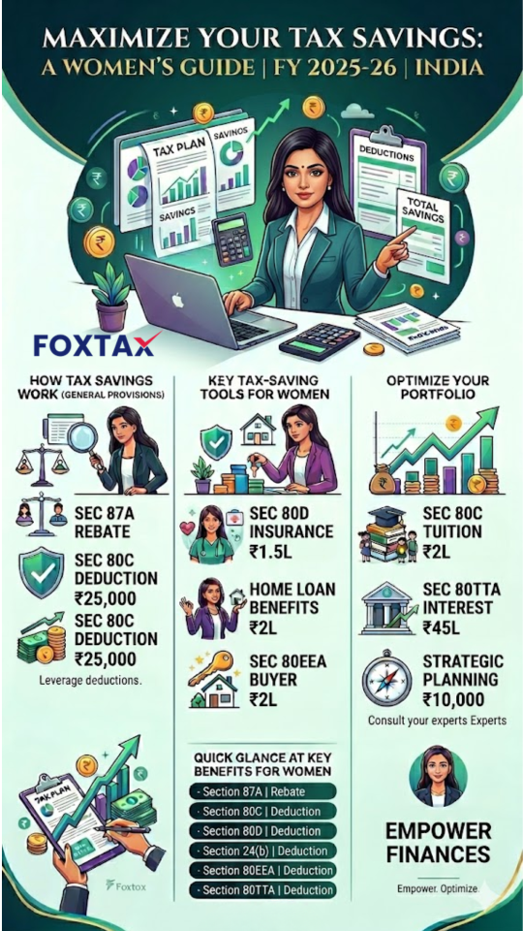
Here is a summary checklist to give you a quick idea about the most effective tax-saving provisions:
- Section 87A Rebate: If your total income is up to ₹7,00,000 (new regime), you can avail of a total tax rebate.
- Section 80C Deduction: Invest up to ₹1.5 lakh in PPF, ELSS, life insurance, or pay children’s tuition fees.
- Section 80D Deduction: Insurance health of self and family up to ₹25,000, and for senior citizen parents up to ₹50,000.
- Section 24(b) Deduction: Interest on home loan for self-occupied property up to ₹2,00,000 can be deducted.
- Section 80EEA Deduction: The first-time homebuyer can claim an additional ₹1,50,000 deduction on home loan interest.
- Section 80TTA Deduction: The interest income from your savings account is tax-free up to ₹10,000.
Conclusion
All in all, while there is no exclusive tax rebate for women in India, the tax system offers numerous powerful provisions that can help you achieve significant savings. By understanding and strategically using deductions under Section 80C, Section 80D, Section 24(b), and Section 80TTA, you can greatly reduce your taxable income. The key is to plan your investments and expenses wisely, keeping your financial goals in mind. With the right approach and professional guidance from Foxtax, you can navigate the tax landscape with confidence and ensure you are not paying more tax than necessary.
For a detailed breakdown of your specific situation, consider consulting an online tax consultant in India or using our income tax calculator to estimate your savings. If you are a business owner, you may also explore tax benefits for female owned business structures or look into business registration options that align with your goals.
Frequently Asked Questions (FAQs)
Q1: Is there any tax exemption for women?
They do get benefits, but only generally, not explicitly women-specific ones. Basically, females have freedom to use the standard tax exemptions and deductions that are available to all individual taxpayers, which includes standard deduction for salaried employees, HRA exemption, and deductions under Section 80C, 80D, and 80TTA etc.
Q2: What is the maximum limit of Section 80C for females?
The maximum deduction limit under Section 80C is ₹1.5 lakh per financial year and this limit remains the same for all individuals including women. The range of deductions sufficiently includes investments and expenses like PPF, ELSS, life insurance premiums, children’s tuition fees, and more.
Q3: What are the exemptions available for taxpayers?
Tax exemptions include agricultural income, interest on NRE accounts for non-resident Indians or NRIs, and partner’s share of profit from a firm. Besides these general exemptions, one can resort to deductions for HRA, LTA, standard deduction, and those under Section 80C, 80D, and 80TTA.
Q4: What is the tax deduction for a single woman?
Single women in India can avail the same deductions as other individual taxpayers. This will include standard deduction of ₹50,000 (for salaried women), deductions under Section 80C (up to ₹1.5 lakh), Section 80D (health insurance), and Section 80TTA (savings account interest).
Q5: What is the tax exemption limit for females in India?
There is no separate tax exemption limit for females. The basic exemption limit is the same for all individuals: ₹2.5 lakh under the old tax regime and ₹3 lakh under the new tax regime. For a more detailed comparison, refer to our guide on old vs new tax regime 2026.