


The freelance economy in India is thriving, and millions of professionals are now opting for flexible working arrangements. Yet, one of the biggest challenges for many of them is the tax component. In a salaried job, your employer will deduct tax at source (TDS), but if you are a freelancer, you would have tax compliance responsibilities entirely on your own. If you are self-employed and wondering “if I am self employed how do I pay taxes”, then the first thing to keep in mind is that your income tax return has to be filed under the head Profits and Gains of Business or Profession, which is completely different from Income from Salary.
This is a totally different scenario as far as taxation is concerned. A professional who is self-employed (or who has business income) is allowed to deduct his business or profession related expenses for computation of income (unlike a salary earner who is allowed only a standard deduction of Rs. 50,000). Also, different tax return forms have to be filed by professionals unlike a regular salaried employee.
How Are Freelancers Taxed in India?
This question is very relevant to all freelancers out there who are just beginning. You need to understand that your freelance income would not be considered as your salary.
Rather the Income Tax Act (1961) would treat this income under ‘Profits & Gains of Business or Profession’. As such, from this classification, clearly a freelancer has to pay tax on the profits earned from rendering the freelance services and tax has to be paid as per the applicable slabs of ‘Individuals’ (which obviously are the same slabs that apply to a salaried).
What is the “Profits and Gains of Business or Profession” Head?
Freelancing of any sort is a form of business and your earnings from it are business income. This is a major change since if you were to be an employee, the income from a job is income from salary. Through this, the income tax department only sees you as a business owner. They want you to report all your freelance income under this head only.
Do Freelancers Pay Tax on Their Total Income?
The tax system encourages businesses and businessmen to spend on expansion and upgrades by considering the expenditure as deductible. The so-called deductible like computer expenses, telephone bill, electricity bill, repairs and maintenance expenses, rent of your office room, conveyance, professional fees, depreciation etc. are deductible business expenses. So you are not paying tax on the total turnover but only on the profit left after deduction of all expenses.
How Much Tax Will I Pay as a Freelancer?
The amount of tax payable by you depends upon mainly two things – how much is your net taxable income and which tax regime (Old or New) you take under. There are no separate tax slabs for freelancers but the tax rates for individuals (which are applicable to everybody) would apply to the freelancers also. The only difference is that as a salaried person you would pay tax on the whole income, but as a freelancer, you are allowed to deduct your “business expenses” before deciding what your taxable income is, and on this taxable income, you pay tax just like anyone else, based on the slab you fall in.
Understanding Income Tax Slabs for Freelancers in India 2026
During the financial year 2025-26, you will have two options— either you opt for the Old Tax Regime or you go with the New Tax Regime. The New Regime has lower tax rates but most deductions and exemptions are virtually eliminated. For example, under the New Regime, no tax is payable on income up to Rs.4 lakhs, and income in the range of Rs.4,00,001 to Rs.8,00,000 is taxed at 5%, and so on.
This is different from the Old Regime where you get a deduction for Section 80C which is up to Rs. 1.5 lakh as well as HRA which can bring down your tax on freelancing. You can use a freelancer income tax calculator if you wish to compare both the regimes for determining which one will be more wallet-friendly for you.
The 50% Rule: What is Presumptive Taxation (Section 44ADA)?
A much beneficial incentive that is available to small freelancers is the scheme of presumptive taxation under Section 44ADA. In case your gross receipts are up to Rs. 75 lakhs, you can consider 50% of your total gross income as your profit and only this amount will be taxable. What you are doing here is essentially declaring your expenses as 50% of your total revenue.
Under the presumptive taxation, you don’t have to show the actual expenses.
For instance, in case you have earned Rs. 10 lakh, you need pay tax only on Rs.5 lakh. Initially being a small scale freelancer, you need not maintain detailed books of account as you are also not liable to get a tax audit under this section.
Doing Taxes as a Freelancer: A Step-by-Step Guide
There are literally thousands of freelancers doing millions of work every day. Now, if at least one of them is not going to mention tax and compliances, that would be a surprise! Still, since the concern is genuine and relevant, we have decided to help out freelancers by telling what are the steps that should be followed for doing taxes as a freelancer so that the whole process doesn’t seem like a headache.
Choosing the Correct ITR Form: ITR-3 vs. ITR-4
The choice of the right tax return form is a very important decision.
- ITR-4 (Sugam): For availing the Presumptive Taxation Scheme under Section 44ADA, you should fill out the ITR-4 form. It is a simpler form and needs filing of less details.
- ITR-3: However, if you are calculating profits in the standard method (deducting actual expenses), you would need to use ITR-3. This form can be used only if the taxpayer keeps detailed books of account and prepares a profit and loss account, and balance sheet. Further, if a person is having both – salary income as well as freelancing income, then ITR-3 would need to be filed as use of ITR-1 (Simple Form) is not permitted for such a case.
Advance Tax: The “Pay-as-You-Earn” Rule
So advance tax is a great tool which can help you in better money management. If a salaried person, due to their regular payroll and employment to the same organization, will often find their tax liability automatically deducted, but freelancers and other self-employed individuals do not have the option of employer withholding and deducting their tax through the TDS mechanism. Advance tax, in this case, is a way for the self-employed to pay their tax liability in installments.
Whether you are a freelancer, a professional or a businessperson, if your total tax liability for the year is Rs. 10,000 or more, you have to pay advance tax as per below instalments:
- 15% latest by June 15
- 45% latest by September 15
- 75% latest by December 15
- 100% latest by March 15
Lack of payment of advance tax or delay in such payment will attract interest charges under Section 234B and 234C.
GST Registration for Freelancers
One’s tax (income tax) liabilities would not be completely discharged with payment of income tax only. Goods and Services Tax (GST) is one such area which can be of concern to self-employed persons who do business. Any person whose aggregate turnover in a financial year exceeds Rs.20 lakhs (Rs.10 lakhs for special category states like those in the North East) has to mandatorily register under GST.
As such one would need to levy GST on their invoices to customers and also be involved in the process of filing of monthly or quarterly GST returns. This is a separate compliance that one has to be aware of in the line of being a self-employed professional.
Key Deductions to Save Tax as a Freelancer in India
Claiming deductions is a piece of cake if you have done proper record-keeping of your income and expenses done for the business or profession. The set of rules applicable even to a personal activity like a house property can be considered as normal business expenses of the professional which can be set off against the taxable profit. This is the very reason why even a tiny professional office allotted within a residence in the city is a nice gift by the tax department.
Common Business Expenses That You Can Deduct From Your Taxable Income
Here is a list of some of the most common deductible business expenses:
- Home Office Expenses: If you dedicate a part of your home exclusively to your work, you can deduct a percentage of your rent, power, and internet bills.
- Equipment and Software: You can deduct the cost of your IT and office equipment (e.g. laptop, smartphone, printer) as well as essential software subscriptions (e.g. Adobe Creative Cloud, Microsoft 365).
- Professional Services: Payments to a business accountant, lawyer, or consultant are entirely deductible.
- Marketing & Advertising: Expenses like website hosting, purchasing domain names, running online ads (Google, Facebook) and printing promotional materials are all considered valid business expenses.
- Travel & Conveyance: You can claim your expenses for meetings with clients, attending industry events or traveling for work.
Personal Tax-Saving Investments (Sections 80C & 80D)
Besides business expenses, there are certain investments that help you save taxes. You can claim deductions of up to ₹1.5 lakhs under Section 80C (Old Tax Regime only) for investments in PPF, ELSS, life insurance premiums, etc. Health insurance premiums (self and family) are also deductible under Section 80D (up to ₹25,000 for self and family and an additional ₹25,000 for parents). These are very effective ways of reducing your tax burden further.
Final Checklist for Managing Your Freelance Taxes
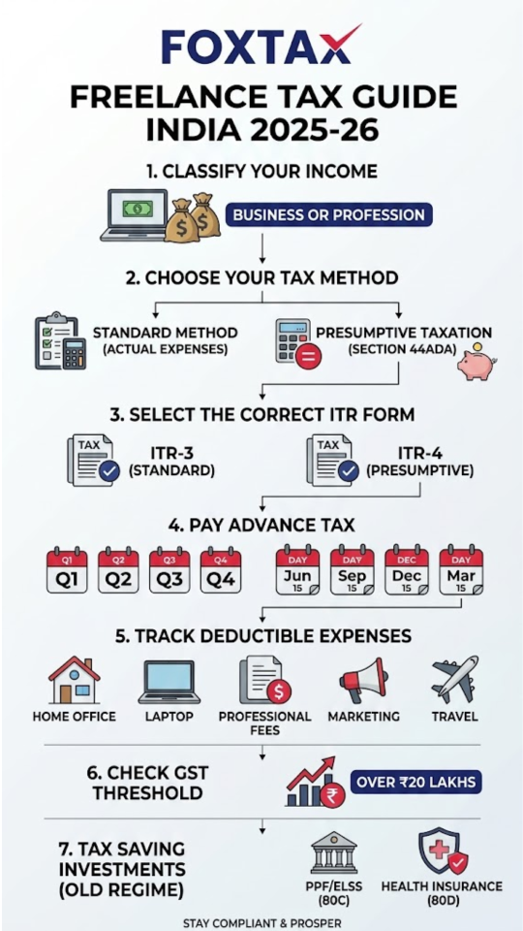
Here is a quick summary checklist for managing your tax on freelancing to make sure you don’t forget any important step:
- Classify Your Income: Always report it under “Profits and Gains of Business or Profession.”
- Choose Your Method: Decide between the Standard Method (actual expenses) or the Presumptive Scheme (Section 44ADA).
- Select the Right ITR Form: Use ITR-4 for the presumptive scheme and ITR-3 for the standard method.
- Pay Advance Tax: Make sure to note the four due dates in your calendar to avoid penalties for non-payment of interest.
- Track All Expenses: Keep a detailed record of all business-related expenses to claim deductions.
- Check GST Threshold: If your turnover is more than ₹20 lakhs, you need to register for GST.
- Use a Tax Calculator: Compare the Old and New tax regimes by using a tax calculator for freelancers in India.
Conclusion
Knowing how to manage tax on freelancing in India is a skill that no self-employed professional should be without. Although it involves more work than a salaried job, it also opens up a lot of avenues for tax saving through deductions and the presumptive taxation scheme.
When you have complete knowledge of paying advance tax and filing correct ITR, you can easily stay away from penalties and keep more of your money with yourself. Compliance is more than just legality, it is the way to build your financial credibility for future loans and visas. When you want personal assistance, think of a service like Foxtax that specializes in simplifying freelancers’ tax compliance and makes it easy for you to trust the process thoroughly.
Frequently Asked Questions (FAQs)
Do I need to pay tax if I am a freelancer?
Yes, if your total income from freelancing and other sources exceeds the basic exemption limit under the new or old regime (whichever you choose), then you are legally required to pay income tax. There is no special exemption for freelancers.
How do I deduct 50% of self-employment tax?
You don’t actually “deduct” 50%. Through the Presumptive Taxation Scheme (Section 44ADA), you are required to declare 50% of your gross receipts as your net profit. The other 50% is deemed as your business expenses, so no further deductions for actual expenses are allowed.
What is the tax slab for freelancers in India 2026?
There is no separate tax slab for freelancers. They are taxed on their profit (after deducting their business expenses from the total revenue) at the individual income tax slabs applicable under either the Old or New Tax Regime for a given Financial Year. Using an online calculator is the easiest way to determine your exact tax liability.
How is tax on freelance income from another country handled?
Income received from a foreign client is subject to tax in India. Even so, you can avail the benefits of a Double Taxation Avoidance Agreement (DTAA) if you have already paid tax to the source country. And, you will need to follow the rules of the Foreign Exchange Management Act (FEMA) for foreign remittances.
What happens if I don’t pay advance tax?
When your tax liability exceeds ₹10,000 and you fail to pay advance tax regularly, the Income Tax Department may initiate charging of interest under Section 234B for default in payment and Section 234C for deferment of installments.
How to save tax as a freelancer in India?
You can save tax by:
- Claiming all legitimate business expenses like internet, rent, software etc.
- Opting for the Presumptive Taxation Scheme under Section 44ADA.
- Making tax-saving investments under Sections 80C and 80D.
- Choosing the right tax regime (Old vs. New) that best suits your situation.