

Bookkeeping vs. Accounting: Understanding the Key Differences
Most companies need clear money records just to keep running. Yet plenty mix up bookkeeping and accounting, treating them like the same thing. As Intuit explained in its 2025 handbook, one handles day-to-day entries, while the other uses those numbers to uncover bigger patterns. Spotting this gap isn’t about theory—it shapes budget choices, tax steps, and what comes next.
What Is the Difference Between Bookkeeping and Accounting?
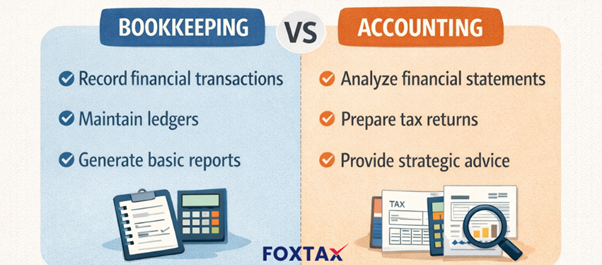
Most people mix them up, but one moves while the other thinks. Recording money events – sales, buys, cash in, cash out – is what bookkeeping does, step by step. From that data, accounting builds summaries, insights, and even guidance over time. Accurate logs come first because shaky entries mean flawed outcomes later.
Bookkeeping: The Recording Function
Most days, bookkeeping means logging numbers right after they happen. One job? Putting down money that comes in or goes out. Ledgers stay updated because entries flow there regularly. Bank reports get checked against records now and then. Bills to pay or collect show up in separate lists. Getting it exactly matters more than speed.
Software such as QuickBooks helps track each move. Journals catch everything first before anything else unfolds.
Accounting: The Analytical Function
From here, numbers start telling stories after bookkeeping finishes its work. Financial reports like income summaries, snapshots of assets versus debts, plus movement of money come together through accountants’ hands.
Instead of just listing figures, they dig into patterns—judging health by profit margins, debt loads, what taxes are due, and even how next year might shape up. According to the University of Cincinnati Online, this process means making sense of records, shaping them into clear updates, then suggesting paths forward.
Is Bookkeeping Part of Accounting?
True, keeping track of financial records sits right at the start of accounting work. This step gathers all basic figures accountants later use. If numbers are off here, everything built after will wobble – like building on cracked stone. Missing details early spoil every result that follows.
The Sequential Relationship
It moves step by step – starting with source papers like bills and slips, then into logs, followed by record books, leading to a check total, shifting into reports on money matters, and ending in review.
From raw entries comes the checkpoint list – this belongs to bookkeeping. After that, accounting steps in, building full summaries and making sense of numbers. Narrow work for one, wider duties for the other – just capturing facts falls under bookkeeping, while handling sorting, wrapping up, studying, and explaining belongs to accounting.
Why Both Are Essential for Business Health
When duties pair well, money matters stay clear. Records get kept neat by one person who follows rules closely. From there, another takes that work—shaping it into plans for expansion, smarter taxes, and fitting loan needs.
Some smaller operations handle both tasks internally at first. Growth changes things; eventually, splitting these jobs makes more sense.
What Are the Outputs of Bookkeeping and Accounting?
What one role produces can be nothing like another’s result. Seeing clearly what comes out lets company leaders grasp what finance staff actually do.
Bookkeeping Outputs: Journals, Ledgers, Trial Balance
Tracking every dollar, bookkeepers build clear records of each purchase and payment. Moving beyond totals, they organize full summaries in ledgers that show how money flows through a business.
Often matching numbers against bank data, they draft reconciliations to catch mismatches early. Instead of guessing, they sort debts by time, showing who owes what and when it’s due. Built for clarity, these files help confirm everything adds up before further review.
Accounting Outputs: Financial Statements and Strategic Reports
Out of all roles, accountants handle the main trio of financial records – that includes how much money comes in and goes out, what a company owns versus owes, along with where cash moves during a period.
Not just those, they also pull together internal summaries for leaders, spending plans, future estimates, plus paperwork needed by tax authorities. When it comes to choices on setting prices, watching expenses, or growing operations, these documents become key tools.
10 Key Differences Between Bookkeeping and Accounting
| Aspect | Bookkeeping | Accounting |
| Definition | Systematic recording of financial transactions | Summarizing, interpreting, and communicating financial data |
| Objective | Create a complete and accurate record | Ascertain profit/loss, financial position, and support decisions |
| Scope | Narrow – only recording and classifying | Wide – recording, classifying, summarizing, analyzing, interpreting |
| Decision support | Does not directly aid strategic decisions | Directly helps management with investment, budgeting, and pricing |
| Primary outputs | Journals, ledgers, trial balance, bank reconciliations | Income statement, balance sheet, cash flow statement, forecasts |
| Required skills | Attention to detail, data entry, basic accounting knowledge | Analytical thinking, financial strategy, tax law, ratio analysis |
| Typical education | High school diploma, associate degree, or certificate | Bachelor’s degree in accounting; often CPA, CMA, or ACCA |
| Who performs | Bookkeeper, accounting clerk | Staff accountant, controller, CFO |
| Focus | Operational, day‑to‑day recording | Strategic, long‑term planning and compliance |
| Nature of work | Administrative and transactional | Analytical and interpretive |
Why Foxtax Excels in Bookkeeping and Accounting Services
Juggling bookkeeping and accounting alone often stretches small and midsize companies too thin. Instead of handling everything internally, some rely on Foxtax to manage their full financial workflow – from tracking everyday entries right through to generating income reports, net worth summaries, and required tax documents.
Experts on the team keep records organized and inspection-ready, all while uncovering ways to strengthen money movement and earnings. Depending on needs, whether it is consistent record keeping help or expert guidance for predicting future finances, support adjusts to fit company scale and field.
Choosing to work with Foxtax removes uncertainty, replacing clutter with transparency around how money truly flows.
Quick Glance: Bookkeeping vs. Accounting Checklist
- Transactions get recorded through bookkeeping; interpretation happens within accounting.
- Out of bookkeeping come ledgers plus trial balances—financial statement and forecasts emerge from accounting.
- Running the numbers keeps things moving, and planning where they go shapes the future.
- Recording transactions requires accuracy, and interpreting numbers requires analytical expertise and credentials.
- Bookkeeping lays down raw details; accounting turns them into meaning.
Conclusion
Figuring out the difference between bookkeeping and accounting matters when handling money choices. It is not just about tracking everyday transactions, but shaping them into plans that guide expansion.
If records stay messy, solid reports like a profit and loss statement or smart tax moves will not happen. At Foxtax, both roles blend smoothly—precise logging followed by deeper number insights.
Startups find it useful, and so do established firms—turning raw data into clear actions while staying compliant and building long-term success.
FAQ Section
Q1: Is it better to be an accountant or a bookkeeper?
Some people lean toward bookkeeping when they like ticking through tasks methodically. Others drift into accounting after spending extra years in classes, drawn by bigger paychecks and room to shift directions later.
One path leans on precision day after day, while the other opens doors to advisory roles or number detective work. Enjoying patterns in data might pull you one way. A taste for digging into financial stories could tip the scales another.
Rewards show up either way – just look closely at what kind of daily rhythm feels right.
Q2: Can a bookkeeper become an accountant?
True, plenty of accountants begin their path doing bookkeeping work. Recording daily transactions builds strong basics.
A college degree in accounting usually opens the door. Credentials such as CPA or CMA often come into play later. Learning while working helps fill missing pieces, and extra classes support that shift over time.
Q3: Can you give an example of the difference between bookkeeping and accounting?
Here’s how it works. When a thousand-dollar sale happens, cash goes up, and that entry gets logged right away. Revenue appears on the opposite side, locked into place.
From there, someone with deeper training steps in, usually the accountant. That data becomes part of a bigger picture, shaping measures like gross profit. Numbers get stacked against others in the field, showing position clearly.
Insight emerges. Maybe pricing needs adjusting, or production costs should shrink. One role tracks movement, while the other finds direction inside the numbers.