

Payroll Management System: A Complete Guide to New Labour Code Compliance for 2026
When it comes to Indian businesses, the payroll management system has been made far more complicated since the 21st November 2025, following the introduction of four new labour codes.
These newer laws brought together 29 previous central labour regulations and have drastically changed the landscape of salary structure, exit management and working hours in india records for your business.
For a contemporary payroll management system, it is an absolute necessity to stay compliant with statutory norms, and to not incur penalties in this realm.
Here’s everything you need to know about the 2026 compliance requirements.
What is a Payroll Management System Under the New Labour Codes?
The function of payroll management under the new labour codes has shifted from salary processing to additional compulsions required under the new Labour Codes, such as 50% basic pay rule, or the full and final completion rule to be completed within 2 days, etc. For Indian HR and finance departments, it brings a one place solution for CTC restructuring, salary slip generation and compliance between various statutory portals (PF, ESI).
The main objective of this system in 2026, is probably to ensure compliance by design.
The Four New Labour Codes Every Employer Must Know
The Indian government has consolidated its 29 old regulations into just four new simplified codes. These are crucial to know for payroll compliance.
1. Code on Wages, 2019
This code sets a national floor for minimum wages and bonus payments to workmen and removes the old state-specific variations. It introduces the important “50% rule” that basic plus dearness allowance should be equal to or more than 50% of the gross CTC. This will have significant implications for how you monitor salaries in your payroll system.
2. Industrial Relations Code, 2020
This code regulates the employer workforce relationship but contains provisions about trade unions, standing orders and rescinding grievances. It makes employment and dismissal easier but makes management more stringent about keeping electronically stored worker agreements.
3. Social Security Code, 2020
This groundbreaking legislation codifies social security laws, which previously First and foremost existed for provident fund, insurance, and maternity benefits. For the first time, social security benefits apply to gig and platform workers and businesses will be required to deduct from wages for a new category of “unorganised workers”. Your payroll system must be equipped to account for these deduction categories as well.
4. Occupational Safety, Health & Working Conditions Code, 2020
This prescribes the national norms for work safety, work hours and health. It has specified the maximum working hours in India, weekly off days and additional wages for overtime work.
The payroll system has to be designed such that it communicates with the attendance system and can capture overtime calculation automatically as these norms.
What are the New Labour Rules for 2026 Salary? (The 50% Rule)
The largest overhaul in 2026 to the payroll structure is the restructuring of the CTC. Under the new Code on Wages, the Basic plus DA is required to constitute at least 50% of the CTC. All other allowances (HRA, special allowance, conveyance etc.) will together fall short by the remaining 50%.
This regulation seems to put an end to the precedent of the compensation strategy of holding basic salary at a bare minimum and keeping allowances at a very high level to attract low PF deductions. What this means for the employee is that the higher the basic, the higher the PF deduction and the consequent tax burden.
For the employer, it will require a payroll management system that automatically re-calculates the current salary structure and ensures that each new offer letter aligns with the mandated CTC restructuring.
How the New Labour Code Impacts Working Hours in India
The Occupational Safety, Health & Working Conditions Code 2020 has simplified working hours in India for most Indian states.
Working hours for the week have been capped at 48 hours maximum but the new rules remove ambiguity by specifying limits for daily working hours, breaks, and overtime, etc.
Standard Working Hours and Overtime
The new code states the working hours should not exceed 9 hours in a day and 48 hours in a week. Anything over 8 hours in a day or 48 hours in a week have to be overtime and paid for at double time the usual wage rate. Your payroll system should calculate quickly the overtime hours with attendance stamps in a day.
Weekly Off and Rest Periods
The law calls for that each employee shall receive a weekly holiday but usually, the daily rest period should follow after a maximum of six days of working. Employers shall keep a record of such weekly off through electronic means.
If not given the prescribed period of rest, it can be challenged under the new law of labour dispute.
Minimum Salary in India as Per Labour Law 2026
The new Wages Code doesn’t set a uniform, national minimum wage. Instead, it establishes a “universal floor wage” that all states are required to incorporate and adjust per the location (state or region) and experience/skill level (unskilled, semi-skilled, skilled).
The floor wage is set by the central government periodically and is readjusted from time to time, and is currently around Rs. 375/day in 2026. However, minimum wages set by states are usually higher.
Minimum salary in India as per labour law norms, which vary from state to state, should be accounted for in payroll management system.
Paying employees below the minimum wages in that state is illegal and each employee should have his basic costs automatically compared to local minimum wages.
Quick Checklist for Payroll Compliance in 2026
Here is a glance at the must-do actions for your payroll system this year:
- Rearrange Salary heads: Basic Pay + DA to make it not less than 50% of CTC and all Allowances should be restricted to the maximum of 50%.
- Reduce F&F Settlement Time: Digitalise exit process for clearing all privileges (salary bonus PF) in 2 days (48 hours) from date of last working day.
- Set Up Overtime Rules: Have the system automatically apply a doubling rate to any working hour exceeding 8 hours per day or 48 hours per week.
- Update Minimum Wages by State: Ensure that your payroll records reflect current minimum wages for each location where you have employees.
- Add Gig Workers: If you have platform workers or gig workers that you are using, make sure the system is set up for deductions on their behalf!
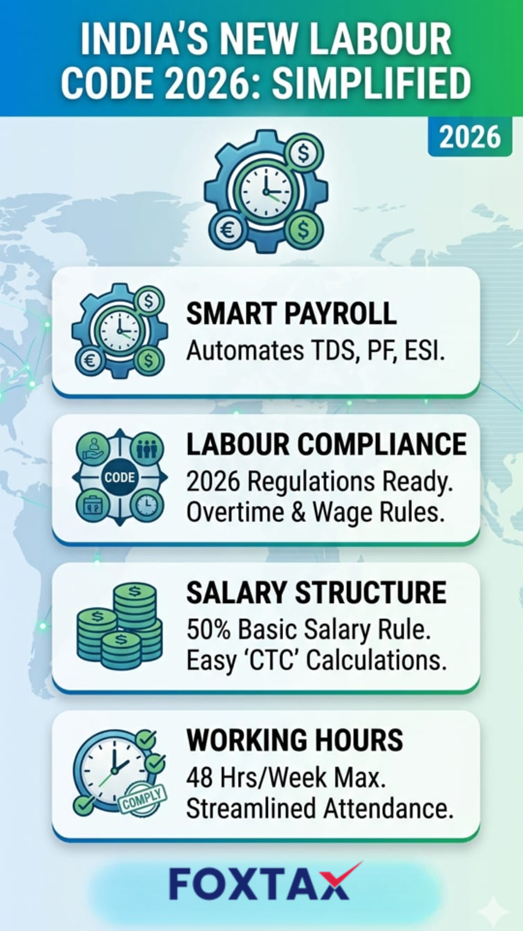
Infographic explaining payroll management system, new labour code 2026, salary structure rules, overtime laws, and minimum wage compliance in India
Conclusion
The new Labour Codes (since November 2025) have changed the payroll scenario in India. Now rather than paying just the salary, the emphasis is on ensuring statutory compliance.
Not complying with the new norms for working hours in India or the minimum salary in India as per labour law can prove to be a serious risk for any Indian firm financially and legally. This can be the most significant change in the way your business operates.
The best possible way to overcome this transition is by leveraging a payroll management system by a specialist like Foxtax. Why worry, when the business specialists of Foxtax can make your business perfectly compliant with the new labour code.
Frequently Asked Questions (FAQ)
What is the full and final settlement law in India 2026?
The recently passed Social Security Code calls for the full and final settlement (F&F) of an employee’s dues to be completed within 2 days (48 hours) following the employee’s last working day. It covers salary bonus travel expenses, and any other outstanding payments.
What is the new HR policy in 2026 regarding allowances?
Per the recently introduced rules, HR policies need to be altered in such a way that total allowances (HRA conveyance special allowance, etc.) should not exceed 50% of an employee’s CTC. Basic Pay and Dearness Allowance must form the other 50%.
Where can I download the new Labour Code 2026 PDF?
Official PDF files for each of the four new labour codes (Code on Wages, Industrial Relations Code, Social Security Code, and OSH Code) can be downloaded free of cost from the official website of the Ministry of Labour & Employment, Government of India (labour.gov.in).