

Your Complete Guide to Payroll Services in India: What, Why, and How
Handling employees’ pay, tax remittances, and compliance can be a real pain for any business owner. As your workforce grows, the challenge of accurately managing payroll increases alongside it. This post will guide you through the essentials of payroll services in India and how you can pick the right one for your enterprise.
What Are Payroll Services? A Simple Explanation
For any entrepreneur, the fundamental question is – what does a payroll service really do? In short, a payroll service provider is a firm that takes over all or some of the payroll-related tasks of your company, acting on your behalf.
This form of payroll outsourcing services covers much more than mere salary calculations. According to industry standards, a full-service payroll provider will oversee the entire lifecycle of employee compensation, tax compliance, and regulatory conformity. It is based on the calculation of wages, deduction of taxes (like TDS), administration of statutory compliances (PF, ESI), and ensuring timely and accurate payment of employees. This relieves a company of the complex computations and keeping abreast with legal changes.
In India, where laws keep changing, it is practically impossible for a business to operate without professional payroll services.
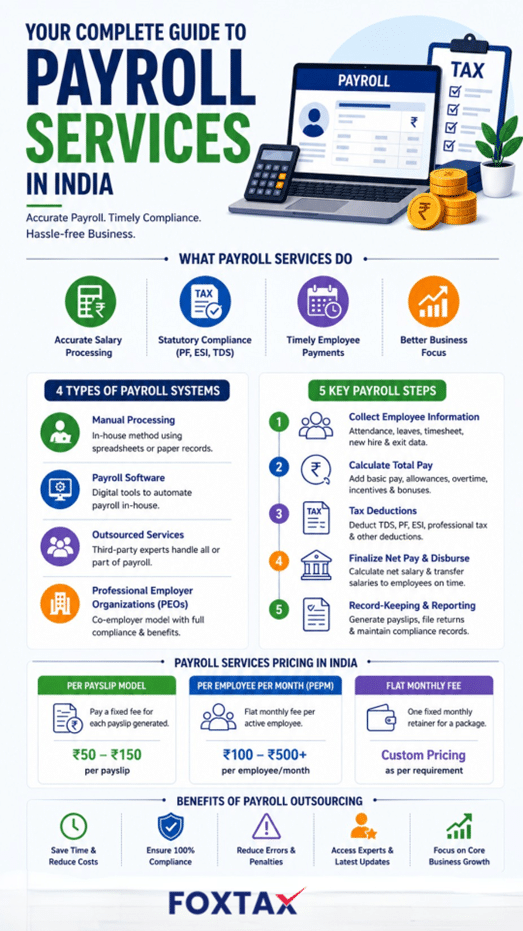
What Are the 4 Types of Payroll Systems Available?
It is basically selecting a payroll system that meets your business needs in terms of size, budget, and desire for authority. Below are the four principal models – they could be hands-on or fully managed.
| System Type | Description | Best For |
| Manual Processing | In-house management using spreadsheets or paper records. High risk of human error and time-consuming. | Very small businesses with <5 employees. |
| Payroll Software | Digital tools purchased for in-house use. Automates calculations but requires internal staff to run and update. | Growing businesses with an HR team. |
| Outsourced Services | A third-party company handles partial or full payroll processes, from calculation to filing. | SMEs looking to save time and reduce errors. |
| Professional Employer Organizations (PEOs) | The PEO becomes a co-employer, handling payroll, benefits, and full compliance under their legal umbrella. | Companies wanting to offload all employer liability. |
Which Payroll System Is Right for Your Business Size?
Usually, outsourced payroll services are the most viable option cost-wise and efficiency for SMEs in India. A company like Foxtax aligns with this concept by offering top-notch expert assistance without the burden of a full-fledged department. One can only automate things by software whereas a service provider is able to go beyond the point, including making exceptions, filing returns, and responding to staff inquiries.
The 5 Key Payroll Steps Every Business Should Know
When you learned about payroll steps, you discovered what a service provider does behind the scenes. Payroll is a methodical and iterative process:
Collecting Employee Information: The initial phase – Here attendance, leaves, timesheet, new employee, and exit data are gathered. The more precise the data, the more accurate the payout.
Summing up Total Pay: At this level, the system totals up basic pay, over time incentive commissions, and any other payments that relate to the pay period.
Tax Deductions: This step is marked by the subtraction of statutory deductions such as Income Tax (TDS), Employee Provident Fund (EPF), and Employee State Insurance (ESI), as well as any loan or professional tax deductions.
Finalizing Net Pay and Salary Distribution: The net amount that needs to be paid is calculated after deductions. Then the bank transfers or checks are processed so employees get their wages on the specified date.
Record-Keeping and Reporting: The last stage is to issue payslips, file monthly/quarterly tax returns like TDS returns and keep payroll records which may be audited in the future. A good service provider will automate the entire filing process.
Having a knowledge of these changes, one can appreciate payroll management services like Foxtax that integrate the entire payroll cycle and keep track of accuracy at every point of time.
A Quick Glance at Payroll Services Pricing in India
The major deciding factor for any business person is the price. Generally speaking, worldwide pricing models remain the same, but the actual figures in Indian Rupees fluctuate. Usually, providers pick one of the following three models:
Per Payslip Model: You are charged a set fee for each payslip that is generated (e.g. ₹50 to ₹150 per payslip).
Per Employee Per Month (PEPM): The flat monthly fee for an active employee usually falls in the range of ₹100 to ₹500+ based on features.
Flat Monthly Fee: One fixed monthly retainer for a fixed service package, usually with setup charges extra.
Key Insight: The per-employee model looks easy, but you must check if year-end filings, physical payslips, or additional reports are subject to hidden charges. It is always better to be a transparent supplier than a cheap one with surprise add-ons.
Why Foxtax is Your Trusted Payroll Partner in India
Before partnering with anyone for the payroll function, one should evaluate their expertise and trustworthiness. This is precisely where Foxtax gets your point as a trustworthy support for Indian enterprises. Unlike regular applications, Foxtax delivers payroll consultancy services as well as online payroll services.
Foxtax comprehends all the intricacies of Indian business from taxation to state-wise laws. Irrespective of whether a company is a start up intending to outsource payroll services or a big company searching for payroll outsourcing services, Foxtax issues solutions that are not only accurate but also timely and compliant. Their skill directed method will make sure that your payroll is processed as well as mutually benefiting tax-wise and compliant with laws. This enables you to devote your time only to the expansion of your core business.
Final Checklist for Choosing the Right Payroll Service
Make sure before committing to a service, that you have ticked all your boxes with this concise checklist.
Statutory Compliance: Is the provider automatically handling PF ESI TDS, and Prof. Tax submissions?
Data Security: Is your sensitive employee data encrypted and stored following Indian IT laws?
Scalability: Can the service handle the growth from 10 to 100 employees without platform change?
Support Access: Is there a real expert available during Indian business hours (not just a chatbot)?
Integration: Can the service be integrated with attendance or HR software you are already using?
Your Complete Guide to Payroll Services in India
Conclusion
It can suck the energy and focus of your business if you run after the complexities of payroll from calculating TDS to filing timely returns. By using professional payroll services, you turn what might have been a risk into a well-organized, error-free process. Whether you are examining the four types of systems or outlining the five payroll steps, the mission is to identify a solution that guarantees accuracy, compliance, and peace of mind.
For Indian companies looking for a dependable advantage, Foxtax combines technology and human skills perfectly, making sure your employees get paid correctly while you concentrate on building your business.
Frequently Asked Questions (FAQs) About Payroll Services
Q1: How do I find the best “Payroll services near me” or “Payroll company in Bangalore”?
You may start with an online search of those local providers with excellent ratings. But, it is more important for payroll to get a service provider with compliance expertise rather than physical proximity. A company like Foxtax, which has a proven record of following Indian labor laws, will be your best choice even if it works online only.
Q2: Are online payroll services safe compared to traditional software?
In fact, trusted online payroll services are secured using encryption methods that banks use and two-factor authentication, which makes them even safer than a computer that is not protected and running offline software. Besides, they also give you automatic software updates, so you are always using the latest compliance version.
Q3: Can a payroll service handle both salary and contractor payments?
Certainly. Those days are long gone when payroll outsourcing services means only employee payroll. The TDS deductions of contractors (Section 194C or 194J), just like employee TDS, are handled by the service. In fact, this is done based on invoice administration.
Q4: What is included in “payroll consultancy services”?
This type of service will allow you to conduct all the payroll activities and more such as how to set up your salary structure in a tax-efficient way, how to advise on the risk of non-compliance, how to manage HR audits and payroll policy implementation. Basically, it is the strategic advisory aspect of payroll management.